
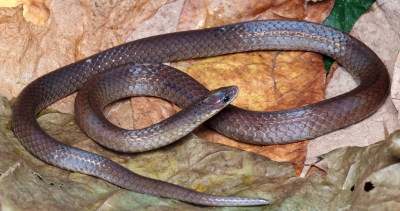
A team of scientists from Mizoram University and Germany’s Max Planck Institute for Biology recently discovered a new species of burrowing snake named Trachischium lalremsangai near the India–Myanmar border. The discovery, detailed in the international taxonomic journal Herpetozoa, relied on specimens collected from Murlen National Park in Mizoram alongside historical museum records from California. The species belongs to the genus Trachischium, a group commonly called slender snakes or worm-eating snakes due to their underground habits and dietary choices. This finding adds vital data to the documented reptile diversity of the Indo-Burma biodiversity hotspot.
Taxonomy and Physical Morphology
The new snake species has distinct physical traits that separate it from other members of its genus.
Scale Pattern and Colors
- Dorsal Scaling: The snake possesses exactly 13 rows of smooth, highly iridescent dorsal scales tracking down its entire body.
- Ventral Coloration: The upper quarter of its belly features a creamish-white color. The remaining three-quarters display a brown shade broken by sparse white speckles. This distinguishes it from related species which typically have dark brown or solid black bellies.
- Head Anatomy: The ocular arrangement features a unique pair of postocular scales situated directly behind the eyes. Its temporal scales follow a strict 1+2 formula layout, consisting of one anterior scale and two posterior scales.
Size and General Behavior
- Body Length: It is categorized as a large-sized member of its genus, with a Snout-to-Vent Length (SVL) measuring between 351 mm and 432 mm.
- Fossorial Habits: The snake is fossorial, meaning it spends its life cycle living underground in loose topsoil or under leaf litter.
- Dietary Traits: It is entirely harmless to humans and feeds primarily on earthworms.
Geographical Distribution and Research History
The confirmation of Trachischium lalremsangai as a new species required a cross-continental academic effort linking field collections with museum archives.
Primary Habitats
The live holotype specimen was captured inside Murlen National Park, located within the Champhai district of Mizoram, at an elevation exceeding 1,500 meters above sea level. This park lies in the Mizo Hills segment of the broader Patkai mountain range. The surrounding ecosystem experiences a subtropical climate dominated by heavy monsoon downpours.
The California Museum Specimen
During the genetic validation phase, researchers located a matching paratype specimen preserved inside the California Academy of Sciences in San Francisco. This archival specimen had been collected originally in 2007 from Haka Township within the Chin State of Myanmar, roughly 90 kilometers away from the Mizoram discovery site. It had remained misidentified as Trachischium reticulata for nearly two decades until DNA sequencing proved its genetic divergence.
Comparative Matrix of Northeast Indian Slender Snakes
The discovery raises the total number of slender snake species found across Northeast India and the Himalayan belt to eleven.
| Species Name | Regional Distribution | Key Diagnostic Feature | Primary Microhabitat |
| Trachischium lalremsangai | Mizoram (India), Chin State (Myanmar) | 13 dorsal scale rows, creamish-white and speckled brown belly | Subtropical mountain forests (>1,500m) |
| Trachischium reticulatum | Northeast India, Myanmar | Reticulated dorsal patterns, uniform dark underbelly | Lowland forest floor litter |
| Trachischium tenuiceps | Eastern Himalayas | Orange or yellowish belly, different head scale fusion | Temperate alpine foothills |
| Trachischium monticola | Assam, Meghalaya hills | Smaller average body length, distinct dark lateral stripes | Sub-montane agricultural soils |
IASPOINT Booster Facts for UPSC
- Etymology: The specific epithet lalremsangai honors Professor Hmar Tlawmte Lalremsanga, the Head of the Zoology Department at Mizoram University, for his lifelong contributions to herpetology and biodiversity documentation in Northeast India.
- Indo-Burma Biodiversity Hotspot: This hotspot spans 2.4 million square kilometers. It encompasses Northeast India south of the Brahmaputra River, Myanmar, Thailand, Laos, Cambodia, Vietnam, and parts of southern China.
- Murlen National Park Profile: Established in 1991, Murlen National Park is famous for dense vegetation often compared to the Amazonian canopy. It is home to rare fauna such as the endangered Hoolock Gibbon, Hume’s Pheasant (the state bird of Mizoram), Barking Deer, and the Serow.
- Fossorial Adaptation: Animal species categorized as fossorial possess specific evolutionary adaptations for digging, such as reduced eye structures, smooth non-abrasive scales, and hard, pointed skulls designed to withstand subterranean soil pressure.
- Natricinae Subfamily: The genus Trachischium belongs to the family Colubridae under the subfamily Natricinae. This group contains a vast array of semi-aquatic and secretive ground-dwelling snakes spread globally.