
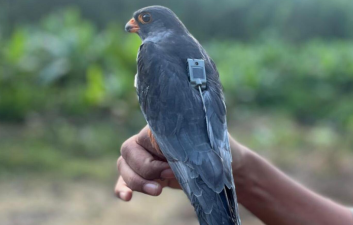
A satellite-tagged male Amur falcon named Apapang successfully completed a 4,700-kilometer non-stop flight from Somalia to central India in 95 hours on May 5, 2026. This journey involved crossing the Arabian Sea without any breaks during its return migration. The bird was tracked by scientists from the Wildlife Institute of India and officials from the Tamenglong forest division under Phase 2 of the Manipur Amur Falcon Tracking Project. This project tagged several birds in Manipur in November 2025 to study their migration patterns, assess ecological corridors, and strengthen conservation efforts for these raptors.
Scientific Profile of Amur Falcon
Taxonomy and Physical Traits
The Amur falcon (Falco amurensis) is a small raptor belonging to the falcon family. It weighs approximately 150 grams. Males have a characteristic dark grey plumage with brick-red thighs, while females display grey upperparts with dark streaks on their white underparts.
Diet and Behavior
These birds are insectivorous raptors. They feed primarily on termites, dragonflies, and other insects during their migration. Their arrival in Northeast India coincides with the emergence of termites, providing them with essential fat reserves for their long overwater flight.
Migration Route and Tracking Project
The Longest Overwater Raptor Migration
Amur falcons undertake one of the longest annual migrations among all birds of prey. They cover a round trip of up to 22,000 kilometers from their breeding grounds in East Asia to their wintering grounds in Southern Africa. The birds are capable of flying daily distances of up to 1,000 kilometers.
Record Flights of Apapang
The tracking data from the Manipur Amur Falcon Tracking Project highlights the extreme physical endurance of these raptors.
- 2025 Journey: The falcon Apapang completed a 6,100-kilometer non-stop flight from India to Kenya.
- 2026 Return Journey: Apapang flew 4,700 kilometers non-stop from Somalia to central India over a duration of 95 hours.
Key Migratory Milestones
| Stage of Migration | Geographical Region Covered | Ecological Purpose |
| Breeding Season | Southeastern Siberia, Northern China, and Mongolia | Reproduction and nesting during summer |
| Autumn Stopover | Northeast India (Manipur, Nagaland, Assam) | Roosting and heavy feeding to build fat reserves |
| Arabian Sea Crossing | Non-stop flight from Western India to East Africa | Direct overwater transit using monsoon winds |
| Wintering Season | Southern Africa (South Africa, Malawi, Zimbabwe) | Foraging during the Southern Hemisphere summer |
Conservation Status and Threats
Global Protection Status
The Amur falcon is protected under multiple international and national frameworks due to its transboundary migration patterns.
- IUCN Red List: Least Concern
- CITES: Appendix II
- Convention on Migratory Species (CMS): Listed under Appendix II and included in the Raptors MOU
- Wildlife Protection Act, 1972 (India): Schedule I (affording the highest level of legal protection)
Threat Mitigation in Northeast India
Historically, thousands of Amur falcons were hunted for meat during their stopover in Nagaland and Manipur, particularly around the Doyang Reservoir. Local community conservation programs, eco-clubs, and strict enforcement by forest departments have completely stopped hunting, turning the region into a safe haven for the species.
IASPOINT Booster Facts for UPSC
- Falcon Capital of the World: Nagaland is widely known as the “Falcon Capital of the World” due to the massive congregation of millions of Amur falcons at the Doyang Reservoir during October and November.
- Wildlife Institute of India (WII): An autonomous institution under the Ministry of Environment, Forest and Climate Change, established in 1982 and based in Dehradun, Uttarakhand.
- Satellite Telemetry: The technology uses solar-powered Platform Transmitter Terminals (PTTs) weighing under 5 grams attached to the back of the birds to track real-time location via the Argos satellite system.
- Pangti Village: A village in Wokha district, Nagaland, which became famous for transforming from a hunting hub into a pioneering community-led conservation site for Amur falcons.