
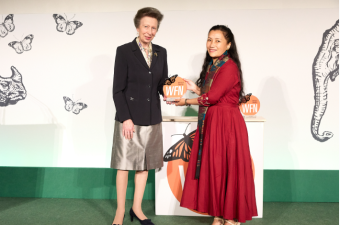
Two Indian women conservationists, Dr. Barkha Subba and Parveen Shaikh, were conferred with the prestigious 2026 Whitley Awards on 29 April 2026 at the Royal Geographical Society in London. Commonly known as the “Green Oscars,” these awards recognize exceptional grassroots environmental leaders across the Global South. Presented by the United Kingdom’s Princess Anne, a patron of the Whitley Fund for Nature, the award provides £50,000 in project funding to each winner. The 2026 cohort included six global winners alongside one Whitley Gold Award recipient, highlighting community-led models for species protection and habitat restoration.
Profile of the Indian Winners and Projects
The two Indian awardees were recognized for their long-term scientific interventions and community stewardship in highly specialized, threatened ecosystems.
Dr. Barkha Subba: Himalayan Salamander Conservation
Dr. Barkha Subba serves as a scientific adviser at the Federation of Societies for Environmental Protection based in Darjeeling, West Bengal. Her award supports the preservation of a rare amphibian lineage and its associated high-altitude aquatic ecosystems.
- Target Species: The Himalayan Salamander (Tylototriton verrucosus), an evolutionarily distinct amphibian capable of full limb regeneration. It is endemic to the wet forest fringes of India, Nepal, and Bhutan.
- Habitat Context: Cool, shaded high-altitude wetlands and lakes in the Darjeeling Himalaya. These areas are under extreme pressure from wetland drainage, unregulated tourism, and land diversification within tea gardens.
- Project Strategy: Out of approximately 30 surviving local breeding sites, the project targets seven critical zones. Key locations include Namthing Biodiversity Heritage Site (government land) along with Margaret’s Hope and Nakhapani (private tea estates).
- Key Interventions: Habitat restoration, removal of invasive plant species, local community awareness programs for eco-tourism, and systematic screening for Chytrid fungus—a deadly global pathogen causing widespread amphibian extinctions.
Parveen Shaikh: Indian Skimmer Recovery
Parveen Shaikh is a scientist associated with the Bombay Natural History Society. Her work centers on riverine bird protection through the recruitment of local community groups.
- Target Species: The Indian Skimmer (Rynchops albicollis), a specialized river bird recognized by its bright orange, scissor-like bill. The bird skims the water surface to catch fish and nests on seasonal sandbars.
- Conservation Status: The species has vanished from most of its historic Southeast Asian range. India currently supports more than 90% of the remaining global breeding population of roughly 3,000 individuals.
- Project Footprint: The “Guardians of the Skimmer” initiative operates within the National Chambal Sanctuary. The project succeeded in raising the local skimmer population from 400 individuals in 2017 to approximately 1,000 by 2025, while doubling nest survival rates from 14% to 27%.
- Future Scale-up: The award funding will expand this community-led monitoring model to key unprotected nesting sites around Prayagraj, Uttar Pradesh, where the Ganga and Yamuna rivers converge.
- Key Interventions: Training local nest guardians, deploying predator-proof fencing against free-ranging dogs and jackals, using GPS mapping for real-time monitoring, and experimenting with artificial floating nesting platforms to combat sudden water level fluctuations.
Institutional Structure of the Whitley Fund for Nature
The Whitley Fund for Nature is a UK-registered charity established in 1994 by Edward Whitley. The institution utilizes a specific direct-funding model to maximize conservation impact on the ground.
| Aspect | Institutional Policy and Mechanism |
| Target Demographics | Grassroots conservation leaders native to countries across the Global South. |
| Funding Core | Direct grants aimed at minimizing administrative intermediaries, sending funds straight to local non-governmental organizations. |
| The Funding Ladder | Initial Whitley Award (£50,000) → Continuation Funding (to scale up proven solutions) → Whitley Gold Award. |
| Strategic Support | Providing international visibility, professional training, and media support to elevate the global profile of local leaders. |
The 2026 Whitley Gold Award
The Whitley Gold Award is the highest honor bestowed by the charity, carrying a prize of £120,000. It is awarded to a past Whitley Award winner to support large-scale long-term conservation work. The 2026 Whitley Gold Award was conferred upon Farwiza Farhan of Indonesia for her work with the NGO HAkA in mobilizing community-led protection and climate resilience inside Sumatra’s Leuser Ecosystem.
Complete List of 2026 Whitley Award Winners
The 2026 awards recognized seven conservationists tackling distinct environmental crises across the globe:
- Farwiza Farhan (Indonesia): Winner of the Whitley Gold Award for empowering grassroots village governance and protecting the Leuser Ecosystem from mega-dams and illegal palm oil expansion.
- Dr. Barkha Subba (India): For community stewardship and wetland restoration to save the Himalayan Salamander in West Bengal.
- Parveen Shaikh (India): For community-led protection of riverine habitats and nest safeguarding for the Indian Skimmer.
- Dr. Marina Kameni (Cameroon): For reviving endemic amphibian populations, including the world’s largest frog, in the Mount Manengouba hotspot.
- Dr. Moreangels Mbizah (Zimbabwe): For developing human-wildlife coexistence models to protect lions and community livelihoods in the lower Zambezi Valley.
- Dr. Issah Seidu (Ghana): For mitigating overfishing and establishing Locally Managed Marine Areas to save critically endangered guitarfish.
- Dr. Paola Sangolquí (Ecuador): For protecting the nesting grounds of the critically endangered Galápagos Petrel from invasive predatory species.
IASPOINT Booster Facts for UPSC
- The Eradi Committee Analogy: While the Eradi Committee in Indian governance deals with corporate insolvency, ecological management often relies on specialist panels. High-altitude wetland policies are guided by the National Wetland Conservation Programme and the international Ramsar Convention framework.
- Philopatry in Amphibians: The Himalayan Salamander exhibits philopatry, meaning individuals instinctively return to their exact natal breeding pools to reproduce. This specialized behavioral trait makes them highly vulnerable to localized habitat loss and serves as an ideal bio-indicator for wetland degradation.
- Threats to Indian Skimmers: Major drivers of the Indian Skimmer’s decline along the Ganga Basin include unregulated sand mining, industrial pollution, heavy boat traffic, and sudden water releases from upstream hydroelectric dams that submerge seasonal nesting sandbars.
- Famous Indian Predecessors: Legendary Indian conservationists who previously won the Whitley Award include Dr. Ananda Kumar (2015, for elephant-human coexistence models in Valparai) and Purnima Devi Barman (2017, for her “Hargila Army” protecting the Greater Adjutant Stork in Assam).
- Sir David Attenborough’s Role: Legendary naturalist Sir David Attenborough serves as a long-standing trustee of the Whitley Fund for Nature, frequently endorsing its model of backing local leaders rather than sending Western experts abroad.