
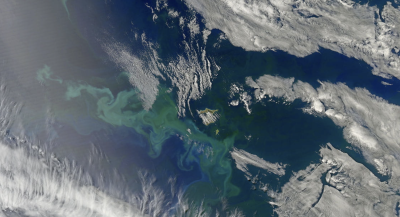
A bright green and blue phytoplankton bloom encircled New Zealand’s remote Chatham Islands in January 2026. The event was visible from space and brought into light the ecological importance of the Chatham Rise, an underwater plateau east of the South Island. Such blooms are common in this region because ocean currents, seafloor contours and seasonal sunlight create highly productive waters.
What Happened
The bloom was formed by phytoplankton, microscopic photosynthetic organisms that multiply rapidly when conditions are favourable. Surface currents and eddies gathered the organisms into swirling patterns around the islands. The display was captured by the VIIRS instrument on the NOAA-20 satellite on 10 January 2026.
Why the Region Supports Blooms
The Chatham Islands lie on the Chatham Rise, where shallow seabed features influence ocean circulation. Cold, nutrient-rich waters from the Antarctic meet warmer, nutrient-poor subtropical waters in the area. This mixing brings nutrients to the surface. Long daylight hours during the austral summer further support rapid phytoplankton growth.
Ecological and Economic Importance
Phytoplankton form the base of the marine food web. Their abundance supports productive fisheries around the islands. Important species include pāua, rock lobster and blue cod. The region also supports a wide range of marine mammals, including five seal species and 25 whale and dolphin species.
Conservation Relevance
Despite high marine productivity, the Chatham Islands are also known for frequent whale and dolphin strandings. Hundreds of animals can become beached in some incidents. This makes the region for marine ecology, fisheries management and conservation studies.
Last Modified: April 27, 2026