
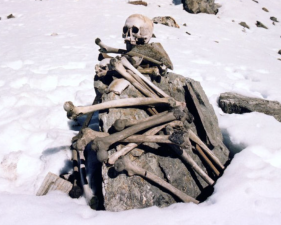
Roopkund Lake is a high-altitude glacial lake in Uttarakhand’s Chamoli district, famous for the human skeletons found around its icy shores. Situated at about 5,020 metres between Trishul Peak and Nanda Ghunti, the lake has long drawn trekkers, researchers and pilgrims. Its unusual remains, harsh climate and local legends have made it one of the most studied and mysterious sites in the Indian Himalayas.
Location and Physical Features
Roopkund is a small glacial lake, usually less than 40 metres across. It remains frozen for most of the year. When the snow melts for a short period in summer, bones and skulls become visible in and around the lake. The site lies in a remote Himalayan landscape of snowfields, alpine meadows and steep mountain trails.
Discovery of the Skeletons
The skeletons were first widely reported in 1942 during patrols in the Nanda Devi region. Early speculation linked them to wartime deaths, but this was later rejected. Over time, researchers also found wooden artefacts, leather slippers, iron spearheads and rings. The cold environment helped preserve some remains and made the site a major archaeological puzzle.
Scientific Findings and Theories
Modern studies have shown that the remains belong to more than 300 individuals and date to different periods. Radiocarbon dating and DNA analysis suggested at least two separate events. Findings identified:
- South Asian individuals linked to around 800 CE.
- A Southeast Asian individual from around 1800 CE.
- A group with ancestry linked to the Eastern Mediterranean.
Earlier studies also found severe head injuries, supporting the theory of death by hailstorm or falling round objects.
Religious Importance and Trekking Route
Roopkund lies near routes used for the Nanda Devi Raj Jat, a major pilgrimage held once every 12 years. The area is also known for the Bedni Bugyal meadow and a popular trekking route from Lohajung via Wan and Bedni Bugyal. The trek usually takes about five days and is best attempted between mid-September and October.
Last Modified: April 28, 2026