
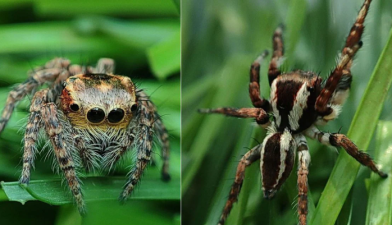
Two new species of jumping spiders have been identified from India’s drylands and urban green spaces, adding to the known biodiversity of semi-arid ecosystems. The discoveries were made during field surveys in western India and in an urban biodiversity park in Maharashtra. The spiders belong to the genus Mogrus, a group of medium-sized jumping spiders found mainly in arid regions of Africa, Europe and Asia.
Species Identified
- Mogrus shushka was found in the dryland regions of Rajasthan and Gujarat.
- Mogrus pune was recorded from the Alfa Laval Biodiversity Park in Maharashtra.
- The name shushka comes from a Sanskrit word meaning dry or arid.
- The name pune honours the city and the role of urban green spaces in conserving biodiversity.
How the Species Were Confirmed
Researchers captured the spiders and examined them under microscopes to compare their anatomy with known species. In jumping spiders, reproductive structures are among the most important features used to identify species. The male and female genital structures of both new species showed distinct differences from their closest relatives.
Key Scientific Findings
- Male Mogrus shushka differs from its nearest relative by a triangular bump on the mating appendage.
- Female Mogrus shushka has a deep semi-circular depression with short internal ducts.
- Male Mogrus pune has a heart-shaped bump and uniquely curved structures.
- Female Mogrus pune has a wide membranous central depression.
Broader Biodiversity Significance
- Researchers also recorded Mogrus larisae in India for the first time.
- The male of Mogrus rajasthanensis was described for the first time.
- The findings underline the rich but underexplored biodiversity of India’s semi-arid habitats.
- They also show that small urban parks can support rare and scientifically important species.