
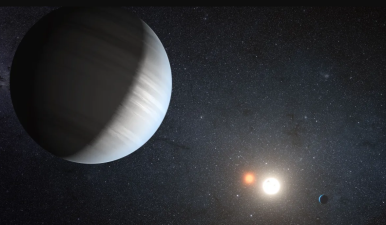
Astronomers from the University of New South Wales (UNSW) Sydney identified 27 potential circumbinary planets, expanding the known catalog of these rare worlds. Circumbinary planets are exoplanets that orbit a pair of gravitationally bound stars, rather than a single host star like the Sun. This breakthrough was achieved by applying a novel planet-hunting method to data gathered by NASA’s Transiting Exoplanet Survey Satellite (TESS). Prior to this discovery, only 18 circumbinary planets had been confirmed out of more than 6,000 cataloged exoplanets. The findings, published in the Monthly Notices of the Royal Astronomical Society, suggest that two-sun systems are more common than previously assumed and provide crucial data on non-coplanar planetary architectures.
Understanding Circumbinary Planets
A circumbinary planet follows a wide external orbit around two central stars that are orbiting each other. Due to the dual gravitational forces at the center, these systems feature complex dynamic environments compared to single-star planetary configurations.
Architectural Alignment
Traditional planet searches have mostly detected planets that share the exact same orbital plane as their host stars. This alignment is known as a coplanar architecture. However, planet formation models indicate that the gravitational turbulence from a binary stellar pair can force young planets into wider, heavily tilted, or non-coplanar paths.
Scale and Distribution of the Discovery
The newly identified candidates present a diverse range of physical and spatial characteristics:
- Host Systems: The 27 planet candidates were detected within a sample of 1,590 binary star systems.
- Mass Range: The candidates vary greatly in size, ranging from Neptune-sized objects (approximately 12 Earth masses) up to gas giants ten times the mass of Jupiter (about 3,200 Earth masses).
- Distance from Earth: These systems are located deep within the Milky Way galaxy, spanning distances from 650 to 18,000 light-years away from Earth.
The Shift in Exoplanet Detection Methods
Most discovered exoplanets have been found using the transit method, which relies on a planet passing directly between Earth and its host star. This transit creates a slight, observable dip in the star’s light. While effective, the transit method is limited because it requires the planet’s orbit to align perfectly with our line of sight from Earth.
The Apsidal Precession Technique
To overcome the limitations of the transit method, the UNSW research team utilized the apsidal precession method. This approach treats the planet as a gravitational perturber rather than looking for its shadow.
How Precession Tracks Hidden Worlds
- Monitoring Stellar Eclipses: The team focused on eclipsing binaries, which are pairs of stars that alternately block each other’s light from Earth’s perspective.
- Measuring Orbital Rotation: The gravitational pull of a third body, such as an orbiting planet, causes the elliptical orbit of the binary stars to gradually rotate over time. This rotation of the orbital path is called apsidal precession.
- Accounting for Other Factors: Astronomers calculate the exact timing of the stellar eclipses. They isolate and subtract the expected precession caused by general relativity, tidal forces, and stellar rotation.
- Identifying the Excess Signal: Any remaining shift in the eclipse schedule indicates the gravitational tug of an unseen third body, allowing astronomers to infer the existence, mass, and orbit of a potential circumbinary planet.
Future Implications for Exoplanetary Science
The application of precession-based hunting opens up a population of planets that traditional surveys could not detect. This advancement helps astronomers understand the true distribution and variety of planetary systems across the universe.
| Mission / Telescope | Primary Role in Circumbinary Research | Data Contribution |
| NASA TESS (Launched 2018) | Provided the foundational time-domain photometry data used to track long-term eclipse schedules. | High-precision light curves of 1,590 eclipsing binaries over multiple years. |
| Ground-Based Radial Velocity Telescopes | Required for follow-up observations to break mathematical degeneracies. | Measures precise stellar velocities to confirm planet masses and orbits. |
| Vera C. Rubin Observatory (LSST) | Anticipated to expand the census via its upcoming 10-year wide-sky survey. | Expected to discover thousands of new circumbinary candidates in deep space. |
IASPOINT Booster Facts for UPSC
- Tatooine Analogy: Circumbinary planets are often referred to as “Tatooine” worlds in popular culture, named after the fictional two-sun desert planet featured in the Star Wars franchise.
- Kepler-16b: Confirmed in 2011 via NASA’s Kepler Space Telescope, Kepler-16b was the first unambiguous, real-world circumbinary planet ever detected using the transit method.
- Apsidal Precession in the Solar System: The concept of apsidal precession is famously demonstrated within our own solar system by the perihelion precession of Mercury. The discrepancy in Mercury’s precession rate provided historical proof for Albert Einstein’s General Theory of Relativity.
- Gaia DR3 Catalog: The UNSW study selected its target stars from the Gaia Data Release 3 catalog, which is generated by the European Space Agency’s (ESA) space observatory mapping the multi-dimensional structure of the Milky Way.
- Legacy Survey of Space and Time (LSST): Located at the Vera C. Rubin Observatory in Chile, the LSST will utilize an 8.4-meter telescope and the world’s largest digital camera to photograph the entire available sky every few nights, drastically increasing data on transient and variable space objects.