
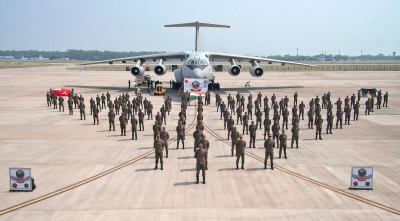
The second edition of the India-Cambodia Bilateral Military Exercise, CINBAX-II 2026, took place from May 4 to May 17, 2026, in Cambodia. Hosted at the Techo Sen Phnom Thom Mreas Provincial Royal Cambodian Air Force Training Centre (Camp Basil) in Kampong Speu Province, the 14-day engagement concluded with a joint validation drill. The exercise involved company-level training between the Indian Army and the Royal Cambodian Army. This bilateral framework deepens strategic cooperation between India and Cambodia, aligning with regional security initiatives involving member states of the Association of Southeast Asian Nations (ASEAN).
Key Structural Components of CINBAX-II
The bilateral military exercise brought together tactical units from both nations to participate in standardized operational drills.
Personnel Deployment and Composition
- Indian Contingent: Comprised 120 personnel drawn primarily from a battalion of the Maratha Light Infantry Regiment.
- Cambodian Contingent: Comprised 160 personnel representing the Royal Cambodian Army.
- Total Participation: A combined force of 280 military personnel executed the two-week joint curriculum.
Core Operational Focus
The training program targeted security operations in sub-conventional and semi-urban environments. The curriculum directly incorporated the tactical parameters of counter-terrorism operations found in modern conflict zones. The training followed the legal and tactical frameworks established under Chapter VII of the United Nations Mandate, which governs actions related to threats to peace, breaches of the peace, and acts of aggression.
Tactical Training and Technical Modules
The operational layout of CINBAX-II focused on bridging technical and procedural differences between the two armies. The instructional modules covered five primary fields:
Specialized Weapons Handling
Troops engaged in integrated mortar drills and advanced sniper tactics to refine precision fire capabilities in challenging environments.
Technological Integration
The exercise included dedicated training on tactical drone operations. This focused on using unmanned aerial vehicles (UAVs) for real-time reconnaissance, surveillance, and target acquisition during urban operations.
Field and Command Exercises
The curriculum included a Command Post Exercise alongside a Field Training Exercise. These simulations allowed officers from both sides to practice joint operational planning, intelligence sharing, and active unit deployment.
Multi-Domain and Emergency Response
Beyond direct combat training, personnel practiced specialized skill sets including combat first aid, multi-domain operations, and coordinated disaster relief procedures.
Validation Phase
The exercise concluded with a thorough validation phase. This field test evaluated the combined forces’ technical readiness, coordination speed, and shared tactical responses under simulated hostile conditions.
Geopolitical and Strategic Dimensions
Bilateral military drills serve as key instruments for foreign policy, security architecture, and regional balance.
India’s Act East Policy
Engaging with Cambodia through bilateral exercises supports India’s Act East Policy. This diplomatic and security framework seeks to expand economic and strategic ties with Southeast Asian nations to maintain a stable, rule-based Indo-Pacific region.
Capacity Building and Security Architecture
CINBAX-II allows India to act as a security partner for friendly nations in the Indo-Pacific. By sharing operational experiences and combat methodologies, India assists in enhancing the capabilities of the Royal Cambodian Armed Forces, which broadens Cambodia’s international defense partnerships.
Overview of India-Cambodia Defense Metrics
| Operational Metric | Exercise Detail (CINBAX-II) |
| Inaugural Edition | Conducted in Pune, India, in December 2024. |
| Host Country (2026) | Kingdom of Cambodia (Kampong Speu Province). |
| Legal Mandate | Chapter VII of the United Nations Charter. |
| Primary Infantry Unit (India) | Maratha Light Infantry Regiment. |
| Primary Focus Area | Counter-Terrorism and Semi-Urban Warfare. |
IASPOINT Booster Facts for UPSC
- Chapter VII of the UN Charter: This specific chapter allows the UN Security Council to determine the existence of threats to peace and authorize military or non-military actions to restore international security, serving as the basis for aggressive UN Peacekeeping operations.
- Maratha Light Infantry: Formed in 1768 as part of the Bombay Sepoys, it is one of the oldest and most decorated light infantry regiments of the Indian Army. The regiment’s battle cry is “Bol Shri Chhatrapati Shivaji Maharaj ki Jai”.
- Kampong Speu Province: Geographically located in southwestern Cambodia, this province holds strategic military importance and hosts multiple primary training facilities for the Royal Cambodian Armed Forces.
- Constitutional Basis for Foreign Exercises: The deployment of the Indian Army for international training exercises aligns with Article 51 of the Directive Principles of State Policy (DPSP) in the Constitution of India, which directs the State to promote international peace and security.
- Statutory Framework: International military operations and personnel management are regulated under the Army Act of 1950 and the Defence of India Act.