
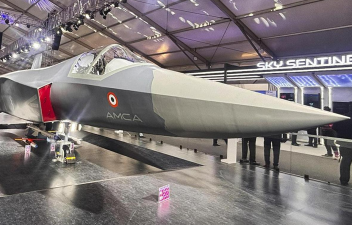
The Defence Research and Development Organisation (DRDO) and the Aeronautical Development Agency (ADA) established the foundation stone for a dedicated Aircraft Integration and Flight Testing Complex in Puttaparthi, Andhra Pradesh on May 15, 2026. Armed with in-principle approval from the Ministry of Defence, the high-tech complex is designed to house assembly, systems integration, ground checks, and full-scale flight trials for indigenous aircraft prototypes, including combat fleets and Unmanned Aerial Systems (UAS). Operating as a focal node for India’s flagship Advanced Medium Combat Aircraft (AMCA) programme, the complex forms part of a multi-phased aerospace and defence manufacturing corridor estimated to draw a cumulative investment of one lakh crore rupees over time.
Strategic Architecture and Infrastructure Blueprint
The setup of the Puttaparthi facility involves collaborative infrastructure sharing between the state government of Andhra Pradesh and central defence planning agencies.
Land Allocation and Zoning
The Andhra Pradesh government allocated land parcels in distinct phases to establish a comprehensive industrial and residential layout:
- Core Testing Complex: A plot of 150 acres directly adjoining the existing Puttaparthi airstrip runway is reserved for core flight testing, hangar construction, and systems integration work.
- Support Infrastructure: An additional 200 acres are designated to host satellite office complexes, research laboratories, and dedicated residential townships for scientists and engineering personnel.
Airfield Upgrades and Navigational Aids
To handle high-performance military fighter prototypes, the existing local aviation infrastructure will undergo structural modifications:
- Runway Extension: The project plan mandates extending the current runway length up to 10,000 feet, providing the necessary distance for safe takeoff and landing cycles of fully armed or heavy prototype aircraft.
- Control and Safety Systems: The state government is installing advanced Air Traffic Control (ATC) towers, specialized military-grade meteorological forecasting stations, and precise radio navigation systems.
Location Advantages
Puttaparthi provides specific advantages for testing secret and experimental military aircraft. The site features open geographical terrain combined with dedicated airspace that has minimal commercial flight traffic. This lack of civilian flight interference allows test pilots to execute complex maneuvers, sonic flights, and weapon-release validation trials without breaking civilian flight safety codes.
Role in the Advanced Medium Combat Aircraft Programme
The primary operational mandate of the new complex is to execute full-scale validation trials for the AMCA project, which is India’s indigenous fifth-generation stealth fighter initiative.
Prototype Development Framework
Following the Cabinet Committee on Security (CCS) clearing a budget of fifteen thousand crore rupees for Full-Scale Engineering Development (FSED), the programme has adopted a parallel validation roadmap involving five distinct prototypes.
Staggered Testing Timeline
| Milestone | Expected Target Schedule | Primary Test Function / Objective |
| First Prototype Rollout | Late 2026 to Early 2027 | Structural verification and basic taxi trials |
| First Flight Trial | 2028 | Initial aerodynamic evaluation and engine validation |
| Prototypes 1, 2, and 3 | Rollout every 8 to 9 months | Mid-air flight characteristics, stability, and core avionics testing |
| Prototypes 4 and 5 | Staggered up to 2031 | Weapons integration, internal bay deployment, and live-fire testing |
| Final Certification | 2032 | Complete airworthiness clearance and combat readyness sign-off |
| Induction and Production | 2034 to 2035 | Service entry for Indian Air Force operational squadrons |
Advanced Structural Features Tested
Engineers at the facility will validate key components that define fifth-generation combat platforms:
- Stealth Profiles: Verifying the radar-cross-section (RCS) suppression properties of the airframe, which uses internal weapon bays and specialized serpentine air intakes to hide the spinning engine blades from enemy radar systems.
- Supercruise Capability: Testing the aircraft’s capacity to maintain supersonic flight speeds exceeding Mach 1 without using fuel-heavy afterburners, increasing its combat operational range.
Broader Aerospace and Defence Ecosystem
The establishment of the testing facility serves as an anchor for a larger industrial manufacturing corridor, helping shift India from a weapons importer to a domestic manufacturer under the Aatmanirbhar Bharat framework.
Private-Public Development Model
The Ministry of Defence approved the “Advanced Medium Combat Aircraft Programme Execution Model,” allowing the ADA to issue Expressions of Interest (EoI) to form joint ventures, consortia, or direct private sector production partnerships. This method ensures that private manufacturing groups can establish production lines right next to the Puttaparthi flight testing hub.
Regional Industrial Clusters
The complex is expected to draw cluster investments across multiple auxiliary industries:
- Avionics and Sensors: Production of Active Electronically Scanned Array (AESA) radars, electronic warfare suites, and infrared search-and-track systems.
- Precision Engineering: Facilities for manufacturing high-stress airframe components and landing gear assemblies.
- Unmanned Systems: Developing, testing, and calibrating high-altitude long-endurance (HALE) and medium-altitude long-endurance (MALE) drones.
Link to the Southern Aerospace Corridor
Puttaparthi’s geographic location in the Sri Sathya Sai district places it close to Bengaluru’s established aerospace hub. This location allows for direct parts supply and engineering support from Hindustan Aeronautics Limited (HAL), major DRDO research laboratories, and private component suppliers located near Kempegowda International Airport.
IASPOINT Booster Facts for UPSC
- Aeronautical Development Agency (ADA): An autonomous society registered under the Ministry of Defence in 1984, headquartered in Bengaluru, specifically created to oversee the development of the Light Combat Aircraft (LCA) programme.
- Fifth-Generation Fleet Examples: Operational aircraft worldwide in this class include the F-22 Raptor and F-35 Lightning II (USA), the Sukhoi Su-57 (Russia), and the Chengdu J-20 (China).
- Engine Multi-Variant Plan: The AMCA Mk1 will use imported General Electric F414 engines generating 98 kN of thrust, while the future AMCA Mk2 variant plans to integrate a co-developed 120 kN class indigenous engine.
- Autonomy in Unmanned Systems: The facility will also test autonomous flight algorithms and artificial intelligence interfaces that enable manned-unmanned teaming (MUM-T), where a human pilot commands a swarm of loyal wingman drones.
- Andhra Pradesh Aerospace Policy: The project matches the structural goals of Andhra Pradesh’s Aerospace & Defence Policy, which offers targeted capital subsidies, power concessions, and fast-track land allotments to defence manufacturing companies.