
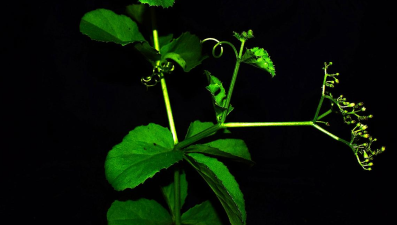
Researchers from Annamalai University discovered a new plant species named Cyphostemma annamalaii in the southern Eastern Ghats of Tamil Nadu. The discovery, made on Sanjeevi hill in the Villupuram district, was formally published in the international botanical journal Phytotaxa in March 2026. This wild climber belongs to the grape family Vitaceae. The species name honors Rajah Sir Annamalai Chettiyar, the founder of Annamalai University. The finding enhances the documented botanical diversity of the Eastern Ghats, which serves as a critical biodiversity zone in India.
Botanical Characteristics and Classification
Taxonomy and Family
Cyphostemma annamalaii is a climbing plant that belongs to the Vitaceae family, commonly known as the grape family. This family consists of woody vines, shrubs, and climbers that typically possess leaf-opposed tendrils to support their climbing habit.
Morphological Features
The plant produces distinctive white or yellow flowers during its blooming phase. It bears round, yellow-colored fruits upon maturity. These morphological features distinguish it from closely related species within the same genus, such as Cyphostemma setosum.
Geographical Distribution and Habitat
Localization
The species was discovered on Sanjeevi hill, located within the Villupuram district of Tamil Nadu. This area forms a part of the southern segment of the Eastern Ghats. The plant thrives at a relatively low altitude of 86 meters above mean sea level.
Ecosystem Dynamics
The habitat of Cyphostemma annamalaii is characterized as a tropical dry forest ecosystem. These forests experience seasonal rainfall and prolonged dry periods, indicating that the plant is adapted to semi-arid tropical climates.
Preservation and Scientific Documentation
Herbarium Repository
To maintain standard botanical records, specimen collection and preservation followed established scientific protocols. Type specimens of Cyphostemma annamalaii are stored and preserved for future reference at two primary centers:
- The Herbarium of St. Joseph’s College in Tiruchirappalli, Tamil Nadu.
- The Botanical Survey of India (BSI) regional center in Coimbatore, Tamil Nadu.
Ethnobotanical and Phytochemical Value
Traditional Medicinal Uses
Local communities traditionally use the plant as a remedy to treat stomach ulcers. The local knowledge sparked scientific interest in validating its therapeutic efficacy.
Modern Pharmacological Potential
Preliminary evaluations indicate that the plant contains bio-active compounds. Ongoing phytochemical studies focus on isolating these compounds to verify its potential antidiabetic and antimicrobial properties.
Comparative Analysis of Related Species
| Character | Cyphostemma annamalaii | Cyphostemma setosum |
| Fruit Color | Round, yellow fruits | Reddish to blackish fruits |
| Flower Color | White or yellow | Greenish-yellow |
| Primary Habitat | Low-elevation tropical dry forests (86m) | Scrub jungles and rocky slopes |
| Key Uses | Traditional treatment for stomach ulcers | Used in treating ulcers and domestic animal wounds |
IASPOINT Booster Facts for UPSC
- The Genus Cyphostemma: This genus was historically treated as a subgenus of Cissus but was later elevated to a distinct genus status within the Vitaceae family.
- Eastern Ghats Geography: Unlike the continuous Western Ghats, the Eastern Ghats are a highly dissected and detached chain of hills. Major rivers like the Godavari, Krishna, Kaveri, and Mahanadi cut through them.
- Botanical Survey of India (BSI): Established in 1890, BSI is the apex research organization under the Ministry of Environment, Forest and Climate Change (MoEFCC) for carrying out taxonomic and floristic studies on wild plant resources of the country.
- Phytotaxa: This is a peer-reviewed international scientific journal for rapid publication on any aspect of systematic botany.