
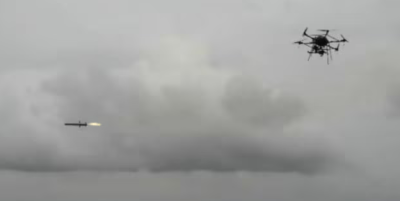
The Indian Army recently inducted two indigenous combat systems under the sixth round of Emergency Procurement: the UAV-Launched Precision Guided Munition (ULPGM) and the AGNIKAA Vertical Take-Off and Landing (VTOL) First-Person View (FPV) kamikaze drone. Inducted on May 11, 2026, these systems mark a major advancement in India’s tactical loitering munition capabilities. Emergency Procurement provisions enabled the rapid acquisition of these critical technologies to meet urgent operational requirements. Both systems have undergone testing in high-altitude terrain and severe electronic warfare conditions, ensuring field readiness along India’s contested borders.
Overview of the New Inductions
UAV-Launched Precision Guided Munition
The ULPGM is India’s first indigenously developed loitering munition. The Defence Research and Development Organisation (DRDO) co-developed this system in partnership with Adani Defence and Aerospace. It functions as a kamikaze weapon that can loiter in the air before striking a target with high precision.
AGNIKAA VTOL FPV Drone
The AGNIKAA is a Vertical Take-Off and Landing, First-Person View kamikaze drone. It is tailored for precision strikes across diverse terrains, including dense urban zones and open battlefields. The VTOL capability allows it to operate from confined spaces without requiring a runway.
Key Technical Specifications
The table below details the performance parameters of the newly inducted indigenous drone systems:
| Feature | UAV-Launched Precision Guided Munition (ULPGM) | AGNIKAA VTOL FPV Drone |
| Primary Developer | DRDO & Adani Defence and Aerospace | Indigenous Defence Industry |
| Strike Range | 2.5 kilometres | 5.0 kilometres |
| Endurance | Short-range tactical loitering | 30 minutes |
| Lethality Radius | Precision single-target impact | 5 metres |
| Guidance System | Imaging Infrared (IIR) Seeker | First-Person View (FPV) / Manual-Assisted |
| Electronic Warfare | Anti-jamming & Anti-spoofing | Anti-jamming & Anti-spoofing |
Strategic and Operational Capabilities
Loitering and Precision Strike
Loitering munitions combine the characteristics of a drone and a missile. They remain airborne to scout an area, select a target, and execute a kinetic strike by crashing into it. The ULPGM utilizes an Imaging Infrared seeker to track and hit targets during day or night conditions.
Electronic Warfare Resilience
Modern battlefields feature heavy GPS jamming and spoofing. Both the ULPGM and AGNIKAA incorporate advanced electronic counter-countermeasures. These systems maintain control and targeting accuracy even when opposing forces attempt to disrupt their communication links or manipulate their navigation signals.
High-Altitude Deployment
The Indian Army tested these platforms in high-altitude environments, validating their performance for deployment along the Line of Actual Control (LAC). The thin air and extreme cold at high altitudes often degrade drone battery life and motor efficiency, but these systems met the operational parameters.
Role of Emergency Procurement
Accelerated Acquisition Timeline
The Ministry of Defence utilizes the Emergency Procurement (EP) route to bypass standard, lengthy defense acquisition cycles. This mechanism grants the armed forces the financial autonomy to buy critical weapon systems quickly during heightened security situations.
Capitalizing Indigenisation
While initial EP rounds relied heavily on foreign imports, recent rounds prioritize domestic defense manufacturing. The induction of ULPGM and AGNIKAA highlights the transition toward sourcing urgent operational equipment from domestic private and public defense enterprises.
IASPOINT Booster Facts for UPSC
- First-Person View (FPV) Technology: FPV drones transmit a live video feed directly to goggles or a screen worn by the pilot. This allows the operator to control the drone with high maneuverability, making it effective for navigating inside buildings, bunkers, or trenches.
- Kamikaze Drones vs. Traditional UAVs: Traditional UAVs launch missiles and return to base. Kamikaze drones, or loitering munitions, are single-use expendable weapons where the drone body itself carries the explosive warhead to destroy the target.
- Imaging Infrared (IIR) Seeker: IIR seekers detect the thermal signature of a target and form a visual heat image. Unlike radar-guided systems, IIR seekers are passive, meaning they do not emit radiation that the enemy can detect or track.
- Emergency Procurement Financial Caps: Under the EP mechanism, the Vice Chiefs of the three armed forces hold the financial power to approve procurement contracts worth up to ₹300 crore per project to meet immediate operational requirements.