
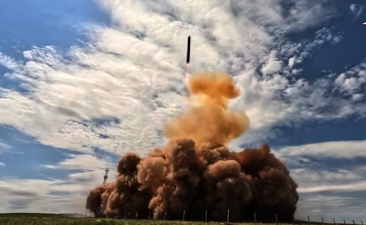
Russia successfully test-fired its next-generation RS-28 Sarmat intercontinental ballistic missile on 12 May 2026. The test launch took place from a silo at the Dombarovsky launch site near Yasny in the Orenburg oblast. Strategic Missile Forces Commander Colonel General Sergey Karakayev reported the validation of the missile’s flight design and technological parameters directly to President Vladimir Putin. This development marks a critical phase in Russia’s effort to update its land-based strategic nuclear forces. The Kremlin announced that the first military regiment carrying the weapon system will enter active combat duty in the Krasnoyarsk region of Siberia by the end of 2026.
Technical Specifications and Design Capabilities
Propulsion and Structural Profile
The RS-28 Sarmat is a silo-based, three-stage, liquid-fueled super-heavy intercontinental ballistic missile. Development of the platform began in 2011 to replace the aging Soviet-era R-36M2 Voyevoda missile systems. The structural and launch mass of the Sarmat exceeds 208 metric tonnes, classifying it as the first post-Soviet super-heavy ballistic missile.
Payload and Warhead Configuration
The weapon system features a high throw-weight capacity capable of carrying up to 10 metric tonnes of payload. The layout accommodates multiple warhead configurations:
- MIRV Systems: It can carry 10 to 15 Multiple Independently Targetable Re-entry Vehicles, allowing a single missile to strike separate geographical targets simultaneously.
- Hypersonic Integration: The design integrates with the Avangard hypersonic boost-glide vehicle, which travels at speeds exceeding Mach 27 to bypass missile defense networks.
Range and Trajectory Dynamics
The missile utilizes a suborbital flight trajectory, entering space at altitudes above 100 kilometers before returning to Earth. During the May 2026 test briefing, Russian state agencies clarified that the platform achieves a maximum operational range exceeding 35,000 kilometers. This extended distance enables the weapon to perform polar and near-polar flights, allowing it to approach targets from unexpected directions, such as traveling over the South Pole to reach the North American continent.
Geopolitical Context and Strategic Signaling
Modernization of Deterrence Architecture
The Sarmat is a core component of a broader Russian strategic weapons modernization program. This initiative includes other advanced platforms such as the Oreshnik intermediate-range ballistic missile, the Poseidon nuclear-armed underwater drone, and the Burevestnik nuclear-powered cruise missile. These systems aim to preserve strategic parity and counter foreign global missile shield defense programs.
Arms Control and Bilateral Communication
Despite the formal expiration of the New Strategic Arms Reduction Treaty (New START) in February 2026 without an immediate successor agreement, standard risk-reduction mechanisms remain active. Russia provided advance notification of the test launch to the United States. This communication aligns with long-standing bilateral protocols intended to prevent strategic miscalculations between nuclear-armed states.
Comparison of Global Strategic Ballistic Missiles
Intercontinental ballistic missiles form the backbone of land-based nuclear deterrence for major global powers, defined by operational ranges exceeding 5,500 kilometers. The operational parameters of primary global platforms vary by propulsion, range, and deployment styles:
| Missile Model | Country of Origin | Propulsion Type | Maximum Range (km) | Launch Platform |
| RS-28 Sarmat | Russia | Liquid-propellant | 35,000+ | Underground Silo |
| LGM-30G Minuteman III | United States | Solid-propellant | 13,000+ | Underground Silo |
| Dongfeng-41 (DF-41) | China | Solid-propellant | 12,000 to 15,000 | Road and Rail Mobile / Silo |
| Agni-V | India | Solid-propellant | 5,000 to 8,000 | Road-Mobile Launcher |
IASPOINT Booster Facts for UPSC
- NATO Nomenclature: The RS-28 Sarmat is designated as SS-X-29 or SS-X-30 by NATO, while popularly referred to in Western defense circles as “Satan II” due to its role as the direct successor to the R-36M “Satan” missile series.
- Liquid vs Solid Propellants: Liquid-fueled missiles like the Sarmat offer higher throw-weight capabilities and longer ranges but require complex storage systems and take longer to prepare for launch compared to solid-fueled alternatives like the US Minuteman III.
- The 62nd Missile Division: The first deployment of the Sarmat is assigned to the 302nd Missile Regiment of the 62nd Missile Division based at Uzhur in the Krasnoyarsk Krai, where existing infrastructure is being repurposed from older Soviet silos.
- Hypersonic Boost-Glide Versus Ballistic Trajectory: Traditional ICBMs follow a predictable parabolic arc through space, whereas hypersonic boost-glide vehicles like Avangard re-enter the atmosphere early and glide at lower altitudes, changing direction to evade radar detection.
- New START Treaty Legacy: Signed in 2010 and extended until February 2026, New START capped the number of deployed strategic nuclear warheads at 1,550 for both the United States and Russia before expiring without a replacement framework.