
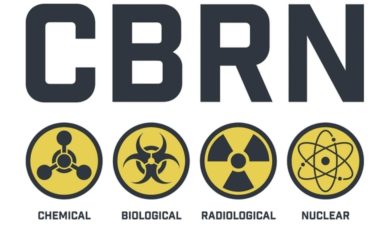
The Defence Research and Development Organisation (DRDO) inaugurated a state-of-the-art Chemical, Biological, Radiological and Nuclear (CBRN) field training and demonstration centre at Burari plains in Delhi on 6 May 2026. The facility was opened by Dr. Samir V. Kamat, Secretary of the Department of Defence R&D and Chairman of DRDO. Operating as a specialized Centre of Excellence under the Institute of Nuclear Medicine and Allied Sciences (INMAS), this facility bridges critical gaps in frontline response capabilities. It provides advanced, controlled testing environments to train personnel across multiple ministries and disaster response agencies against asymmetric warfare and technical hazards.
Core Infrastructure of the Burari Plains Centre
The newly established CBRN Centre of Excellence incorporates specialized technological wings to simulate, monitor, and counter hazardous warfare scenarios.
Operational and Research Units
- Radiological and Nuclear Test Bed: Provides a controlled field environment to test radiation detection equipment, evaluate nuclear energy technologies, and practice safe hazardous material handling.
- Heavy Ion Research Unit: Dedicated to studying high-energy atomic particles to aid the development of advanced shielding materials and study radiation biology.
- Emergency Medical Response Units: Specialized medical facilities focused on rapid diagnosis, injury classification, and immediate stabilization of victims exposed to toxic agents or radiation.
- Real-Time Field Operation Systems: Command and control setups designed to deploy communication networks and track situational hazards during an active contamination event.
Institutional Linkages and Training Mandate
The centre operates under the direct supervision of INMAS, a premier DRDO laboratory specializing in nuclear medicine, radiation biodosimetry, and radioprotective drug development. Through structured programs and specialized technical workshops, the facility trains frontline personnel from the following organizations:
- Ministry of Defence (Armed Forces personnel)
- Ministry of Home Affairs (Central Armed Police Forces)
- National Disaster Management Authority (NDMA)
- National Disaster Response Force (NDRF)
Classification of CBRN Threats
CBRN defense targets four distinct categories of non-conventional weapon agents and materials, each requiring specific containment, detection, and medical protocols.
| Threat Category | Common Agents Involved | Primary Impact Mechanism | DRDO Countermeasure Examples |
| Chemical (C) | Sarin, Mustard Gas, VX nerve agent, Industrial toxins | Asphyxiation, blistering, nervous system failure | Universal Chemical Biological Warfare decontaminant formulations, CWA colorimetric sensors |
| Biological (B) | Anthrax, Ricin, Botulinum toxin, Ebola virus | Severe infectious diseases, systemic poisoning, pandemics | Laser-Induced Fluorescence detectors, portable RT-PCR systems |
| Radiological (R) | Caesium-137, Cobalt-60 (used in “Dirty Bombs”) | Ionizing radiation exposure, localized contamination | Blast biodosimetry kits, point-of-care radiation exposure triage devices |
| Nuclear (N) | Enriched Uranium, Plutonium-239 (Detonation) | Thermal blast, shockwave, widespread radiation fallout | Nuclear explosion detection systems, radiation-hardened electronics |
Pillars of CBRN Defense Architecture
Effective national CBRN defense relies on a sequential response framework that spans from early battlefield detection to post-event decontamination.
Detection and Surveillance
- Sensing Technologies: Deployment of automated Chemical Warfare Agent (CWA) sensor kits and Biological Aerosol Detectors.
- Standoff Systems: Remote sensing tools like Standoff Chemical Detectors to identify hazardous clouds from safe distances.
- Exo-Atmospheric Monitoring: Satellite payloads engineered by DRDO to identify exo-atmospheric nuclear explosions and estimate weapon yield.
Personal Protection and Shielding
- Individual Protective Equipment: Development of specialized NBC (Nuclear, Biological, Chemical) suits incorporating high-adsorbent Activated Carbon Fabric (ACF) technology.
- Respiratory Protection: Advanced NBC canisters and chromium-free carbon filters designed to neutralize toxic inhaled vapors.
- Structural Hardening: Protocols for collective protection shelter systems, ensuring infrastructure is secured against air blast overpressures and toxic air infiltration.
Medical Management and Decontamination
- Decorporation Therapy: Administration of chemical agents to remove radioactive isotopes or heavy metals from internal organs.
- Radioprotective Countermeasures: Utilization of combinatorial therapeutic drugs formulated to mitigate tissue damage from mixed radiation exposure.
- En masse Decontamination: Use of multi-spectrum decontaminant formulations sprayed over personnel, vehicles, and terrains to neutralize active chemical or biological elements.
IASPOINT Booster Facts for UPSC
- INMAS Core Focus: The Institute of Nuclear Medicine and Allied Sciences (INMAS), located in Delhi, is the primary laboratory of DRDO responsible for research in nuclear medicine, non-invasive imaging, and radiological protection.
- The Roaring vs Non-Roaring Science: In specialized CBRN protective engineering, materials must undergo radiation hardening. Similarly, DRDO’s Defence Laboratory Jodhpur (DLJ) creates specific simulator tools for testing radiation source detection.
- Nodal Guidelines Provider: The National Disaster Management Authority (NDMA) has issued institutional guidelines making it mandatory for major Indian mega-cities and ports to house specialized CBRN emergency response shelters.
- The Geneva Protocol and CWC: India is a signatory to both the Biological Weapons Convention (BWC) and the Chemical Weapons Convention (CWC), meaning its CBRN defense programs are entirely defensive, focusing on protection, medical countermeasures, and civil defense.
- First Responders: The National Disaster Response Force (NDRF) maintains dedicated battalions trained explicitly by DRDO to handle domestic CBRN industrial disasters and terror emergencies.