
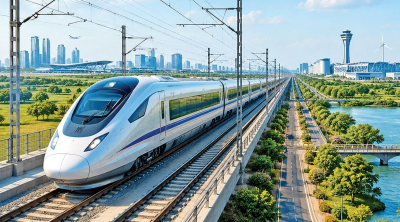
The Cabinet Committee on Economic Affairs (CCEA) approved the Ahmedabad (Sarkhej)–Dholera Semi High-Speed Double Line rail project on 13 May 2026. Spearheaded by the Ministry of Railways, this 134-kilometre greenfield corridor in Gujarat carries an estimated capital outlay of ₹20,667 crore. The project is designed as India’s first semi high-speed rail corridor built on completely indigenous technology. It connects the metropolitan hub of Ahmedabad to the Dholera Special Investment Region (SIR), the upcoming Dholera International Airport, and the Lothal National Maritime Heritage Complex. The infrastructure network is targeted for commercial operations by the financial year 2030–31.
Technical Specifications and Operational Speed
The corridor introduces engineering changes to the regional transit network by elevating operating speeds well above standard broad-gauge limits.
Velocity Metrics and Fleet Dynamics
- Design Speed: The physical track infrastructure, overhead equipment, and signaling systems are engineered to support a maximum capability of 220 kilometres per hour (kmph).
- Operational Speed: Passenger trains, including newly manufactured trainsets and compatible Vande Bharat variants, will run at regular commercial speeds of 200 kmph.
- Travel Time Reduction: Total transit time between Sarkhej and Dholera will drop to 34 minutes, while journeys extending from Sabarmati to Dholera will take 48 minutes. This facilitates rapid daily commuting and same-day return options.
Civil Engineering and Structural Profile
- Track Length and Realignment: The double-line broad gauge track covers a total length of 134 kilometres along the Ahmedabad-Dholera Expressway corridor.
- Elevated Sections: To eliminate level crossings and maximize safety, a 74-kilometre portion of the line will be constructed on elevated viaducts.
- Structural Crossings: The alignment features 13 passenger stations, three mega bridges, two rail over bridges (ROBs), and 39 road under bridges (RUBs).
Multi-Modal Integration and PM Gati Shakti
The project is conceptualized under the framework of the PM Gati Shakti National Master Plan to enable synchronized infrastructure planning.
Inter-System Passenger Interconnectivity
The rail corridor links directly with municipal and high-speed rail networks inside Ahmedabad. It connects with local Gujarat Metro stations at Sabarmati, Gandhigram, and Vastrapur. Furthermore, the line interfaces directly with the terminal station of the Mumbai–Ahmedabad High-Speed Rail (the Bullet Train project) located at Sabarmati.
Industrial Freight Alignment
For industrial logistics, the new line connects to the Western Dedicated Freight Corridor (WDFC) via a dedicated rail link at Maraiyya near Sanand. This linkage connects the manufacturing units within the Dholera Special Investment Region to primary container ports along the western coastline.
Socio-Economic and Environmental Impact
The infrastructure expansion affects rural demographics, industrial supply chains, and carbon reduction metrics simultaneously.
Demographic Coverage
The 134-kilometre track goes through the Ahmedabad district, providing transport accessibility to 284 rural settlements. It links an estimated rural population of 500,000 directly to urban economic centers.
Environmental Sustainability Indicators
The shift from fossil-fuel-dependent road transport to electric rail propulsion yields measurable ecological savings:
| Sustainability Parameter | Projected Annual Mitigation Value |
| Crude Oil Import Substitution | 0.48 Crore Litres |
| Carbon Dioxide (CO2) Abatement | 2.00 Crore Kilograms |
| Afforestation Equivalence | 10 Lakh Mature Trees |
Strategic Role of Dholera SIR
The railway serves as the logistics backbone for the Dholera Special Investment Region, a flagship node of the Delhi-Mumbai Industrial Corridor (DMIC). Dholera is being structured as a smart industrial city featuring specialized zones for defense manufacturing, aviation industries, electronics packaging, and large-scale semiconductor fabrication plants. High-speed connectivity supports the delivery of components to the upcoming Dholera International Airport and enhances heritage tourism access to the archaeological ruins of the Indus Valley Civilization at Lothal.
IASPOINT Booster Facts for UPSC
- Namo Bharat vs. Vande Bharat: While Vande Bharat trains operate on upgraded existing tracks with top speeds up to 130–160 kmph, the Sarkhej-Dholera line uses Namo Bharat rapid rail principles on a specialized, dedicated semi high-speed corridor designed for continuous 200 kmph operations.
- Indigenous Technology Blueprint: This project serves as the national reference model. The standard operating procedures, ballastless track designs, and signaling systems developed here will be replicated across future semi high-speed routes across different states.
- CCEA Composition: The Cabinet Committee on Economic Affairs is chaired by the Prime Minister. Its mandate covers reviewing economic trends, coordinating integrated infrastructure investments, and fixing final approvals on projects exceeding designated financial thresholds.
- Lothal Significance: Located at the end of this rail link, Lothal was the ancient world’s oldest known artificial dockyard, dating back to 2400 BCE. The Ministry of Ports, Shipping and Waterways is constructing the National Maritime Heritage Complex here to showcase India’s maritime history.