
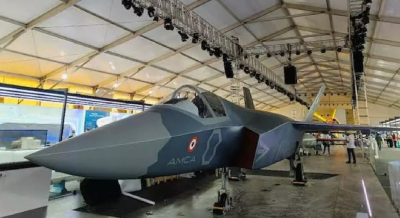
The foundation stone for the Advanced Medium Combat Aircraft infrastructure facility was laid on 15 May 2026 in Puttaparthi, Andhra Pradesh. This center will serve as the core hub for the integration, development, and flight testing of India’s indigenous fifth-generation stealth fighter jet. Led by the Aeronautical Development Agency under the Defence Research and Development Organisation, the project has an approved budget of ₹15,803 crore. The facility is expected to draw industrial investments worth ₹1 lakh crore, create 7,500 direct jobs, and establish a major defense manufacturing cluster in the region.
Technical Specifications and Design Architecture
The Advanced Medium Combat Aircraft is engineered as a twin-engine, stealth multirole fighter tailored for the Indian Air Force. Its design incorporates specific aerodynamic and structural parameters to minimize radar visibility and maximize combat survivability.
- Stealth Configurations: The airframe utilizes an internal weapons bay to carry missiles and bombs, preventing external payloads from reflecting radar waves. It features a serpentine air intake duct to hide the spinning engine blades from enemy radar, along with a special radar-absorbent material coating on the outer skin.
- Weight and Payload Metrics: The aircraft falls into the 25-tonne class category. It has a maximum takeoff weight of approximately 25,000 kilograms and can carry a tactical payload of up to 6,500 kilograms distributed between internal and external stations.
- Avionics Infrastructure: The cockpit features a large area display touchscreen, an advanced electronic warfare suite, and an active electronically scanned array radar capable of tracking multiple air and ground targets simultaneously.
Public-Private Partnership and Manufacturing Ecosystem
The program marks a shift from public-sector monopoly to a collaborative Special Purpose Vehicle framework, involving top tier Indian industrial firms.
Land Allocation and Infrastructure Scope
The Andhra Pradesh government allocated 600 to 650 acres of land in Puttaparthi for the project. This site will house specialized stealth testing chambers, structural health monitoring labs, assembly lines, and dedicated flight-test runways.
Strategic Corporate Consortiums
The project relies on a co-development model where private entities manage large structural work packages:
- Tata Advanced Systems: Expected to manage the fabrication of the main fuselage sections and carbon-composite assemblies.
- Larsen & Toubro: Tasked with manufacturing critical structural components, landing gear components, and specialized wings.
- Bharat Forge: Handling the heavy metal forging, engine housing rings, and high-strength titanium alloys required for high-stress airframe joints.
Project Timeline and Induction Strategy
The development schedule is strictly divided into testing phases to ensure structural safety and regulatory clearance before serial manufacturing begins.
Core Milestones and Prototyping
The program follows a precise testing timeline leading to full deployment:
- Prototype Rollout: Scheduled for September 2027.
- Maiden Test Flight: Planned for late 2028.
- Comprehensive Flight Testing: Running from 2028 to 2033 across diverse climatic conditions.
- Full Production Certification: Target finalized for 2034.
Phased Engine Deployment Strategy
The aircraft will be introduced in two distinct variants based on engine availability:
- Mark 1 Variant: The initial two squadrons will be powered by twin US-made General Electric F414-INS6 turbofan engines, generating around 98 kilonewtons of thrust with an afterburner.
- Mark 2 Variant: Subsequent squadrons will integrate a higher-thrust engine, generating 110 to 120 kilonewtons, developed jointly by India’s Gas Turbine Research Establishment and an international defense engine manufacturer.
Structural Comparison of Combat Aircraft Generations
| Parameter | Fourth Generation (e.g., LCA Tejas Mk1A) | Fifth Generation (e.g., AMCA) |
| Weapons Storage | External hardpoints only | Internal weapons bay + optional external pylons |
| Radar Signature | Standard radar cross-section | Ultra-low radar cross-section via stealth geometry |
| Engine Configuration | Single-engine setup | Twin-engine configuration for backup safety |
| Supercruise Ability | Requires afterburner to maintain supersonic speed | Can maintain supersonic flight without using afterburners |
| Sensor Capabilities | Independent radar and infrared tracking systems | Fully integrated sensor fusion across all systems |
IASPOINT Booster Facts for UPSC
- Aeronautical Development Agency (ADA): Established in 1984 under the Ministry of Defence, this nodal agency is responsible for designing and managing India’s Light Combat Aircraft and fifth-generation fighter programs.
- Supercruise Performance: The ability of a fighter aircraft to maintain supersonic cruise speeds without activating its fuel-heavy afterburners, saving fuel and extending its combat range.
- Radar Cross Section (RCS): A measure of how detectable an object is by radar. The AMCA design aims for an RCS comparable to a small bird or marble, making it difficult for enemy air defense systems to lock onto.
- Special Purpose Vehicle (SPV): A legal entity created to fulfill a narrow, specific objective. For AMCA, the SPV brings together DRDO, Hindustan Aeronautics Limited, and private companies to share financial risks and production speed.
- Diverterless Supersonic Inlet (DSI): A specialized type of jet engine air intake that eliminates complex moving parts while deflecting boundary layer air away from the engine, improving both aerodynamic efficiency and stealth.