
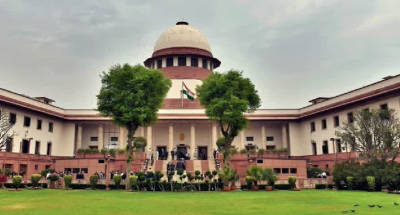
The Supreme Court of India dismissed a batch of appeals filed by the Uttar Pradesh government seeking to levy local Value Added Tax on natural gas transported interstate through common carrier pipelines. A bench comprising Justice J.K. Maheshwari and Justice Atul S. Chandurkar upheld a 2012 Allahabad High Court decision that quashed the tax assessment orders against Reliance Industries Limited and major buyers like Tata Chemicals and IFFCO. The apex court ruled that the sale of natural gas extracted from the KG-D6 basin off the Andhra Pradesh coast and sold to buyers in Uttar Pradesh constitutes an interstate sale under Section 3(a) of the Central Sales Tax Act, 1956, placing it entirely outside the taxation jurisdiction of individual states.
Constitutional and Legislative Framework
The distribution of fiscal powers between the Union and the States governs the taxation of goods crossing state borders.
Constitutional Provisions
- Article 269(1): Grants the Central Government exclusive competence to levy and collect taxes on the sale or purchase of goods taking place in the course of interstate trade or commerce.
- Article 286(1): Explicitly prohibits state legislatures from imposing a tax on the supply of goods or services where the supply takes place outside the state or in the course of interstate trade.
- Seventh Schedule: The Union List (List I) under Entry 92A covers taxes on the sale or purchase of goods other than newspapers, where such sale or purchase takes place in the course of interstate trade or commerce.
Central Sales Tax Act, 1956
- Section 3(a): Defines a sale or purchase of goods as an interstate transaction if it occasions the movement of goods from one state to another. The movement must be an inseparable part of the contract of sale.
- Section 4(2): Lays down the situs tests to determine when a sale takes place inside a state. However, the Supreme Court clarified that Section 3 takes precedence over Section 4; if a sale satisfies Section 3, a state cannot use situs rules to claim it as a local sale.
- Explanation 3 to Section 3 (2016 Amendment): Inserted to clarify that gas transported through common carrier pipelines maintains its interstate character even when it undergoes physical co-mingling with gas from other sources.
Core Dispute and Judicial Interpretations
The conflict between the Uttar Pradesh tax authorities and private entities centered on the physical behavior of natural gas during pipeline transit.
Argument of the State of Uttar Pradesh
The state government contended that natural gas is a fungible and unidentifiable commodity. When injected into a common carrier pipeline, it mixes with gas belonging to other entities. The state argued that the gas remains “unascertained” during transit and is only identified, metered, and appropriated at the buyers’ factories inside Uttar Pradesh. On this ground, the state claimed the transaction was a local, intra-state sale subject to 21 percent state Value Added Tax (VAT).
Counter-Arguments and Corporate Stand
Reliance Industries Limited and the consortium partners argued that the pre-existing Gas Sales and Purchase Agreements (GSPA) explicitly dictated the interstate movement. Under the GSPA, delivery, metering, and the transfer of title and risk occurred at Gadimoga near Kakinada in Andhra Pradesh. Central Sales Tax (CST) was already paid in Andhra Pradesh, and statutory Form-C declarations were issued to the buyers.
Key Observations by the Supreme Court
- Contractual Obligation: The court found that the movement of gas from Andhra Pradesh to Uttar Pradesh was not incidental but a direct contractual obligation under the GSPA.
- Rejection of Co-mingling Theory: The court ruled that the physical intermixing of gas inside a common pipeline is a mere incident of transportation. It cannot alter or relocate the legal character of a sale that was already concluded at the delivery point.
- Clarificatory Nature of 2016 Amendment: The bench highlighted that the 2016 amendment inserting Explanation 3 to Section 3 of the CST Act was enacted by way of abundant caution. It is clarificatory and applies retrospectively to past disputes.
- Public Trust Doctrine Limitation: The court rejected Uttar Pradesh’s reliance on the Public Trust Doctrine, ruling that the doctrine is meant for natural resource management and environmental governance. It cannot be repurposed to alter constitutional taxation limits or create non-existent tax jurisdictions.
Three Essential Ingredients of an Interstate Sale
The Supreme Court relied on the landmark State of Andhra Pradesh v. NTPC (2002) judgment to reiterate the criteria that establish an interstate sale:
| S.No | Essential Criteria | Status in KG-D6 Case |
| 1 | Presence of a contract of sale incorporating an express or implied stipulation for interstate movement. | Satisfied via pre-existing Gas Sales and Purchase Agreements (GSPA). |
| 2 | Actual physical movement of goods from one state to another pursuant to such a contract. | Satisfied as gas moved from Andhra Pradesh to factories in Uttar Pradesh. |
| 3 | The contract of sale must be the proximate and direct cause of the interstate movement. | Satisfied as movement was triggered solely to execute the supply obligations. |
Implications for Fiscal Federalism and Economy
The ruling clarifies the boundaries of state taxing powers, ensuring a uniform domestic market.
Preserving Federal Balance
The judgment emphasizes that India is a union of states with economic disparities. The architects of the Constitution placed fiscal policies touching interstate commerce under the Union government to prevent federating units from instituting protectionist measures to augment local resources at the cost of free trade.
Economic and Investment Certainty
The top court noted that stable and predictable jurisprudence in fiscal laws is vital for economic growth. Clear demarcation of taxing powers prevents double taxation, reduces litigation costs for essential infrastructure inputs like natural gas, and protects international consortiums operating under Production Sharing Contracts with the Union Government.
IASPOINT Booster Facts for UPSC
- Status of Petroleum under GST: When the Goods and Services Tax (GST) was introduced in 2017, five petroleum products—crude oil, high-speed diesel, motor spirit (petrol), natural gas, and aviation turbine fuel—were temporarily kept outside the purview of GST. They continue to attract Central Excise Duty and State VAT/CST.
- Production Sharing Contract (PSC): It is a term used in the hydrocarbon sector where the contractor bears the initial exploration risks and costs. If a discovery is made, the contractor recovers the costs from the produced oil/gas (Cost Petroleum) and shares the remaining profit (Profit Petroleum) with the Government based on a formula.
- New Exploration Licensing Policy (NELP): Launched in 1997-98 by the Government of India to boost private and foreign investment in oil and gas exploration. It was replaced in 2016 by the Hydrocarbon Exploration and Licensing Policy (HELP), which introduced a uniform licensing system and a revenue-sharing model instead of profit-sharing.
- Fungible Goods: In commercial law, fungible goods are items that are identical, interchangeable, and cannot be distinguished from another unit of the same item (e.g., oil, gas, grain). The legal transfer of ownership of fungible goods can happen before physical separation if specified by a valid contract.