
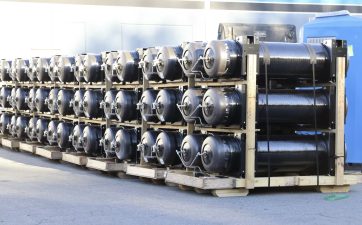
The Technology Development Board (TDB), a statutory body under the Department of Science & Technology (DST), signed an agreement on May 16, 2026, with NTF Energy Solutions Pvt Ltd to establish a manufacturing facility for advanced Type-IV Composite CNG Cylinders. Backed by financial assistance from the TDB, this indigenously developed project aims to commercialise lightweight, hydrogen-compatible gas storage systems by September 2027. This initiative marks a crucial advancement in alternative fuel storage, targeting improved vehicular fuel efficiency, lower emissions, and a transition toward a domestic clean mobility infrastructure.
Technical Evolution of CNG Gas Storage Cylinders
High-pressure gas storage technology has evolved across four distinct structural generations. The shift from pure metallurgy to advanced polymeric and carbon-fibre composites dictates the efficiency and weight of modern vehicular fuel storage.
Type-I Cylinders
These are traditional, all-metal cylinders manufactured entirely from seamless steel or aluminium. They represent the heaviest and least expensive variant available. A standard steel Type-I cylinder used in passenger vehicles weighs between 60 kg and 70 kg, imposing a substantial payload burden that lowers fuel efficiency.
Type-II Cylinders
This design comprises a metallic inner liner, typically steel or aluminium, reinforced by a composite wrap like glass fibre or carbon fibre wrapped exclusively around the cylindrical middle section or hoop. This provides moderate weight relief compared to Type-I models.
Type-III Cylinders
These systems feature a thin, lightweight metallic liner, usually aluminium, fully overwrapped with carbon fibre composite material across the entire body. They deliver up to 30% weight reduction relative to Type-II variants and tolerate higher structural pressures.
Type-IV Cylinders
Representing the latest commercial shift, Type-IV cylinders replace the metallic core entirely with a non-metallic, corrosion-free polymer inner liner. The liner is fully overwrapped with an optimised Carbon Fibre Reinforced Polymer (CFRP) layup via advanced filament winding technologies.
Structural and Operational Performance Comparisons
| Feature | Conventional Type-I Steel Cylinders | Advanced Type-IV Composite Cylinders |
| Material Composition | 100% Seamless Low-Carbon Steel | Polymer Liner with Carbon Fibre Overwrap |
| Average Component Weight | 60 kg to 70 kg | 15 kg to 20 kg |
| Net Structural Weight Saved | Baseline reference | 40 kg to 45 kg reduction per vehicle |
| Regulatory Pressure Benchmark | 400 bar | 400 bar |
| Engineered Burst Pressure | Standard limits | Exceeds 600 bar |
| Corrosion Tendency | Susceptible to internal and external rust | Completely corrosion-free |
| Fuel Compatibility | Standard Compressed Natural Gas (CNG) | CNG, Hydrogen-CNG (H-CNG) blends, Pure Hydrogen |
Impact on Vehicular Efficiency and Safety
The substitution of steel with advanced composites yields direct operational and structural benefits for the automotive sector.
Weight Reduction and Mileage Optimization
Replacing a 60–70 kg steel cylinder with a 15–20 kg Type-IV composite variant sheds 40–45 kg per vehicle. Minimizing the deadweight directly scales down the vehicular engine load, boosting fuel economy and overall mileage.
Mechanical Wear and Drivability
Lower vehicular payload results in reduced mechanical wear and tear on suspension, braking units, and tyres. This improves long-term vehicle serviceability, balancing drivability and reducing overall operating costs.
Enhanced Structural Integrity
The composite material configuration lowers the risk of catastrophic bursting compared to rigid steel shells. Designed for Indian climate and road conditions, these cylinders handle continuous pressure cycling, extreme ambient temperatures, and heavy vibrations without leakage.
Integration with the Green Energy Transition
The deployment of Type-IV technology positions India’s transport infrastructure for future clean energy transitions.
Hydrogen-CNG and Pure Hydrogen Readiness
The inner polymer liner resists hydrogen embrittlement, a chemical degradation process that weakens traditional steel tanks. This makes Type-IV cylinders fully compatible with upcoming Hydrogen-CNG (H-CNG) blends and dedicated hydrogen fuel cell infrastructures.
Decarbonization and Emission Compliance
Enhanced fuel economy translates directly to a lower net carbon footprint per kilometre. These lightweight gas storage setups assist automobile manufacturers in meeting increasingly strict domestic and international vehicle emission standards.
Commercial Scaling and OEM Partnerships
Initial industrial deployment targets passenger vehicles, followed by a phased scale-up to commercial transportation, industrial storage cascades, and bulk energy distribution systems. Automobile manufacturers have started integrating modified boot space configurations in new vehicle models to support direct factory installation.
Domestic Manufacturing Obstacles and Materials Supply Chain
While the design and production technologies are developed in-house at research hubs like IMT Manesar, Haryana, full manufacturing localisation faces specific material bottlenecks.
Carbon Fibre Import Reliance
The specialized carbon fibre required for the high-pressure structural overwrap is not produced at scale in India. The raw material must be imported, binding production costs to global petrochemical supply chains.
Localisation Drivers
Domestic demand for high-strength advanced composites remains limited by its tight coupling with upstream oil and gas industries. However, rising adoption across clean mobility sectors is projected to drive major industrial players to build local carbon fibre manufacturing units, advancing technological self-reliance and import substitution.
IASPOINT Booster Facts for UPSC
- Statutory Framework of TDB: The Technology Development Board is a statutory body established under the Technology Development Board Act, 1995. Operating under the Department of Science & Technology, its mandate is to provide equity capital, soft loans, or financial grants to commercialise indigenous research and promote the adaptation of imported technologies.
- Filament Winding Technology: This automated manufacturing process feeds continuous strands of resin-impregnated carbon fibre under controlled tension onto a rotating mandrel (the polymer liner) to generate high-strength composite pressure vessels.
- Hydrogen Embrittlement: A phenomenon where structural metals, notably high-strength steel, absorb atomic hydrogen, causing lattice disruptions that lead to cracking and catastrophic structural failure under stress. This explains why Type-IV polymer liners are preferred for hydrogen storage over Type-I steel.
- H-CNG Composition: Hydrogen-CNG blends typically feature 18% to 20% hydrogen by volume. This mix improves thermal efficiency and cuts carbon monoxide emissions by up to 70% compared to conventional natural gas.
- Burst Pressure Safety Margins: While standard domestic regulatory frameworks mandate a structural endurance threshold of 400 bar for high-pressure gas storage, advanced Type-IV cylinders are engineered to survive burst pressures exceeding 600 bar.