
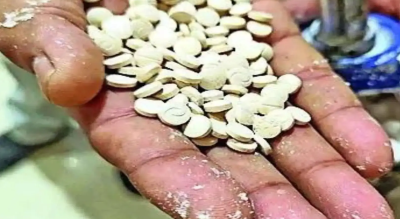
The Narcotics Control Bureau (NCB) executed a targeted multi-state crackdown codenamed Operation RAGEPILL, resulting in India’s first-ever seizure of Captagon, a highly addictive synthetic stimulant. Acted upon precise intelligence shared by a foreign drug law enforcement agency, the operation led to the recovery of 227.7 kg of Captagon in both tablet and powder forms. The total contraband is valued at approximately ₹182 crore in the international illicit market. A Syrian national operating as a key logistics handler for an international narcotics syndicate was arrested during the raids, revealing clandestine attempts to exploit Indian maritime and commercial infrastructure as transit routes for West Asian destinations.
Modus Operandi and Cross-State Recoveries
The Delhi Layout
The initial breakthrough occurred when NCB teams raided a rented residential accommodation in the Neb Sarai locality of South Delhi. The search yielded 31.5 kg of Captagon tablets meticulously concealed inside a commercial chapati-cutting machine. Investigations revealed that this specific consignment was packaged and ready for export to Jeddah, Saudi Arabia.
The Mundra Port Interception
Following the interrogation of the arrested foreign national, enforcement efforts shifted to Gujarat. The NCB intercepted a suspicious shipping container at the Container Facilitation Station (CFS) at Mundra Port. The cargo was officially declared as sheep wool imported from Syria. A comprehensive physical examination exposed three hidden bags containing 196.2 kg of high-grade Captagon powder, which was intended for transshipment to major destination markets across the Gulf region.
Profile of the Seized Substance
Chemical Composition
Captagon was originally developed in the 1960s as a pharmaceutical brand name for Fenethylline, a synthetic compound linking amphetamine and theophylline. It was initially prescribed to treat conditions such as attention deficit hyperactivity disorder (ADHD) and narcolepsy. Due to its severe addictive properties and potential for abuse, the original pharmaceutical formulation was globally banned.
Current Illicit Forms
Modern illicit versions circulating in black markets are produced in clandestine laboratories. These counterfeit tablets generally lack the original fenethylline compound and instead consist of varying combinations of amphetamine, caffeine, methamphetamine, and other synthetic stimulants.
Physiological Impact
The drug acts as a powerful central nervous system stimulant. It induces temporary euphoria, prolonged wakefulness, heightened alertness, and suppressed appetite and fatigue. However, long-term abuse causes severe psychological dependence, physical deterioration, increased aggression, and cognitive impairment.
Geopolitical Dynamics and Transit Patterns
The West Asian Consumption Hub
Captagon has emerged as a major public health and law enforcement challenge across the Middle East and Gulf Cooperation Council (GCC) nations, particularly Saudi Arabia. In local Arabic street slang, the drug is frequently referred to as ‘Abu Hilalain’ (meaning ‘father of the two crescents’) due to the distinctive logo of two overlapping crescent moons stamped onto the pills.
The Conflict Linkage
The substance gained global notoriety as the “Jihadi Drug” due to its widespread production and consumption within conflict zones in West Asia. Militant factions and extremist networks used the drug to eliminate fear and fatigue among combatants during active operations. Furthermore, the low production cost combined with high street prices turned the trade into a premier source of illicit financing for transnational organized crime cartels and insurgent groups.
India as a Transit Corridor
The shifting geopolitical landscape and crackdowns on traditional manufacturing units in the Levant have forced international syndicates to diversify their logistics. The Mundra Port seizure indicates that traffickers are increasingly utilizing India’s commercial maritime networks as transit pathways to mask the original origin of shipments before forwarding them to final consumer markets in the Middle East.
Indian Regulatory Framework Against Narcotics
The NDPS Act, 1985
Amphetamine and its chemical derivatives are strictly classified as Psychotropic Substances under the Narcotic Drugs and Psychotropic Substances (NDPS) Act, 1985. The manufacture, possession, transport, and export of these substances carry stringent statutory penalties, including rigorous imprisonment and heavy financial fines.
Institutional Mechanisms
India employs a multi-layered enforcement matrix to counter transnational trafficking. The NCB functions as the nodal coordination agency, operating in tandem with state police forces, customs departments, and international bodies like Interpol and the United Nations Office on Drugs and Crime (UNODC). Recent infrastructure upgrades include advanced cargo screening protocols managed by the Bureau of Port Security (BoPS) and industrial security deployment at major commercial gateways.
Key Frameworks and Drug Control Initatives
| Parameter/Initiative | Operational Scope & Details |
| MANAS Helpline | A dedicated national toll-free portal (1933) launched by the NCB to receive anonymous public intelligence on narcotics smuggling. |
| NCORD Mechanism | The Narco Coordination Centre mechanism, structured across four distinct tiers from central to district levels, facilitating real-time data sharing. |
| Zero-Tolerance Policy | The administrative directive implemented by the Ministry of Home Affairs to dismantle the financial and logistical backbones of drug syndicates. |
| SIMS Portal | The Seizure Information Management System, a digitized pan-India repository tracking drug seizures, suspect profiles, and trafficking trends. |
IASPOINT Booster Facts for UPSC
- Nodal Ministry: The Narcotics Control Bureau (NCB) functions under the administrative control of the Ministry of Home Affairs (MHA), Government of India.
- International Conventions: India is a signatory to all three major United Nations drug conventions: the Single Convention on Narcotic Drugs (1961), the Convention on Psychotropic Substances (1971), and the Convention against Illicit Traffic in Narcotic Drugs and Psychotropic Substances (1988).
- Golden Crescent and Golden Triangle: India is geographically sandwiched between the world’s two prime illicit opium-producing regions: the Golden Crescent (Iran, Afghanistan, Pakistan) to the west, and the Golden Triangle (Myanmar, Laos, Thailand) to the east.
- Constitutional Provision: Article 47 of the Directive Principles of State Policy (DPSP) directs the State to endeavor to bring about the prohibition of the consumption of intoxicating drinks and drugs harmful to health, except for medicinal purposes.
- PMLA Integration: Drug trafficking offenses under the NDPS Act are scheduled offenses under the Prevention of Money Laundering Act (PMLA), 2002, allowing enforcement directorates to attach assets generated via narcotics trade.