
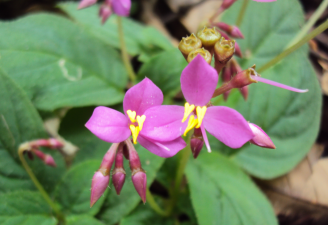
Researchers from the Department of Botany at the University of Calicut and the Botanical Survey of India (BSI) discovered a new flowering plant species named Sonerila roxburghii in the ecologically sensitive Western Ghats of Kerala. Found in the Mankulam and Kallar areas of Idukki district at altitudes between 1,380 and 1,480 meters, this species is classified as Critically Endangered due to its restricted distribution and habitat threats. The formal discovery was published in the international peer-reviewed journal Annales Botanici Fennici in Finland, reinforcing the status of the Western Ghats as a premier global biodiversity hotspot containing highly endemic plant lineages.
Taxonomic Classification and Overview
Sonerila roxburghii belongs to the Sonerila genus under the Melastomataceae family. The genus is characterized as a large group of delicate tropical herbs or undershrubs mostly found in shady, moist, high-altitude rocky habitats. Unlike most other members of the family that have five petals, the Sonerila genus possesses a distinct trimerous structure consisting of exactly three petals and three stamens arranged in a single whorl. This specific lineage is largely confined to the higher reaches of the Western Ghats within the Indian subcontinent.
Morphological Characteristics
The physical features of Sonerila roxburghii distinguish it from other known herbaceous species in the region.
Stem and Height
The plant features erect, delicate stems capable of growing up to a height of 60 centimeters.
Floral Structure
It bears trimerous flowers that display a distinctive light pink or rosy-pink coloration, supported by a three-celled inferior ovary.
Foliage
The leaf surfaces are smooth and flattened, showing a characteristic structural adaptation where the lamina gradually tapers towards the supporting stem.
Geographical Distribution and Habitat
The species is strictly restricted to high-altitude montane ecosystems within the southern Western Ghats.
Specific Locality
The entire known population is localized within the Mankulam and Kallar regions of the Idukki district in Kerala.
Altitudinal Range
It thrives strictly in micro-habitats situated between 1,380 meters and 1,480 meters above mean sea level.
Environmental Niche
The plant adapts to moist, high-altitude rocky cliffs, wet crags, and moss-covered rock crevices that experience high moisture content from seasonal precipitation.
Conservation Status and Threats
The researchers provisionally classified Sonerila roxburghii under the Critically Endangered category based on the International Union for Conservation of Nature (IUCN) Red List criteria. Its limited geographical extent makes the entire population vulnerable to minor environmental shifts. The primary survival hazards include:
- Infrastructure Development: Uncontrolled construction activities across high-altitude areas cause slope instability and directly clear the micro-habitats.
- Quarrying and Mining: Industrial operations targeting laterite-rich regions lead to extensive landscape modification and loss of topsoil.
- Tourism Footprint: Unregulated tourist flow into the fragile interior zones of Idukki triggers soil compaction and immediate plant destruction.
- Habitat Fragmentation: The isolation of small plant populations prevents genetic exchange, creating isolated hill ecosystems vulnerable to localized extinction events.
IASPOINT Booster Facts for UPSC
- William Roxburgh: The species name Sonerila roxburghii honors the Scottish botanist William Roxburgh, who is celebrated as the “Father of Indian Botany” and served as the Superintendent of the Royal Botanic Garden, Calcutta. He was one of the earliest taxonomists to document the Sonerila genus in India.
- Botanical Survey of India (BSI): Established in 1890 under the Ministry of Environment, Forest and Climate Change, BSI is the apex research organization for surveying, researching, and cataloging the plant resources of India.
- Trimerous Distinction: While standard members of the Melastomataceae family have 5 petals, the Sonerila genus stands out because it has only 3 petals, 3 stamens, and a 3-celled inferior ovary.
- Western Ghats Hotspot: The Western Ghats is recognized as one of the world’s “eight hottest hotspots” of biological diversity, showing an exceptionally high rate of endemism among amphibians, fish, and angiosperms.
- Allied Species: Other unique Sonerila species recently documented by the same research team from the Western Ghats include Sonerila longipedunculata, Sonerila lateritica, Sonerila konkanensis, and Sonerila stolonifera.