
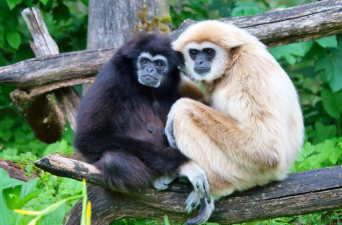
The Wildlife Institute of India recently installed canopy bridges with safety nets over a railway line in Assam’s Hollongapar Gibbon Sanctuary. This railway line has fragmented the forest since 1887, isolating populations of the endangered Western Hoolock Gibbon due to their inability to cross canopy gaps. The initiative has successfully recorded the first documented use of artificial canopy bridges by gibbons globally. It aims to reconnect isolated groups and ensure safe movement across the transport corridor. This intervention addresses the severe threat that habitat fragmentation poses to arboreal mammals in the region.
The Hollongapar Gibbon Sanctuary
The Hollongapar Gibbon Sanctuary is a semi-evergreen forest reserve located in the Jorhat district of Assam, India. It covers an area of approximately 21 square kilometers. The sanctuary was officially designated in 1997, having previously been known as the Bhogdoi Forest Reserve. It is bounded by the Bhogdoi River and is surrounded by tea gardens, which create a distinct ecological island.
Biodiversity Profile of the Sanctuary
The sanctuary is unique because it hosts seven distinct primate species, the highest density for any single protected area in India.
- Apes: Western Hoolock Gibbon (Hoolock hoolock)
- Macaues: Rhesus Macaque, Assamese Macaque, Pig-tailed Macaque, Stump-tailed Macaque
- Other Primates: Capped Langur, Bengal Slow Loris
- Other Wildlife: Asian Elephants, Leopards, Jungle Cats, Wild Boars, and over 200 species of birds.
Understanding the Western Hoolock Gibbon
The Western Hoolock Gibbon is the only ape species found in India. Gibbons are small, tailless arboreal apes known for their distinctive calls and specialized mode of locomotion called brachiation, where they swing from branch to branch using their long arms.
Conservation Status and Distribution
- IUCN Red List Status: Endangered
- Wildlife Protection Act, 1972: Schedule I (affording the highest level of legal protection)
- CITES: Appendix I
- Geographical Range: Found in Northeast India (south of the Brahmaputra and east of the Dibang rivers), Bangladesh, and northwestern Myanmar.
Threats to the Species
- Habitat Fragmentation: Linear infrastructure like railway tracks, roads, and power lines split continuous canopy covers. Gibbons are strictly arboreal and rarely descend to the ground, making them highly vulnerable to canopy gaps.
- Habitat Loss: Expansion of tea plantations, agricultural encroachment, and illegal logging reduce the available forest cover.
- Genetic Isolation: Fragmented populations cannot mate with outside groups, leading to inbreeding depression and local extinctions.
The Canopy Bridge Initiative
The railway line operated by Northeast Frontier Railway cuts directly through the Hollongapar sanctuary, dividing it into unequal compartments. The Wildlife Institute of India, in collaboration with the Assam Forest Department, designed and installed specialized canopy bridges to bridge this 1887-era gap.
Technical Features of the Artificial Bridges
The structures are designed to mimic natural tree canopies and withstand environmental degradation.
- Material: High-grade, weather-resistant ropes and webbed safety nets suspended across the railway tracks.
- Height and Length: Positioned at the average height of the surrounding forest canopy to match the natural movement zone of the gibbons.
- Safety Mechanisms: Safety nets are placed underneath the primary ropes to prevent accidental falls onto the railway tracks or high-voltage overhead traction wires.
Ecological Impact of the Project
- Restoring Gene Flow: By allowing gibbons to cross the tracks, the bridges enable interbreeding between separated troops, enhancing genetic diversity.
- Benefit to Other Species: Other arboreal mammals like the Capped Langur and Bengal Slow Loris use these structures to navigate the fragmented habitat safely.
- Mitigation of Linear Infrastructure Impacts: The project serves as a model for integrating eco-conscious engineering into existing and future transport corridors cutting through wildlife habitats.
Comparative Analysis of Indian Primate Conservation
| Primate Species | Primary Habitat | IUCN Status | Major Threats |
| Western Hoolock Gibbon | Tropical Evergreen Forests (Assam, Arunachal Pradesh) | Endangered | Canopy fragmentation, shifting cultivation, infrastructure |
| Lion-tailed Macaque | Western Ghats (Silent Valley, Tamil Nadu, Karnataka) | Endangered | Habitat fragmentation due to tea/coffee plantations, dam construction |
| Golden Langur | Western Assam and Bhutan (Manas Biosphere Reserve) | Endangered | Habitat loss, hybridization, electrocution by power lines |
| Phayre’s Leaf Monkey | Tripura, Mizoram | Endangered | Shifting cultivation, forest degradation, hunting |
IASPOINT Booster Facts for UPSC
- Taxonomy: India is home to two sub-species of Hoolock Gibbons: the Western Hoolock Gibbon (Hoolock hoolock) and the Eastern Hoolock Gibbon (Hoolock leuconedys). The Eastern Hoolock Gibbon is found mainly in specific pockets of Arunachal Pradesh and is classified as Vulnerable by the IUCN.
- Mishmi Hills Exception: A recent study indicated that gibbons found in the Mishmi Hills of Arunachal Pradesh, previously thought to be a separate species called the Mishmi Hills Gibbon, are genetically variations of the Western Hoolock Gibbon.
- Anatomy Fact: Gibbons are the fastest of all tree-dwelling, non-flying mammals. Their arm length is almost double the length of their legs, which aids their unique brachiating movement.
- Monogamy: Unlike many other primates, Hoolock Gibbons are monogamous. They form permanent pair bonds and live in small family groups consisting of a mating pair and their offspring.
- State Animal: The Hoolock Gibbon is the state animal of Arunachal Pradesh.
- Eco-Sensitive Zones: Hollongapar Gibbon Sanctuary has a declared Eco-Sensitive Zone around it to regulate industrial development and commercial activities within a specific radius of the protected area boundary.