
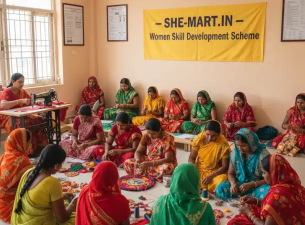
The Ministry of Rural Development (MoRD) initiated a nationwide roadmap for creating women-led rural marketing ecosystems through the SHE-MARTs (Self Help Entrepreneurs-Marketing Avenues for Rural Transformation) initiative. To finalize the operational guidelines for this Union Budget announcement, Deendayal Antyodaya Yojana–National Rural Livelihoods Mission (DAY-NRLM) organized a two-day National Consultation in Bhubaneswar, Odisha. Hosted by the Odisha Livelihoods Mission and facilitated by PRADAN, the consultation convened State Mission Directors, financial institutions, and sector experts. The initiative aims to shift self-help groups (SHGs) from a credit-linked livelihood model to a market-linked enterprise ecosystem, directly supporting the government’s target of creating three crore additional Lakhpati Didis by 2029.
Strategic Shift: Livelihood to Enterprise Ownership
The rollout of SHE-MARTs alters the economic landscape for rural women collectives by modifying how products move from farm gates to retail shelves.
Moving Up the Value Chain
Traditional SHG interventions prioritized microcredit, financial inclusion, and basic production like tailoring, dairy, or handicrafts. SHE-MARTs shift focus to vertical integration, allowing women collectives to manage the full value chain, including aggregation, packaging, quality control, inventory management, and direct retail distribution.
Elimination of Middlemen
By creating a permanent, structured marketplace managed by women, the model eliminates intermediary traders. This structural change ensures that a greater share of the retail margin is retained by the primary women producers, raising household incomes.
Transitioning from Welfare to Business
The foundational principle of the initiative shifts from subsidy-dependent assistance to community-owned, professionally managed retail platforms. This approach focuses on business viability, cost-efficiency, and market competitiveness rather than long-term reliance on government grants.
Institutional Architecture and Operation
The execution of SHE-MARTs utilizes the multi-tiered institutional framework of DAY-NRLM to scale operations efficiently. Self-Help Groups (SHGs) ──> Village Organizations (VOs) ──> Cluster-Level Federations (CLFs) ──> SHE-MARTs (Retail Nodes)
Node of Operation
SHE-MARTs will be established at the cluster level and managed by Cluster-Level Federations (CLFs). CLFs are registered community groups that bring together multiple village organizations and SHGs within a block or sub-block. This federated structure allows for inventory pooling, bulk transport, and enhanced bargaining power.
Selection and Eligibility
While open to rural artisans and manufacturers, preference is given to women who have already achieved financial milestones or received training under the Lakhpati Didi framework. Participating SHGs must demonstrate an established track record under DAY-NRLM.
Financial and Infrastructure Grid
To enable these marts to compete with commercial retail brands, the policy framework provides a blend of fiscal and logistical support:
- Targeted Credit Support: Provision of interest-free loans up to Rs. 5 lakh for enterprise creation and initial working capital.
- SME Growth Fund: Financial backup from a specialized Rs. 10,000 crore fund designed to scale up MSME champions.
- Viability Gap Funding (VGF): Deployment of VGF in low-income or aspirational districts to support the retail outlets until they achieve business break-even.
Key Focus Areas and Value Addition
The enterprise model introduces modern commercial standards to traditional rural products to improve market acceptance.
Quality Assurance and Standardization
SHE-MARTs will serve as processing hubs where rural goods undergo systematic quality testing, standardization, and professional packaging. This ensures products satisfy formal retail standards and urban consumer preferences.
Unified Branding
Products will be marketed under a specialized “SHE” identity. Transforming the acronym from Self-Help Group to Self-Help Entrepreneur builds brand equity, allowing rural collectives to command premium prices in semi-urban and urban markets.
Sectoral Diversification
The marketing network extends beyond conventional agri-products:
- Blue Economy Integration: Serving as retail outlets for processed fish products, supported by clean energy investments like solar-powered cold storage chains.
- Care Economy Formalization: Acting as a listing and booking network for rural women trained as certified caregivers for geriatric and childcare services.
Implementation and Financial Matrix
| Feature / Metric | Details and Operational Parameters |
| Nodal Ministry | Ministry of Rural Development (MoRD) |
| Core Mission Linkage | Deendayal Antyodaya Yojana–National Rural Livelihoods Mission (DAY-NRLM) |
| Geographic Coverage | Planned across all States and UTs, targeting at least one SHE-MART per district |
| Total Program Outlay | Supported by a dedicated segment within the enhanced Rs. 5.01 lakh crore Gender Budget |
| Key Implementation Partners | State Rural Livelihoods Missions (SRLMs), NABARD, and National Support Organisations (NSOs) |
| Primary Financial Instruments | Interest-free capital loans, Credit Guarantees, and Viability Gap Funding |
IASPOINT Booster Facts for UPSC
- Lakhpati Didi Definition: A strategic initiative under DAY-NRLM where the government enables women members of rural SHGs to achieve a sustainable annual household income of at least Rs. 1 lakh through diversified livelihoods.
- Lakhpati Didi 2.0: The updated phase introduced in the Union Budget shifts emphasis from basic income-generating activities to formal business ownership, digital financial literacy, and advanced e-commerce integration.
- Gender Budgeting Trends: The allocation in the Union Budget has been increased to approximately Rs. 5.01 lakh crore, constituting nearly 9.4% of the total budget expenditure, reflecting a policy focus on women-led development.
- The “Three S” Strategy: The programmatic alignment of SHE-MARTs and associated rural schemes is built on three pillars: Safety (social security), STEM (technical skill development for women), and Scale (expanding enterprises into formal markets).
- PRADAN: Professional Assistance for Development Action, acting as the National Support Organisation (NSO) to provide technical assistance, training, and strategic planning for the implementation of SHE-MARTs.
- DAY-NRLM Institutional Ladder: The scheme operates on a four-tier structure: primary Self-Help Groups (10–15 women) at the base, Village Organizations (mapping 10–20 SHGs), Cluster-Level Federations (aggregating multiple VOs at block level), and District/State Livelihood Missions at the apex.