
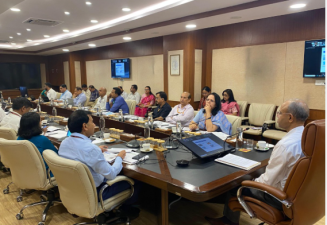
The Department of Drinking Water and Sanitation organised the 7th District Collectors’ Peyjal Samvad through video conferencing to review progress under Jal Jeevan Mission (JJM) 2.0 and Swachh Bharat Mission-Grameen (SBM-G) Phase 2. Senior officials, district collectors, deputy commissioners and mission directors discussed implementation challenges, service delivery, sustainability and district-level best practices for rural water supply and sanitation.
Focus on JJM 2.0 and SBM-G Phase 2
The meeting underlined the national goal of safe tap water for every rural household and improved sanitation in villages. Districts were urged to accelerate Har Ghar Jal certification, strengthen operation and maintenance systems, and ensure long-term functionality of water supply assets. The emphasis was on moving beyond infrastructure creation towards reliable service delivery.
New Tools for Monitoring and Accountability
A key theme was the use of new mechanisms for performance tracking. These included:
- Jal Arpan, which involves handing over completed water assets to Gram Panchayats after a 15-day trial run.
- Jal Seva Aankalan, a Gram Panchayat-led assessment system for service quality and functionality.
- Sujala Gaon ID and Sujalam Bharat App, designed to create digital footprints of rural water assets.
Officials were asked to speed up District Technical Unit reviews, District Improvement Plans and State Service Improvement Plans. The framework links local feedback with corrective action and dashboard-based monitoring.
District Best Practices Shared
Five districts presented field-level innovations. Tehri Garhwal brought into light high tap water coverage, source sustainability through convergence, and greywater management saturation. Koderma showcased technology-enabled monitoring, grievance redressal and water quality testing. Anantnag presented a convergence model that resolved long-standing water scarcity in remote habitations. Raebareli reported progress in tap water coverage and scientific waste management. Vijayapura shared large multi-village schemes, strong O&M practices and community-led sanitation efforts.
Way Forward for District Administration
The meeting stressed that district collectors play a central role in mission success. Regular DWSM meetings, better dashboard review, stronger district technical capacity, and community participation were identified as priorities. The focus remains on achieving full coverage, improving service reliability, and ensuring sustainable rural water and sanitation systems.
Last Modified: April 27, 2026