
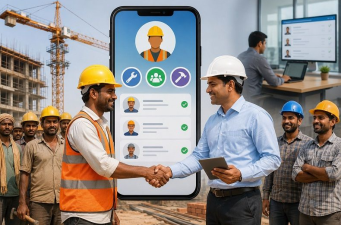
The Haryana government officially launched the “ShramMitra” mobile application on May 20, 2026, to modernize its informal labor market. Developed by the Haryana Building and Other Construction Workers Welfare Board, the digital platform serves as an electronic employment exchange to connect informal workers directly with prospective employers. The initiative aims to phase out the traditional physical labor chowk system, allowing daily wage laborers to secure work directly from their homes. At the time of launch, the state labor department had already pre-loaded the verified data of nearly 75,000 registered construction workers onto the application matrix.
Core Architecture and Structural Features
Institutional Development
The app is designed, owned, and managed by the Haryana Building and Other Construction Workers Welfare Board. It operates under the state’s Directorate of Labour to bring structural regulation into the unorganized construction and self-employment sectors.
Multilingual and Multi-Platform Access
- Operating Systems: The application is available free of cost on both Android (Google Play Store) and iOS (Apple App Store) platforms to ensure widespread technological accessibility.
- Linguistic Interface: The platform supports a trilingual interface operating in Hindi, English, and Punjabi to cater to the diverse linguistic demographics of the state’s workforce.
Integrated Geo-Mapping Technology
The application integrates built-in geo-mapping and Global Positioning System (GPS) tracking capabilities. This allows both parties to access live information regarding localized job locations, real-time physical distance, and exact travel times, optimizing daily transit logistics for manual laborers.
Functional Mechanism and Stakeholder Integration
Registration and Profile Verification
Workers can upload comprehensive digital profiles detailing their specific technical skills, verified work experience, and area specialization. The platform segments workers into two core functional groups:
| Construction & Trade Workers | Informal Self-Employed Workers |
| Masons | Barbers |
| Carpenters | Cobblers |
| Electricians | Tailors |
| Plumbers | Domestic helpers |
| Painters and Welders | Vehicle washers |
Direct Negotiation and Communication
The application features live chat functions, push notifications, and voice-note capabilities. Employers post their exact job openings and physical site requirements, allowing direct bilateral negotiations regarding daily wage rates, expected work duration, and specific work terms without intermediary interference.
Policy Impact and Socio-Economic Benefits
Elimination of Middlemen and Wage Exploitation
By acting as a direct electronic exchange, the platform bypasses commission-seeking contractors and middlemen. This ensures that the financial compensation agreed upon is transferred entirely to the laborer, enhancing income transparency.
Safety, Dignity, and Operational Security
The physical labor chowk system frequently exposes workers to safety hazards, extreme weather, and unpredictable employment scouting. ShramMitra provides transactional dignity by shifting the recruitment process into a secure, indoor digital environment.
Governance Based on Real-Time Data
The data collected via the application allows the state administration to monitor labor supply-demand dynamics across different districts. This real-time visibility enables precise policy decisions, localized welfare scheme distribution, and targeted skill development programs.
IASPOINT Booster Facts for UPSC
Key Institutional Frameworks and Digital Interventions
- e-Shram Portal: Launched in 2021 by the Union Ministry of Labour and Employment, this is the first national database of unorganized workers, seeded with Aadhaar numbers to streamline social security delivery.
- Haryana Building and Other Construction Workers Welfare Board: A statutory body constituted under Section 18(1) of the Building and Other Construction Workers (Regulation of Employment and Conditions of Service) Act, 1996, responsible for managing state welfare funds for construction laborers.
- Unorganized Sector Definition: Under the Unorganized Workers’ Social Security Act, 2008, it refers to production or service units owned by individuals or self-employed workers where the total employment strength is typically less than ten workers.
- Article 43 of the Constitution: A Directive Principle of State Policy (DPSP) that mandates the State to secure a living wage, decent standard of life, and social and cultural opportunities for all workers, whether agricultural or industrial.
- Labour Chowk Ecosystem in Haryana: The state labor department tracks approximately 135 operational physical labor chowks. Field teams are deployed to these sites to provide on-spot assistance for digital onboarding onto the ShramMitra ecosystem.