
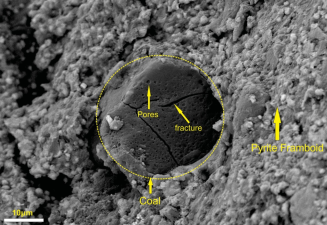
Geologists from Banaras Hindu University and IIT (ISM) Dhanbad have discovered a rare microscopic sunflower-shaped pyrite mineral within lignite coal reserves in Gujarat. This marks the first report of such a unique mineral formation in India. The discovery provides insights into ancient oxygen-poor marine environments during the formation of these coal beds. However, it also highlights challenges in coal purification due to the deeply embedded sulfur. Understanding this structure helps researchers develop better pollution control methods and improve safety measures in coal mines.
Understanding Pyrite and the “Sunflower” Formation
Chemical Composition and Nature
Pyrite is a naturally occurring iron sulfide mineral with the chemical formula FeS2. It is commonly known as “fool’s gold” due to its brassy-yellow metallic luster. In the newly discovered samples from Gujarat, the pyrite does not form its typical cubic crystals. Instead, it exhibits a unique, microscopic radiating structure that resembles a sunflower.
Microscopic Morphology
The sunflower pyrite consists of an inner core and an outer rim made of microscopic spherical aggregates called framboids. These framboids are less than 10 micrometers in size. The structural setup of this mineral is detailed below:
| Feature | Description |
| Inner Core | Densely packed, tiny crystalline pyrite framboids. |
| Outer Rim | Radiating, elongated pyrite crystals resembling sunflower petals. |
| Size Range | Microscopic scale, requiring scanning electron microscopy (SEM) to view. |
| Host Rock | Low-rank lignite coal deposits in Gujarat. |
Geological Significance and Paleoenvironment
Indicators of Anoxic Environments
The formation of sunflower pyrite requires specific environmental conditions. It serves as a definitive proxy for anoxic, or oxygen-depleted, depositional environments. These minerals form when sulfate-reducing bacteria break down organic matter in the absence of oxygen.
Marine Incursion in Lignite Beds
The presence of these iron sulfides indicates that ancient peat swamps faced periodic marine incursions. Seawater provided a rich supply of sulfate ions (SO42-), which reacted with available iron and organic matter in the sediment to precipitate pyrite. This helps geologists reconstruct the Eocene epoch paleogeography of Western India.
Environmental and Mining Challenges
Spontaneous Combustion Risks
The fine-grained, high-surface-area structure of sunflower pyrite increases the reactivity of the coal. When exposed to atmospheric oxygen and moisture, the mineral oxidizes rapidly. This exothermic reaction generates heat and increases the risk of spontaneous combustion within coal seams and stockyards.
Acid Mine Drainage (AMD)
Oxidation of these microscopic pyrite structures produces sulfuric acid (H2SO2) and dissolved iron. This chemical runoff leaches into local groundwater and surface water bodies, leading to Acid Mine Drainage. AMD lowers the pH of aquatic ecosystems, making them toxic to life.
Air Pollution and Coal Washing Challenges
Because the sunflower pyrite is intricately embedded at a microscopic level within the organic coal matrix, physical coal washing cannot easily remove it. Burning this sulfur-rich lignite releases high amounts of sulfur dioxide (SO2) gas, a primary driver of acid rain and respiratory illnesses.
IASPOINT Booster Facts for UPSC
- Lignite Distribution: Gujarat holds major lignite reserves in districts like Kutch, Bharuch, Surat, and Bhavnagar. The state uses this low-rank coal extensively for local thermal power generation.
- Framboid Etymology: The term “framboid” comes from the French word for raspberry (framboise), owing to the raspberry-like appearance of the microscopic crystal clusters under electron microscopes.
- Pyrite Oxidation Equation: The chemical reaction that drives acid mine drainage and spontaneous heating is represented as:2FeS2 + 7O2 + 2H2O → 2Fe2+ + 4SO42- + 4H^+
- Industrial Utility: While a pollutant in coal, pure pyrite is historically used in the commercial production of sulfur dioxide, sulfuric acid, and occasionally as a gemstone.