
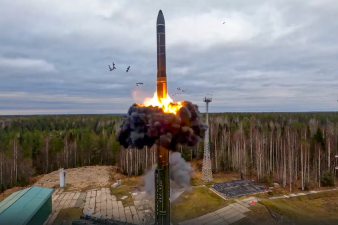
On May 24, 2026, Russia deployed its advanced Oreshnik hypersonic ballistic missile during a massive coordinated drone and missile strike targeting Kyiv and surrounding regions, marking the third reported use of this weapon in the ongoing conflict. The missile struck the city of Bila Tserkva in the Kyiv region as part of a wider assault involving roughly 600 drones and 90 missiles of various configurations. While Ukrainian air defense networks successfully intercepted a vast majority of the incoming threats, the ballistic vector breached defenses, causing severe infrastructure damage and civilian casualties. Russian leadership maintains that the Oreshnik is completely immune to contemporary Western anti-missile systems, positioning it as a highly strategic element in their regional strike doctrine.
Technical and Structural Profile
Design Origin and Classification
The Oreshnik (translated as “Hazel Shrub” or “Hazelnut Tree” in Russian) is a mobile, solid-fueled, Intermediate-Range Ballistic Missile (IRBM). Western intelligence and defense analysts categorize the system as a specialized variant derived from the discontinued RS-26 Rubezh Intercontinental Ballistic Missile (ICBM) program. To optimize the missile for intermediate theater operations, engineers likely removed a core booster stage from the RS-26 architecture, effectively reducing its maximum range while shifting its primary operational orientation toward regional strategic strikes.
Kinematics and Propulsion
The missile utilizes high-impulse solid-fuel motors distributed across a two-stage propulsion design. It is deployed from a heavy, road-mobile Transporter-Erector-Launcher (TEL) chassis, maximizing operational mobility and post-launch survivability. The propulsion system is engineered for an exceptionally powerful and rapid boost phase to minimize the launch detection window and hamper early-stage interception. During its mid-course and terminal phases, the Oreshnik achieves hypersonic velocities exceeding Mach 10, equivalent to roughly 12,300 kilometers per hour.
Payload and Re-entry Architecture
The most distinct feature of the Oreshnik is its advanced payload delivery bus, which features Multiple Independently-targetable Reentry Vehicle (MIRV) capability. This marked the first historical deployment of a MIRV-capable ballistic system in an active combat environment. The structural and payload parameters include:
| Parameter | Specifications and Details |
| Operational Range | Estimated between 3,500 kilometers and 5,500 kilometers. |
| Flight Ceiling | Reaches altitudes between 75 kilometers and 100 kilometers near the atmospheric boundary. |
| Payload Capacity | Approximately 800 to 1,500 kilograms total throw weight. |
| Warhead Configuration | Dual-capable; can carry conventional penetrators or nuclear warheads. |
| MIRV Sub-munitions | Disperses 6 distinct re-entry vehicles, each carrying 6 terminal kinetic or explosive sub-munitions (up to 36 total elements). |
| Thermal Protection | Advanced metallurgical shielding capable of withstanding friction temperatures up to 4,000°C. |
Combat Mechanics and Kinematics
The Oreshnik follows an unconventional ballistic flight profile. Upon completing its rapid boost phase, the missile elevates its payload to the upper atmosphere or near-space boundary. At this juncture, instead of utilizing standard unguided re-entry blocks, it releases its payload bus. The individual warheads travel at hypersonic terminal speeds, plunging at a near-vertical dive angle toward independent targets. This extreme velocity combines with a massive concentration of kinetic energy, enabling even inert or conventional variants to penetrate deeply buried, hardened concrete structures and underground command bunkers.
Strategic and Geopolitical Implications
Air Defense Saturation and Interception Vulnerabilities
The deployment highlights severe challenges for theater air defense systems. Standard short-and medium-range air defense units cannot track or intercept targets traveling at Mach 10 along a near-vertical terminal trajectory. While high-tier systems like the US-made Patriot or specialized terminal high-altitude systems possess limited theoretical interception capabilities against ballistic vectors, their stock of interceptor missiles remains limited. The Oreshnik uses its 36-sub-munition MIRV configuration to saturate radar tracking systems, making complete interception nearly impossible.
Theater Coverage and European Security
With an operational reach extending up to 5,500 kilometers, the road-mobile Oreshnik can target almost every major capital city across continental Europe when launched from deep within western Russia or deployment sites in Belarus. Because the system can transition between conventional kinetic penetrators and high-yield nuclear warheads, it serves as a powerful instrument for regional deterrence and strategic leverage without requiring the activation of intercontinental-class nuclear forces.
IASPOINT Booster Facts for UPSC
- Chronology of Combat Deployment: The Oreshnik has been deployed exactly three times in combat history: first against Dnipro in November 2024, second against an infrastructure facility in Lviv in January 2026, and third against the Kyiv region in May 2026.
- The RS-26 Rubezh Connection: The RS-26 program was officially paused or discontinued around 2018 to reallocate state defense funding toward the Avangard hypersonic glide vehicle (HGV). The Oreshnik represents the structural revival of that technology for intermediate theater operations.
- Kinetic Energy Weaponry: During certain deployments, the Oreshnik has carried inert kinetic penetrators (such as solid dense metal rods) rather than explosive warheads. The extreme speed of Mach 10 converts mass directly into massive destructive energy upon impact (Ek = 1/2mv2), mimicking the impact force of a low-yield explosive without chemical elements.
- Intermediate-Range Nuclear Forces (INF) Treaty: The development and deployment of the Oreshnik fall directly into the class of ground-launched missiles with ranges between 500 and 5,500 kilometers that were strictly banned under the 1987 INF Treaty, which collapsed in 2019.
- Circular Error Probable (CEP): The CEP measures a missile’s precision, representing the radius of a circle inside which 50 percent of the missiles will land. Due to its heritage from the RS-26 ICBM platform, the Oreshnik is estimated to possess a conventional target CEP between 100 meters and 250 meters.