
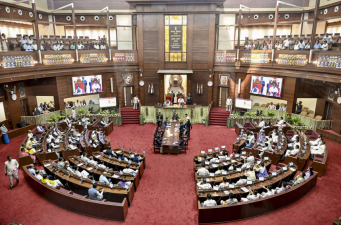
The Assam government introduced the Uniform Civil Code (UCC) Assam Bill, 2026, in the state Legislative Assembly to establish a unified legal framework for marriage, divorce, succession, and live-in relationships. Tabled by Parliamentary Affairs Minister Atul Bora on behalf of Chief Minister Himanta Biswa Sarma, the Bill seeks to replace existing religion-based personal laws with common civil statutes to provide gender justice and absolute equality. Assam is the third state under Bharatiya Janata Party governance to introduce a UCC framework, following Uttarakhand and Gujarat.
Key Architectural Features of the Bill
The proposed legislation acts as a comprehensive civil code applicable across communities while balancing the state’s unique demographic composition.
Complete Exclusion of Scheduled Tribes
The framework excludes Scheduled Tribes (STs) from its ambit, whether they reside in the hills or the plains of Assam. This statutory protection insulates the customary laws and traditional practices of the state’s indigenous tribal communities, who make up roughly 12.45% of the local population.
Protection of Diverse Cultural Rituals
The draft law retains absolute freedom for individuals to solemnize marriages using existing religious rites, customs, and ceremonies. The text explicitly protects traditional procedures, including:
- Vedic Bibah and Saptapadi (Hindu)
- Nikah (Muslim)
- Anand Karaj (Sikh)
- Ahom Chaklong (Ahom community)
- Holy Union (Christian)
- Ashirvad
Marriage and Divorce Regulations
The draft bill sets uniform standards for contracting and dissolving marriages to eliminate social discrepancies.
Standardized Minimum Age and Monogamy
- Legal Age: The legal marriageable age is standardized at 21 years for grooms and 18 years for brides across all religious groups.
- Prohibition of Polygamy: The bill enforces strict monogamy. Neither party must have a living spouse at the time of the wedding. Any previous marriage must be legally dissolved or annulled before a new union can take place.
- Consent and Capacity: Both partners must be capable of giving valid legal consent. Marriages cannot be solemnized if either party suffers from mental disorders that render them unfit for marriage or subject to recurrent attacks of insanity.
Compulsory Registration Protocol
All marriages and divorces must be officially registered with the state machinery. Couples must submit a formal marriage memorandum to the localized Sub-Registrar within 60 days of the ceremony.
Codification of Divorce and Custody
The Bill removes unilateral forms of divorce and establishes common grounds for dissolution. Legally recognized grounds include mutual consent, cruelty, desertion for more than two years, conversion to another faith, incurable mental disorders, venereal diseases, or if a partner remains untraceable for over seven years. For child custody post-divorce, the code stipulates that early childhood custody of children under five years of age will ordinarily remain with the mother.
Legal Standardization of Live-in Relationships
The Assam UCC Bill introduces structural accountability for live-in relationships to shield partners and offspring from legal vulnerability.
Mandatory Timelines and Restrictions
Partners entering a live-in relationship must register their union with the designated authority within 30 days of cohabitation. The state will refuse registration under the following specific conditions:
- If the relationship falls within the defined degrees of prohibited relationships, unless permitted by validated custom.
- If either partner is already legally married or bound by another registered live-in relationship.
- If at least one of the partners is a minor.
- If consent was obtained via force, coercion, fraud, or misrepresentation.
Legal Rights for Partners and Children
To ensure social security, any child born out of a registered or unregistered live-in relationship receives full legal legitimacy under the law. Furthermore, if a woman is deserted by her live-in partner, she holds explicit legal standing to approach a competent jurisdictional court to claim financial maintenance.
Succession and Inheritance Framework
The bill restructures the statutory architecture of property devolution by introducing gender-equal inheritance rules for intestate succession (when a person dies without leaving a valid will).
Class-1 Heirs Equalization
The legislation creates a uniform order of preference among Class-1 legal heirs. The property of the deceased is shared equally among:
- Surviving spouse
- Children (equal rights for sons and daughters)
- Parents of the deceased
Testamentary Succession
For testamentary execution, the draft confirms that any adult citizen of sound mind possesses the absolute right to execute a written, witnessed Will to dispose of their self-acquired property.
Penal Provisions and Legislative Repeals
The legislation lays down dynamic penal metrics under the Bharatiya Nyaya Sanhita (BNS), 2023, and specific fines to deter non-compliance and fraudulent practices.
| Offense | Prescribed Punishment / Fine |
| Polygamy or Bigamy | Imprisonment up to 7 years under Section 82 of BNS, 2023 |
| Fraudulent/Deceptive Marriage (by force or concealment) | Imprisonment up to 7 years along with a fine |
| Child Marriage or Marriage without Consent | Imprisonment up to 2 years, or a fine, or both |
| Illegal Dissolution of Marriage (violating divorce procedures) | Imprisonment up to 3 years along with a fine |
| Marriage within Prohibited Relationships (without valid custom) | Imprisonment up to 6 months or a fine up to ₹50,000 |
| Failure to Register Live-in Relationship (within 30 days) | Imprisonment up to 3 months or a fine up to ₹10,000 |
| Concealing Facts/Forged Docs in Live-in Registration | Imprisonment up to 3 months, a fine up to ₹25,000, or both |
Repeal of Existing Acts
To streamline the civil administrative apparatus, the 2026 Bill repeals the Assam Compulsory Registration of Muslim Marriages and Divorces Act, 2024. However, it incorporates a standard savings clause to protect the validity of polygamous marriages that were legally solemnized prior to the enforcement of this new Uniform Civil Code.
IASPOINT Booster Facts for UPSC
- Constitutional Basis: The Uniform Civil Code finds explicit mention under Article 44 of the Directive Principles of State Policy (DPSP) in Part IV of the Indian Constitution, which states that the “State shall endeavour to secure for the citizens a uniform civil code throughout the territory of India.”
- Enforceability of DPSPs: As per Article 37, DPSPs are non-justiciable and cannot be enforced by any court, but they are fundamental in the governance of the country, and it is the duty of the State to apply these principles in making laws.
- Legislative Competence: Personal laws relating to marriage, divorce, inheritance, and succession fall under Entry 5 of the Concurrent List (List III) of the Seventh Schedule of the Constitution. This grants joint legislative competence to both the Parliament and State Legislatures.
- Goa’s Unique Model: Goa is the only state in India that has historical uniformity in civil laws via the Goa Civil Code (Portuguese Civil Code of 1867), which was retained after its liberation in 1961. However, Uttarakhand was the first independent state to draft and pass a fresh post-independence UCC Act.
- Judicial Signposts on UCC: The Supreme Court of India has regularly urged the government to implement Article 44 in milestone cases, including the Mohammad Ahmed Khan v. Shah Bano Begum (1985) case, the Sarla Mudgal v. Union of India (1995) case, and the John Vallamattom v. Union of India (2003) judgment.