
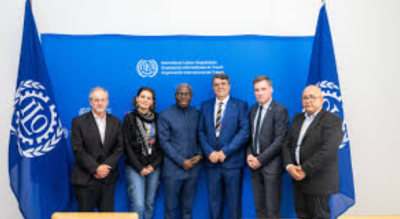
The 114th Session of the International Labour Conference (ILC) took place in Geneva, Switzerland, in June 2026. India’s Union Minister of State for Labour and Employment, Shobha Karandlaje, led the Indian delegation, highlighting the nation’s progress in inclusive growth, gender equality, and institutionalized social dialogue. On the sidelines of the plenary sessions, India held structured bilateral meetings with delegations from Nepal, Angola, and Mauritius. These dialogues focused on formalizing labour mobility agreements, upgrading skill development frameworks, and exporting India’s specialized digital governance modules for employment services to Global South partners.
Strategic Bilateral Engagements
Enhancing Ties with Nepal
India and Nepal reviewed existing bilateral cross-border employment setups. The discussions emphasized regularizing labour mobility, simplifying remittance corridors, and mapping vocational skills to prevent the exploitation of migrant workers. This engagement aligns with India’s “Neighbourhood First” policy, aiming to stabilize and uplift the shared regional workforce.
Strategic Partnerships with Angola and Mauritius
The bilateral discussions with Angola and Mauritius focused on maritime skills, blue economy employment, and digital capacity building. India extended institutional support to Angola to upgrade its vocational training centres. With Mauritius, the dialogue centered on expanding the existing Comprehensive Economic Cooperation and Partnership Agreement (CECPA) framework to encompass seamless professionals mobility and joint skill certification programs.
Sharing Digital Public Infrastructure (DPI)
Tech-Driven Labour Welfare Models
India presented its Digital Public Infrastructure (DPI) ecosystem as a benchmark for modern labour administration. The delegation demonstrated how digital platforms can successfully transition informal workers into formal financial systems, manage social security distribution, and match job seekers with employers at a national scale.
E-Shram and National Career Service (NCS)
India offered technical assistance and source code architectures of its core labour portals to partner countries:
- e-Shram Portal: Operates as a comprehensive national database of unorganized workers, seeded with Aadhaar, to streamline social security benefits delivery.
- National Career Service (NCS): Serves as a digital marketplace bridging job seekers, employers, training providers, and placement agencies.
Skill Development and Global Mobility Matrix
Skill Mapping and Standardization
To foster international labour migration, India advocated for cross-border skill harmonization. This involves aligning national qualification frameworks with international standards, ensuring that certifications issued in India are recognized by destination countries without requiring extensive re-qualification.
International Frameworks for Labour Cooperation
The bilateral agreements utilize specific legal and operational instruments to ensure safe, orderly, and regular migration pathways:
| Mechanism / Instrument | Target Operational Area | Primary Policy Objective |
| Migration and Mobility Partnership Agreement (MMPA) | Institutionalized Labour Channels | Curbs illegal migration while fast-tracking visas for skilled professionals. |
| Social Security Agreement (SSA) | Portability of Pension Benefits | Protects detached workers from double social security taxation. |
| National Qualifications Framework Alignment | Skill Equivalency Mapping | Standardizes vocational benchmarks across international jurisdictions. |
IASPOINT Booster Facts for UPSC
- About the International Labour Conference (ILC): Known as the “International Parliament of Labour,” the ILC meets annually in Geneva to set global labour standards and supervise the application of international conventions.
- ILO Tripartite Structure: The International Labour Organization (ILO) is unique among UN agencies as it brings together government, employer, and worker representatives on an equal footing to shape policies.
- ILO Core Conventions Ratified by India: India has ratified six out of the eight core/fundamental ILO Conventions. It has not ratified Convention 87 (Freedom of Association) and Convention 98 (Right to Organize and Collective Bargaining).
- Global Skills Gap Study: The ILO and G20 frameworks emphasize “Global Skill Harmonization,” a concept heavily supported by India during its G20 Presidency to address demographic skill deficits in aging economies.