
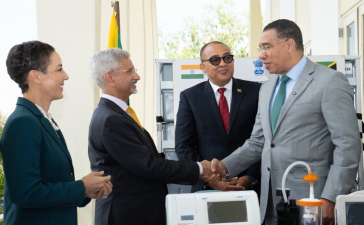
On 4 May 2026, India gifted 10 BHISHM Cube mobile hospital units to Jamaica during a high-level bilateral meeting in Kingston between Indian External Affairs Minister S. Jaishankar and Jamaican Prime Minister Andrew Holness. This diplomatic transfer took place under the aegis of India’s Aarogya Maitri project, an initiative aimed at providing humanitarian medical assistance to developing nations during crises. The engagement highlighted growing bilateral cooperation, supplemented by India gifting a new scoreboard to Jamaica’s Sabina Park cricket stadium as part of a wider Caribbean tour covering Suriname and Trinidad and Tobago.
Understanding Project BHISHM and Aarogya Maitri
Core Framework and Genesis
The Bharat Health Initiative for Sahyog Hita and Maitri (BHISHM) is an indigenous emergency medical project designed to bridge the gap between primary and definitive care during the critical “golden hour” of disasters. It operates under the umbrella of Project Aarogya Maitri (Health Friendship), which Prime Minister Narendra Modi officially announced during the virtual Voice of Global South Summit in January 2023. The institutional framework promotes South-South cooperation by supplying high-tech medical assets to developing countries experiencing natural disasters or humanitarian emergencies.
Structural Architecture of the BHISHM Cube
The BHISHM Cube is the world’s first modular, portable field hospital system. Its construction features a multi-tiered hierarchy to maximize field efficiency:
- Mini-Cubes: The fundamental block of the system. There are 72 mini-cubes in a full unit, with each module weighing under 20 kilograms to allow manual transport, bicycle carriage, or drone delivery.
- Mother Cubes: A set of 36 mini-cubes are combined inside a metallic cage framework to create one Mother Cube.
- Full BHISHM Unit: Two Mother Cubes are paired together to constitute a complete deployable field hospital unit.
Technical Specifications and Capabilities
Operational Parameters
The system is engineered to function entirely off-grid in extreme terrain conditions, ranging from high-altitude zones to coastal flood areas.
| Parameter | Specifications and Details |
| Patient Capacity | Can handle and treat up to 200 emergency casualties simultaneously. |
| Surgical Output | Outfitted with equipment to perform 10 to 15 basic surgeries per day. |
| Setup Time | Entire unit can be fully deployed and operational within 12 minutes. |
| Operating Room Readiness | Dedicated surgical field can become functional in less than 10 minutes. |
| Self-Sufficiency Window | Carries survival provisions, water, and food for a 5-person medical crew for 48 hours. |
| Durability | Waterproof, corrosion-proof, and designed to withstand high-impact physical stress. |
Technological Integration
The field hospital utilizes advanced digital systems to ensure resource optimization and ease of use in diverse geopolitical environments:
- RFID Tracking: Every medical supply item and piece of equipment features a Radio-Frequency Identification (RFID) tag for real-time inventory management and tracking expiry dates.
- Multilingual Software: The administrative tablet features a user interface available in 180 languages, providing instructional setup videos and supply data to international medical staff.
- AI and Analytics: Integrates artificial intelligence to predict resupply timelines, monitor field medical data, and coordinate emergency responses with regional health networks.
- Integrated Infrastructure: Houses portable ventilators, mini-ICUs, multi-parameter monitors, blood testing machinery, basic X-ray setups, self-generating limited oxygen systems, and solar-power-backed generator modules.
Strategic Relevance and Past Deployments
International and Domestic Utility
The project functions as a cornerstone of India’s soft power and health diplomacy, moving beyond the framework of the earlier Vaccine Maitri program. Domestically, the system provides emergency medical backups at massive public congregations, such as its deployment during the Pran Pratishtha ceremony in Ayodhya in January 2024. Globally, India has provided these units to multiple partner countries facing crises, including presenting four BHISHM Cubes to Ukraine in August 2024 for immediate trauma care.
Transport and Delivery Mechanisms
The physical design enables multi-modal logistics. The Indian Armed Forces have validated its structural resilience via successful high-altitude para-drop operations from transport aircraft at altitudes reaching 15,000 feet, confirming that the medical kits can be securely airdrobed directly into cut-off conflict regions or disaster epicenters.
IASPOINT Booster Facts for UPSC
- Nodal Executing Agencies: Conceived by the Ministry of Defence, the procurement and logistics management for the Aarogya Maitri Cubes are spearheaded by HLL Lifecare Limited (a public sector undertaking under the Ministry of Health and Family Welfare).
- Global South Center of Excellence: Hand-in-hand with Project Aarogya Maitri, India established a dedicated research hub to study and develop scalable development solutions and healthcare practices tailored specifically for developing economies.
- Philosophical Underpinning: The project translates India’s civilizational philosophy of ‘Vasudhaiva Kutumbakam’ (The World is One Family) into institutional health diplomacy.
- Logistics Versatility: The full cube unit can fit inside standard military transport helicopters (like the Mi-17 series) and specialized multi-role transport aircraft (like the C-130J Super Hercules) for rapid cross-border operations.