
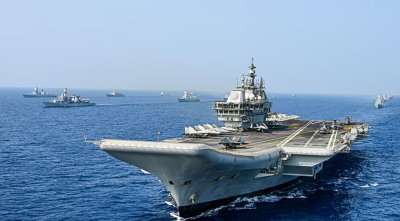
The Pakistan Navy, assisted by the Pakistan Maritime Security Agency, provided emergency humanitarian aid to MV Gautam, an Indian offshore tug and supply vessel stranded in the Arabian Sea on 4-5 May 2026. The vessel experienced a total power failure due to an irreparable generator malfunction while traveling from Oman to India, leaving it adrift with six Indian nationals and one Indonesian national onboard. Following an SOS alert, the Maritime Rescue and Coordination Centre in Mumbai contacted Pakistani authorities because the vessel was within the Pakistan Search and Rescue Region. The patrol ship PMSS Kashmir was deployed to provide food, medical aid, and technical support. The Indian Coast Guard ship ICGS Rajratan simultaneously converged at the site to coordinate further towing operations.
Framework of Maritime Search and Rescue
International maritime safety relies on a structured network of treaties and dedicated geographical search zones to protect life at sea, independent of bilateral political relationships.
International Convention on Maritime Search and Rescue (SAR)
The legal architecture for these operations is governed by the SAR Convention of 1979, anchored by the International Maritime Organization (IMO). The global ocean is divided into distinct Search and Rescue Regions (SRRs). Each region is assigned to a coastal state responsible for maintaining a Maritime Rescue Coordination Centre (MRCC). Under this framework, neighboring MRCCs must maintain real-time communication channels to coordinate assets when a distressed vessel drifts across adjoining boundaries.
United Nations Convention on the Law of the Sea (UNCLOS)
Article 98 of UNCLOS establishes a statutory obligation on every master of a ship to render assistance to any person found at sea in danger of being lost. Coastal states must promote the establishment, operation, and maintenance of an adequate and effective search and rescue service.
Strategic Geography of the Arabian Sea
The Arabian Sea serves as a critical maritime highway connecting the energy-rich Persian Gulf and the Gulf of Oman with South Asia and East Africa.
| Oceanographic Parameter | Hydrographic and Strategic Details |
| Geographical Boundaries | Bounded by the Arabian Peninsula to the west, Iran and Pakistan to the north, India to the east, and the Horn of Africa to the southwest. |
| Primary Chokepoints | Standard entry via the Strait of Hormuz (connecting to the Persian Gulf) and the Bab-el-Mandeb (connecting to the Red Sea). |
| Economic Density | Carries a major portion of India’s crude oil imports and container trade moving through Western Indian ports. |
| Monsoonal Impact | Subject to reversing seasonal winds, creating high-swell states that elevate mechanical risks for small offshore tugs and supply vessels. |
Operational Protocols for Distressed Vessels
When an offshore asset suffers a critical propulsion or power failure, standardized emergency steps are triggered to stabilize the platform.
Damage Assessment and Bordering Actions
- Power Stagnation: A total power failure disrupts primary communication, leaving the vessel dependent on battery-operated, short-range Very High Frequency (VHF) radios.
- Inter-Agency Boarding: Technical personnel from the responding naval asset board the distressed vessel to evaluate structural integrity and determine if field repairs are feasible.
- Towing Arrangements: If the main generator is deemed unfixable, the responding units secure the vessel’s drift parameters until commercial or national towing vessels arrive to eliminate navigational threats to commercial shipping lanes.
IASPOINT Booster Facts for UPSC
- Indian Coast Guard (ICG) Statutory Role: Established under the Coast Guard Act, 1978, the ICG operates as an independent Armed Force of the Union under the Ministry of Defence. It functions as the national coordinating authority for Maritime Search and Rescue in the Indian SRR.
- Indian National SAR Board (NMSARB): Formed to optimize SAR operations, it integrates inputs from the Indian Navy, Indian Air Force, Indian Coast Guard, and ISRO, utilizing the space-based INSAT SAR system.
- Bilateral Precedents: Humanitarian operations in the Arabian Sea frequently transcend geopolitical lines. In 2024, the Indian Navy rescued 23 Pakistani sailors from an Iranian fishing vessel, Al-Kambar 786, which had been hijacked by pirates off the coast of Yemen.
- PMSS Kashmir Profile: PMSS Kashmir is a 94-meter, Chinese-built, multi-purpose patrol vessel operated by the Pakistan Maritime Security Agency, designed for maritime law enforcement, pollution control, and search and rescue operations.
- Offshore Tug Characteristics: Unlike standard merchant ships, offshore tugs are high-power, deep-sea vessels optimized for towing oil rigs, salvage operations, and anchor-handling operations in heavy sea states.