
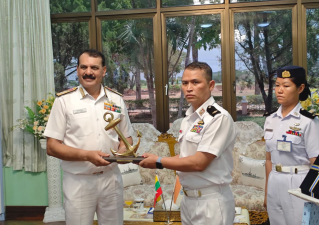
Indian Navy Chief Admiral Dinesh K Tripathi visited Myanmar from 2 to 5 May 2026 to strengthen bilateral naval ties and maritime cooperation. He held discussions with Myanmar’s naval and defence leadership, including Navy Commander-in-Chief Admiral Htein Win and Defence Minister General Htun Aung, focusing on security in the Bay of Bengal and the Indian Ocean Region. The high-level visit emphasized capacity building, training exchanges, hydrography, and operational interoperability between the two navies. This engagement reinforces India’s Act East policy and Neighbourhood First vision, given that both nations share a 1,643-kilometer land border and a crucial maritime boundary in the strategic Bay of Bengal.
Strategic Dimensions of Maritime Cooperation
The maritime relationship between India and Myanmar serves as a critical pillar for regional stability and sea lane security.
Geopolitical Importance of the Bay of Bengal
- Sea Lines of Communication (SLOCs): The Bay of Bengal connects shipping routes from East Africa and West Asia to South Asia and South-East Asia. Maintaining open, secure lanes is vital for global and regional trade.
- Countering Regional Hegemony: Enhanced bilateral naval coordination helps balance external strategic footprints and ensures a rules-based order in the Indian Ocean Region.
- Joint Surveillance: Cooperative patrolling helps check unconventional security threats like piracy, human trafficking, and illegal, unreported, and unregulated (IUU) fishing.
Operational Highlights of the 2026 Naval Visit
- Infrastructure and Asset Tour: The Indian Navy Chief toured Myanmar Navy’s indigenously built frigate UMS Kyan Sit Thar and visited the Central Naval Command Headquarters to assess operational capabilities.
- Capacity Building Transfers: India handed over a small arms simulator and a rigid inflatable boat (RIB) to Myanmar to improve its coastal security and riverine operations.
- Core Areas of Engagement: Talks centered on regularizing training exchanges, expanding hydrographic survey partnerships, and enhancing technical collaboration.
Key Frameworks and Joint Initiatives
India and Myanmar participate in multiple institutional mechanisms to secure their shared maritime domain.
Institutional Security Mechanisms
| Mechanism / Initiative | Description and Objective |
| IMCOR (India-Myanmar Coordinated Patrol) | Bi-annual maritime patrolling along the International Maritime Boundary Line (IMBL) to combat maritime crimes. |
| MILAN Exercise | Myanmar regularly participates in this biennial multilateral naval exercise hosted by the Indian Navy. |
| Kaladan Multi-Modal Transit Transport Project | Connects Kolkata port with Sittwe port in Myanmar, opening an alternative route to India’s Northeast. |
| Security and Growth for All in the Region (SAGAR) | India’s overarching maritime vision that guides capacity-building and disaster relief support to Myanmar. |
Defence Indigenisation and Infrastructure Support
India supports Myanmar’s naval modernization through the supply of defence hardware. India previously transferred UMS Minye Theinkhathu, a Sindhughosh-class diesel-electric submarine, marking Myanmar’s entry into underwater naval operations. Coastal surveillance radar chains and sonar systems supplied by Indian defence public sector units help Myanmar monitor its Exclusive Economic Zone (EEZ).
IASPOINT Booster Facts for UPSC
- Land and Maritime Confluence: Myanmar is the only South-East Asian country that shares both a land border (1,643 km) and a maritime boundary with India in the Bay of Bengal. Four northeastern states share borders with Myanmar: Arunachal Pradesh, Nagaland, Manipur, and Mizoram.
- Sittwe Port: Located at the mouth of the Kaladan River in Myanmar’s Rakhine State, this strategic port was developed by India under the Kaladan Multi-Modal Transit Transport Project to bypass the Siliguri Corridor.
- UMS Kyan Sit Thar: An indigenously manufactured Kyan Sittha-class frigate of the Myanmar Navy that features stealth technologies and incorporates electronic equipment supplied by Indian defence entities.
- Hydrography Cooperation: Under bilateral agreements, the Indian Navy’s National Hydrographic Office assists Myanmar in mapping its coastal waters and preparing navigational charts, enhancing safe commercial shipping.
- BIMSTEC Alignment: Both nations are members of the Bay of Bengal Initiative for Multi-Sectoral Technical and Economic Cooperation (BIMSTEC), which includes a dedicated counter-terrorism and transnational crime sub-sector.