
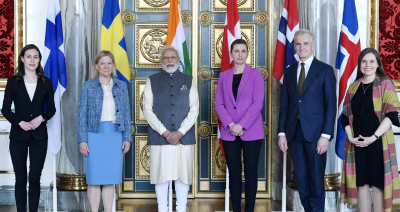
The Third India-Nordic Summit held in Oslo on May 19, 2026, marks a pivotal advancement in inter-regional cooperation, officially elevating relations to a Green Technology and Innovation Strategic Partnership. Building on the foundational framework established at the inaugural summit in 2018, this high-level multilateral alliance binds India with the five Nordic nations—Denmark, Finland, Iceland, Norway, and Sweden. The expanded partnership blends advanced Nordic technological niche assets in clean energy, circular economy systems, and polar research with India’s massive industrial scale, manufacturing talent pools, and digital infrastructure capabilities to build resilient supply chains and accelerate the low-carbon transition.
Architectural Pillars of the Joint Framework
Cleantech and Energy Transition
The primary driver of the partnership focuses on institutional technology transfers and synchronized capital investments in the renewable energy matrix.
- Green Hydrogen and Ammonia: Joint development of low-cost electrolyzer manufacturing facilities to scale green hydrogen production for heavy industries.
- Geothermal Energy Deployment: Direct transfer of advanced sub-surface exploration and deep-well drilling technology from Iceland to tap India’s geothermal fields in Ladakh and Himachal Pradesh.
- Smart Power Grids: Integration of Scandinavian automated grid-balancing systems into India’s national electricity grid to manage the intermittent nature of large-scale solar and wind inputs.
The Blue Economy and Sustainable Shipping
Bilateral agreements focus on greening maritime infrastructure and ensuring long-term environmental safety across international shipping lanes.
- Green Shipping Corridors: Development of zero-emission coastal vessels and hydrogen-fueled commercial shipping vessels in partnership with Norwegian maritime clusters.
- Smart Port Infrastructure: Implementing automated waste-recycling systems and shore-to-ship power supply networks at major Indian ports to lower dockside carbon emissions.
- Sustainable Fisheries Management: Collaborative research on marine spatial planning, deep-sea aquaculture monitoring, and satellite tracking of illegal, unreported, and unregulated fishing.
Frontier Digitalization and Next-Generation Tech
The alliance expands beyond sustainability into core high-technology sectors to co-author global digital governance norms.
- 6G Telecom Testbeds: Collaboration between the Bharat 6G Alliance and Finnish telecommunications hubs to build secure next-generation communication networks and hardware.
- Quantum Computing and AI: Joint laboratory testing for high-performance quantum algorithms applied to weather modeling, pharmaceutical discovery, and democratized AI governance frameworks.
- Cybersecurity Networks: Joint training programs and threat-intelligence sharing protocols with Denmark to secure critical industrial control systems and cloud storage infrastructure.
Geostrategic and Climate Dimensions
Securing Monsoons via Polar Research
Integrating India’s Arctic Policy (“India and the Arctic: building a partnership for sustainable development”) within Nordic polar research infrastructure remains a key geostrategic objective. Enhanced engagement within Arctic Council working groups allows the Ministry of Earth Sciences to study the direct teleconnections between Arctic ice melt and variations in tropical maritime monsoon patterns, directly helping safeguard agricultural cycles.
Sovereign Wealth Mobilization
The bilateral upgrades include a dedicated Sovereign Investment Corridor to streamline foreign direct investment. This framework channels patient capital from the Norwegian Government Pension Fund Global (GPFG) into long-term Indian infrastructure projects, meeting the strict Environmental, Social, and Governance (ESG) criteria required by institutional European investors.
Bilateral Trade Dynamics and EFTA-TEPA Alignment
The partnership directly capitalizes on the recently signed India-EFTA Trade and Economic Partnership Agreement (TEPA). This agreement helps clear regulatory bottlenecks, target a shared goal of USD 100 billion in investments, and double bilateral trade by 2030.
| Country | Key Economic and Technology Focal Points (2024-2026) |
| Denmark | Evaluation of India-Denmark Green Strategic Partnership (2020); offshore wind energy grids, urban water management systems. |
| Sweden | Operationalization of the Joint Action Plan (2026-2030); LeadIT (Leadership Group for Industry Transition) targeting steel and cement decarbonization. |
| Norway | Formal entry into India’s Indo-Pacific Oceans Initiative (IPOI); deep-sea technology, sovereign green bonds. |
| Finland | Presidency of the Nordic Council (2026); high-performance computing, specialized industrial machinery. |
| Iceland | Geothermal grid optimization, cold-chain logistics for marine food preservation. |
Structural Challenges in Implementation
Technology Localization Barriers
Nordic economies operate within high-income, capital-intensive markets, creating technologies that carry high upfront costs. Adapting these advanced solutions requires a reduction in production costs and extensive localization before they can be effectively deployed across price-sensitive Indian markets.
Regulatory and IPR Variations
Differing compliance mandates regarding Intellectual Property Rights (IPR) regimes frequently slow technology sharing in sensitive domains like quantum computing and green hydrogen. Furthermore, strict European ESG reporting compliance rules place heavy regulatory burdens on small and medium enterprises within the Indian manufacturing supply chain.
IASPOINT Booster Facts for UPSC
- Nordic Council: Established in 1952, it is the official body for formal inter-parliamentary cooperation among Nordic countries. Finland holds the presidency for 2026, and its secretariat is located in Copenhagen, Denmark.
- EFTA Nations: The European Free Trade Association comprises four nations: Iceland, Liechtenstein, Norway, and Switzerland. It operates independently of the European Union (EU).
- Himadri Station: India’s first permanent Arctic research station, established in 2008, located at Ny-Ålesund in the Svalbard archipelago, Norway.
- Arctic Council: A high-level intergovernmental forum addressing challenges faced by Arctic governments and indigenous peoples. India obtained Observer status in 2013, which was subsequently renewed.
- World Circular Economy Forum (WCEF): A global initiative highlighting solutions for a circular economy. India and the Nordic nations will jointly host the next iteration in Gujarat in September 2026.
- Indo-Pacific Oceans Initiative (IPOI): Launched by India at the East Asia Summit in 2019, it focuses on maritime security, marine ecology, and disaster risk reduction. Norway is the newest European nation to formally join the maritime ecology pillar.