
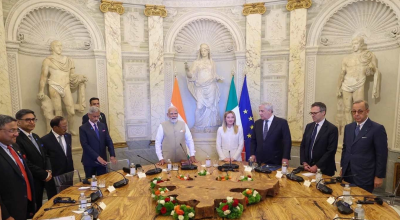
Prime Minister Narendra Modi and Italian Prime Minister Giorgia Meloni upgraded bilateral relations to a Special Strategic Partnership during a bilateral meeting in Rome on May 20, 2026. The leaders planted a Black Mulberry sapling, known as Krishna Toot in India, under the “Ek Ped Maa Ke Naam” initiative to represent environmental sustainability and deep-rooted cultural ties. They reviewed the implementation of the Joint Strategic Action Plan 2025–2029, charting out expanded bilateral cooperation across trade, defense industrial integration, critical minerals, and digital technology. The leaders set a specific target to scale total bilateral trade to €20 billion by the year 2029 while pushing for the early finalization of the India-EU Free Trade Agreement.
Core Pillars of the Joint Strategic Action Plan 2025–2029
The Joint Strategic Action Plan, initially adopted in November 2024 at the G20 Summit in Rio de Janeiro, acts as a time-bound operational framework. During the May 2026 meeting, both nations firmed up institutional mechanisms to supervise its progress.
Institutional Framework and Oversight
- Foreign Ministers Mechanism: A new structured framework led by the respective Foreign Ministers will regularly review the action plan and provide high-level policy guidance.
- Annual Leadership Summits: The prime ministers agreed to institutionalize annual meetings between heads of government, to be held either bilaterally or on the sidelines of multilateral fora.
- Senior Officials Consultations: Annual bilateral consultations will continue at the senior official level to ensure administrative synchronization across ministries.
Sectoral Allocations and Strategic Focus Area
The action plan divides the partnership into distinct operational pillars, mapping out responsibilities across economic, scientific, and infrastructure sectors.
| Strategic Pillar | Focus Sectors and Initiatives | Target / Mechanism |
| Economic Cooperation | Automotive, semiconductors, advanced manufacturing, textiles, pharmaceuticals | Target of €20 billion bilateral trade by 2029 |
| Connectivity & Infrastructure | Ports, land logistics, maritime transport | Institutional cooperation on the India-Middle East-Europe Economic Corridor (IMEC) |
| Science & Technology | Artificial Intelligence, telecommunications, digitalization of services, Industry 4.0 | Execution of the Executive Programme for Scientific and Technological Cooperation 2025–27 |
| Critical Resources | Joint extraction, refining, and e-waste recycling of critical minerals | Signed Memorandum of Understanding (MoU) on Critical Minerals |
Economic and Commercial Engagement
Trade Dynamics and Investment Expansion
The economic relationship is backed by the regular exchange of high-level Business Forums, with three forums held within the last year alone. To achieve the €20 billion target by 2029, both countries are focusing on supply chain diversification. Collaborative efforts will target mutual investments in clean technologies, medical engineering, tourism, and steel manufacturing.
Financial and Legal Agreements
- India-EU Free Trade Agreement: Both sides prioritized the speedy conclusion of the EU-India FTA negotiations to reduce tariff barriers.
- Financial Institutional Ties: A new channel of communication will open between stock exchanges, investment funds, venture capital entities, and national banks to facilitate small and medium enterprise (SME) partnerships.
- Agriculture Pact: The nations finalized an MoU for comprehensive cooperation in agricultural research and modern farming techniques.
Defense, Security, and Connectivity
Defense Industrial Roadmap
The elevation to a Special Strategic Partnership includes a defense industrial roadmap. This initiative focuses on moving past standard procurement to co-development and co-production of military hardware. Key operational priorities include maritime security collaboration, cyber resilience, counter-terrorism intelligence sharing, and technology transfer in secure military communications.
Global Connectivity Networks
Italy occupies a key maritime position in the Mediterranean, making it a natural European entry point for trade from the Indo-Pacific. Both nations reaffirmed their commitment to the India-Middle East-Europe Economic Corridor (IMEC) to build secure supply chains. They authorized the first IMEC Ministerial Meeting to take place in 2026 to accelerate infrastructure development. Additionally, an MoU on maritime transport and ports was signed to set up a dedicated maritime joint working group.
IASPOINT Booster Facts for UPSC
- Agricola Medal 2026: During the Rome visit, the Director-General of the Food and Agriculture Organisation (FAO) presented Prime Minister Narendra Modi with the FAO Agricola Medal, the highest award of the organization, at the FAO headquarters in Rome.
- Historical Treaty Milestone: Diplomatic relations between the Republic of India and the Italian Republic were formally established in 1947. The relationship was upgraded to a Strategic Partnership in March 2023, before being elevated to a Special Strategic Partnership in May 2026.
- Botanical Classification of the Sapling: The Black Mulberry (Morus nigra) planted during the summit belongs to the family Moraceae. It is highly valued for its medicinal properties, culinary uses, and role in sericulture (silk production).
- Indo-Pacific Oceans Initiative (IPOI): Italy officially joined India’s Indo-Pacific Oceans Initiative under the ‘Science, Technology and Innovation’ pillar, establishing a clear link between Mediterranean security and Indo-Pacific stability.
- Migration and Mobility Partnership: India and Italy have an operational Migration and Mobility Partnership Agreement (MMPA) to counter illegal migration while regularizing student and professional visas.
- G7 and G20 Synergy: Italy is a member of the G7 and hosted the G7 Summit in Apulia in June 2024, where India was invited as an outreach country, emphasizing the growing engagement between the two nations across multilateral groups.