
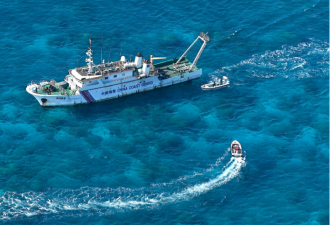
China has increased its maritime presence around Scarborough Shoal, a strategically sensitive fishing ground in the South China Sea. The latest deployment includes fishing boats, coast guard or naval vessels, and a floating barrier at the shoal’s entrance. The move has deepened tensions with the Philippines, which claims the area lies within its exclusive economic zone.
What Happened at Scarborough Shoal
Photographs from mid-April showed several Chinese fishing boats anchored near the shoal, along with a floating barrier stretching across the entrance. A probable Chinese patrol vessel was also seen nearby. Philippine officials said the barrier was installed to block access for Filipino fishermen. The barrier was later reportedly removed, but patrol activity continued.
Competing Claims Over the Shoal
Scarborough Shoal, known in the Philippines as Bajo de Masinloc and in China as Huangyan Island, is a rich fishing area. The Philippines says it falls within its exclusive economic zone. China claims sovereignty over it as part of its territory. Despite the dispute, effective control remains with China, which has maintained a presence there since 2012.
Philippine and US Response
The Philippines has continued to send coast guard and fisheries vessels to support local fishermen. It has also expanded security cooperation with the United States. Joint naval activity near the shoal has increased under President Ferdinand Marcos Jr., who has moved closer to Washington in response to China’s assertiveness in the South China Sea.
Legal and Strategic Significance
A 2016 Permanent Court of Arbitration ruling supported the Philippines on several South China Sea issues and said China’s blockade at the shoal violated international law. However, the court did not decide sovereignty over Scarborough Shoal. The dispute remains a major flashpoint in regional security and maritime law.
Last Modified: April 27, 2026