
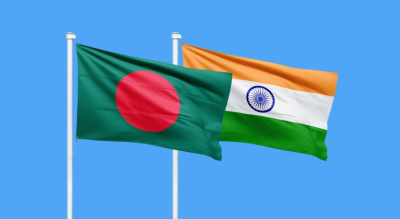
India has surpassed the United States to become Bangladesh’s second-largest trading partner, accounting for 8.47% of Bangladesh’s total external trade. According to the latest data from the Bangladesh Bureau of Statistics, bilateral trade volume reached Tk 123.28 billion, marginally ahead of the United States’ share of 8.46%. This development highlights Bangladesh’s growing economic focus on regional trade with neighboring nations. The shift comes at a critical juncture as New Delhi actively recalibrates its diplomatic and economic engagement with the newly formed government in Dhaka under Prime Minister Tarique Rahman, following a landslide election victory.
Context and Evolving Dynamics
Shifting Political Landscape
For more than a decade, India’s engagement with Bangladesh was heavily anchored around the Awami League government led by former Prime Minister Sheikh Hasina. This political alignment facilitated deep security cooperation, counter-insurgency tracking in India’s Northeast, and the execution of the 2015 Land Boundary Agreement. The transition to the new administration under Prime Minister Tarique Rahman of the Bangladesh Nationalist Party (BNP) requires a transition from a personality-driven relationship to institutionalized economic mechanisms. India’s External Affairs Ministry has initiated high-level bilateral talks to build constructive engagement and sustain regional stability under the updated political setup.
Trade Hierarchy and Regional Dependence
While India has assumed the second position, China remains Bangladesh’s largest trading partner, holding a dominant 21.21% share of total trade. The revised trade hierarchy positions major global and regional economies as follows:
| Rank | Trading Partner | Share of Total Trade (%) | Primary Commodities Exchanged |
| 1 | China | 21.21% | Capital machinery, industrial raw materials, electronics, textile inputs, chemicals. |
| 2 | India | 8.47% | Cotton, yarn, food grains (rice, wheat), onions, sugar, electricity, intermediate goods. |
| 3 | United States | 8.46% | Readymade garments (exports), liquefied petroleum gas (LPG), agricultural produces (imports). |
| 4 | Indonesia | ~4.00% | Edible oils, coal, raw industrial materials. |
| 5 | Brazil | ~3.50% | Agricultural commodities, minerals. |
Key Pillars of Economic Interdependence
Core Trade Components
Trade between India and Bangladesh is heavily driven by geographical proximity, which reduces freight costs and logistics timelines. India’s exports largely sustain Bangladesh’s massive manufacturing and textile sectors.
- Industrial Inputs: India is a major supplier of raw cotton, yarn, fabric, and intermediate goods required for Bangladesh’s Readymade Garments (RMG) industry.
- Essential Commodities: Bangladesh relies on India for daily food security items, including onions, rice, wheat, and sugar.
- Trade Balance: The bilateral trade basket is highly skewed in favor of India, with Indian exports hovering around $12 billion and imports from Bangladesh remaining near $2 billion annually.
Energy and Infrastructure Grid
The economic relationship is backed by cross-border energy infrastructure that is deeply integrated into Bangladesh’s national grid.
- Power Cross-Flow: India supplies more than 2.4 gigawatts (GW) of electricity daily to Bangladesh to meet its urban and industrial demand.
- Maitree Super Thermal Power Plant: A 1320 MW joint venture project that serves as a cornerstone of bilateral energy collaboration.
- Friendship Pipeline: The India-Bangladesh Friendship Pipeline facilitates the direct transport of refined high-speed diesel from Indian refineries to the northern districts of Bangladesh.
Connectivity and Transit Agreements
The geopolitical positioning of Bangladesh allows India crucial transit routes to its landlocked Northeastern states.
- Multimodal Transit: Regular rail, road, and inland waterway networks permit Indian cargo to move between the Indian mainland and the Northeast via Bangladeshi territory, dropping transit times by over 50%.
- Port Utilization: Agreements allow India access to Chattogram and Mongla ports for coastal shipping and transshipment.
Emerging Institutional Challenges
Graduation from LDC Status
Bangladesh is scheduled to graduate from the Least Developed Country (LDC) category. This structural shift will strip Dhaka of preferential tariff benefits and duty-free quota-free access under the South Asian Free Trade Area (SAFTA) agreement. To prevent a trade slump, both nations are exploring a Comprehensive Economic Partnership Agreement (CEPA).
Non-Tariff Barriers and Border Management
Frequent implementation of export caps or sudden bans on essential goods (like onions or wheat) by India to control domestic inflation creates price volatility in Bangladeshi retail markets. Conversely, Bangladeshi exporters face stringent non-tariff barriers, testing laboratories clearance issues, and bureaucratic delays at Indian land customs stations.
Transboundary Water Conflicts
The expiration of the historic 1996 Ganges Water Treaty serves as a key diplomatic pressure point. Delays in completing the Teesta River water-sharing agreement complicate trade talks, as domestic politics in Bangladesh tightly links economic concessions to equitable water distribution.
IASPOINT Booster Facts for UPSC
- Subcontinental Trade Volume: Bilateral trade between India and Bangladesh stood at approximately $13–14 billion in recent fiscal cycles, making Bangladesh India’s largest trading partner in the South Asian subcontinent.
- Legal Framework Foundation: The formal base of modern bilateral trade flows stems from the 1972 Treaty of Friendship, Cooperation and Peace and the landmark 1974 Land Boundary Agreement (ratified via the 100th Constitutional Amendment Act of India in 2015).
- SAFTA Rollout: Under SAFTA provisions, India extended duty-free access to Bangladesh for most tariff lines, excluding only alcohol and tobacco, which boosted Bangladeshi garment inflows into the Indian domestic market.
- Border Haats: To spur local economies and curb smuggling, India and Bangladesh operate localized border markets called ‘Border Haats’ along the frontiers of Tripura, Meghalaya, Mizoram, and Assam.
- CEPA Timeline: Negotiations for the Comprehensive Economic Partnership Agreement (CEPA) gained urgency following Bangladesh’s planned economic graduation to preserve long-term institutional trade concessions.