
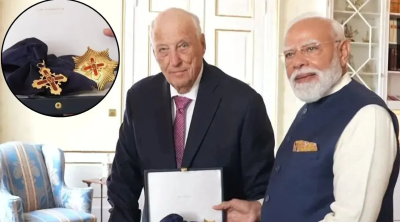
Prime Minister Narendra Modi was conferred with the Grand Cross of the Royal Norwegian Order of Merit by King Harald V in Oslo on May 18, 2026. This prestigious award marks the 32nd international honor received by Prime Minister Modi and occurred during the first visit by an Indian Prime Minister to Norway in 43 years. The accolade recognizes outstanding service to Norway and humanity, establishing a major milestone during his diplomatic tour of Nordic nations. Concurrently, India and Norway agreed to elevate their bilateral ties to a Green Strategic Partnership, targeting enhanced collaboration in renewable energy, climate action, and the blue economy.
Institutional Framework of the Order of Merit
The Royal Norwegian Order of Merit represents a core component of Norway’s state recognition system for foreign nationals and diplomats.
Historical Evolution and Governance
- Establishment: The order was founded by King Olav V on January 14, 1985, to reward foreign nationals and Norwegian citizens residing permanently abroad.
- Conferring Authority: The reigning Monarch of Norway serves as the Grand Master of the Order, acting on recommendations from the Ministry of Foreign Affairs.
- Insignia Design: The award features a gold or silver Cross of St. Olav with a red-enamelled background. The center contains the unique royal monogram of King Olav V.
Structural Hierarchy of the Order
The order is organized into three distinct classes, which are further divided into five separate ranks.
| Class | Rank Designation | Target Recipients and Operational Profile |
| First Class | Grand Cross (Storkors) | Bestowed upon foreign Heads of State, Heads of Government, and senior royal family members. |
| Second Class | Commander with Star | Awarded to senior diplomats, ambassadors, and high-ranking military commanders. |
| Second Class | Commander (Kommandør) | Conferred upon mid-level diplomatic envoys and international public figures. |
| Third Class | Knight First Class | Reserved for professional attachés and technical specialists. |
| Third Class | Knight (Ridder) | Awarded to junior foreign service personnel and global cultural contributors. |
The India-Norway Green Strategic Partnership
The diplomatic meetings in Oslo resulted in a comprehensive transition of bilateral relations into a structured economic framework.
Clean Energy and Technological Transition
- Green Hydrogen Hubs: Deployment of joint pilot projects to commercialize hydrogen production and develop storage infrastructure.
- Wind Energy Ecosystems: Sharing specialized technical expertise from Norway’s offshore wind sector to accelerate India’s coastal energy grids.
- Decarbonization Drills: Setting up joint research laboratories to explore industrial carbon capture, utilization, and storage (CCUS) solutions.
Blue Economy and Maritime Infrastructure
The maritime strategy focuses on establishing sustainable shipping lanes and managing ocean resources responsibly.
- Green Shipping Initiatives: Developing zero-emission battery-powered and ammonia-fueled cargo vessels for coastal trade.
- Marine Spatial Planning: Implementing standardized data frameworks to manage coastal resources along India’s coastline.
- Deep-Sea Mining Regulations: Collaborating on environmental impact assessment studies within the frameworks of the International Seabed Authority (ISA).
India-EFTA Trade and Economic Partnership Agreement (TEPA)
The leaders evaluated the implementation roadmap of the landmark India-EFTA TEPA trade pact.
- Investment Benchmarks: Creating specialized mechanisms to facilitate the targeted $100 billion investment from EFTA nations into India over the next 15 years.
- Tariff Streamlining: Formulating standard operational rules to lower customs duties on industrial machinery, precision instruments, and specialized chemicals.
- Employment Integration: Establishing joint educational modules to link Indian technical experts with Nordic innovation clusters.
IASPOINT Booster Facts for UPSC
- The Nordic Council: A geo-political inter-parliamentary co-operation forum consisting of five countries (Denmark, Finland, Iceland, Norway, and Sweden) along with three autonomous territories.
- The Svalbard Treaty (1920): An international treaty recognizing the sovereignty of Norway over the Arctic archipelago of Svalbard. India signed the treaty in 1920 and operates its permanent Arctic research station, ‘Himadri’, at Ny-Ålesund.
- India’s Polar Research Footprint: India’s scientific presence in the polar regions includes the ‘IndARC’ underwater mooring observatory in the Kongsfjorden fjord, Svalbard, which monitors Arctic climate variations and glacier melt rates.
- The India-Norway Ocean Dialogue: Established through a Memorandum of Understanding in 2019 to promote cooperation on ocean management, marine plastic pollution mitigation, and sustainable aquaculture.
- The European Free Trade Association (EFTA): An intergovernmental organization set up for the promotion of free trade. It operates parallel to the European Union and comprises Iceland, Liechtenstein, Norway, and Switzerland.