
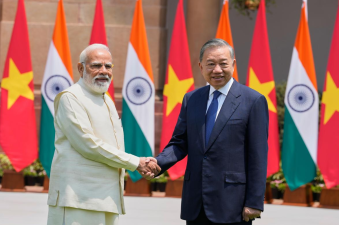
Vietnam President To Lam made a three-day state visit to India from May 5 to May 7, 2026, marking his first official bilateral foreign visit since being elected. He received a ceremonial welcome at the Rashtrapati Bhavan in New Delhi on May 6, where he engaged in high-level discussions with President Droupadi Murmu and Prime Minister Narendra Modi. This high-profile visit directly marks the tenth anniversary of the India-Vietnam Comprehensive Strategic Partnership established in 2016. The engagement resulted in the signing of 13 bilateral agreements and the elevation of their relationship to an Enhanced Comprehensive Strategic Partnership, focusing heavily on trade expansion, defense cooperation, digital payment connectivity, and supply chain security.
Strategic and Political Convergence
The relationship between New Delhi and Hanoi has transitioned from historical civilizational ties into a deep strategic alignment based on mutual security interests in the Indo-Pacific region.
Geopolitical Commitments
- Indo-Pacific Alignment: Both nations share a common vision for a free, open, and rules-based Indo-Pacific region, ensuring unhindered commerce and respect for international law.
- Maritime Safety: The leaders emphasized the absolute necessity of maintaining peace, stability, security, and freedom of navigation and overflight in the South China Sea.
- Peaceful Dispute Resolution: Both countries called for the resolution of maritime disputes through peaceful means, without resorting to the threat or use of force, adhering strictly to the United Nations Convention on the Law of the Sea (UNCLOS 1982).
- Counter-Terrorism Cooperation: Vietnam extended full diplomatic support to India in combating transnational terror, explicitly condemning the past Pahalgam security attacks, while both sides committed to joint operations against money laundering and cyber financial scams.
Diplomatic Upgrades
To institutionalize these growing strategic ties, India and Vietnam agreed to establish a new “2+2 Dialogue” mechanism. This forum will periodically bring together the Foreign Ministers and Defense Ministers of both nations to synchronize maritime security strategies and defense manufacturing partnerships.
Economic, Trade, and Sectoral Agreements
Economic diplomacy formed the core of the 2026 state visit, with both countries setting clear commercial benchmarks and finalizing structural agreements across various technical sectors.
Bilateral Trade Targets
The two nations formally set a target to achieve a bilateral trade volume of $25 billion by the year 2030. To facilitate this expansion, the leaders urged for the quick completion and early review of the ASEAN-India Trade in Goods Agreement (AITIGA) to remove existing tariff barriers.
Key Memorandum of Understandings (MoUs) Signed
During the bilateral summit, 13 distinct cooperation documents were exchanged between various ministries and organizations:
| Sector | Signatory Institutions | Core Objective of Agreement |
| Critical Minerals | IREL (India) Limited & Institute for Technology of Radioactive and Rare Elements (ITRRE), Vietnam | Joint exploration, mining, and supply chain processing of Rare Earth Elements. |
| Digital Payments | Reserve Bank of India (RBI) & State Bank of Vietnam (SBV); NPCI International & National Payment Corporation of Vietnam | Interlinking India’s Unified Payments Interface (UPI) with Vietnam’s fast payment systems for QR-code-based retail cross-border transactions. |
| Digital Technology | Ministry of Electronics and IT (India) & Ministry of Science and Technology (Vietnam) | Technical institutional cooperation in digital public infrastructure, artificial intelligence, and semiconductor design. |
| Pharmaceuticals | Central Drugs Standard Control Organisation (India) & Drug Administration of Vietnam | Streamlining regulatory compliance to increase market access for Indian generic medicines in Vietnam. |
| Public Auditing | Comptroller and Auditor General of India (CAG) & State Audit Office of Vietnam | Knowledge exchange and capacity building in public sector financial governance and auditing. |
| Culture & Heritage | Indian Knowledge Systems project & University of Social Sciences and Humanities, Ho Chi Minh City | Academic research cooperation under the Gyan Bharatam initiative and the Cultural Exchange Programme (2026-2030). |
Agricultural Market Access
The bilateral talks cleared persistent sanitary and phytosanitary hurdles, resulting in reciprocal market access for key agricultural products. India will begin exporting grapes and pomegranates to the Vietnamese market, while Vietnam will export fresh durians and pomelos to Indian consumers.
Cultural and Civilizational Footprint
The bilateral visit also integrated components of cultural diplomacy, highlighting the shared heritage that bridges the two countries.
Bodh Gaya Pilgrimage
President To Lam began his official state visit in Bodh Gaya, Bihar. He offered formal prayers at the Mahabodhi Temple, a prominent UNESCO World Heritage Site that marks the location where Gautama Buddha attained enlightenment. The Vietnamese delegation also visited the Vietnamese Buddhist Monastery in Bodh Gaya, emphasizing Buddhism as a living civilizational link between the two societies.
Educational Collaborations
To strengthen institutional tracks, an MoU was signed between the Ho Chi Minh National Academy of Politics and Nalanda University in Rajgir, Bihar. This will facilitate faculty exchanges, joint historical research, and student enrollment programs centered on ancient Asian linkages.
IASPOINT Booster Facts for UPSC
- Comprehensive Strategic Partnership: The highest tier in Vietnam’s diplomatic hierarchy. India is one of a select few nations—alongside China, Russia, Japan, the United States, South Korea, and Australia—with which Vietnam maintains this advanced level of bilateral relationship.
- Act East Policy: Vietnam is considered a key geographic and strategic pillar of India’s Act East Policy, serving as a critical gateway to the broader ASEAN economic block.
- Mekong-Ganga Cooperation (MGC): An initiative launched in 2000 in Vientiane, Laos, comprising India and five ASEAN nations (Cambodia, Laos, Myanmar, Thailand, and Vietnam) to boost cooperation in tourism, culture, education, and transportation.
- UNCLOS 1982: The United Nations Convention on the Law of the Sea is an international treaty that establishes a comprehensive legal framework for all marine and maritime activities, which both India and Vietnam recognize as the sole legal basis for determining maritime rights in the South China Sea.
- VINATOM: The Vietnam Atomic Energy Institute, whose subsidiary branch (ITRRE) signed the rare earths mineral pact with India’s public sector undertaking, IREL Limited.