
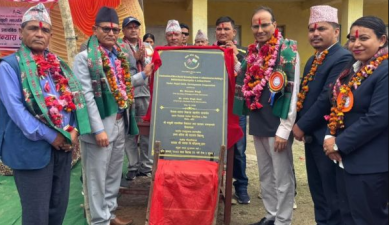
The Government of India has committed a grant assistance of Nepali Rupees 560.2 million (approximately Rs 35.1 crore) to build 14 earthquake-resilient schools in Nepal. These schools will come up across eight districts that were severely devastated by the 2015 Gorkha earthquake. This project is executed through a formal agreement signed by Nepal’s Central Level Project Implementation Unit-Education under the Ministry of Education and Sports and the authorized implementing agencies. The financial and technical support forms part of India’s ongoing developmental partnership and post-disaster recovery assistance dedicated to rebuilding the public infrastructure of the Himalayan nation.
Key Features of the Infrastructure Project
The structural and administrative blueprints of the initiative focus on disaster mitigation and long-term utility.
Design and Building Standards
- Seismic Resilience: Construction complies strictly with the National Building Code and earthquake-resistant standards set by the Government of Nepal.
- Comprehensive Layout: The infrastructure plan incorporates academic blocks, fully furnished classrooms, administrative rooms, and laboratories.
- Gender-Segregated Sanitation: Every school will feature separate, modern hygiene and sanitation units for boys and girls.
- Project Management: The Central Building Research Institute (CBRI), Roorkee, provides technical supervision and project management consultancy.
Target Districts in Nepal
The 14 schools are distributed across eight districts that suffered the maximum structural loss during the 2015 seismic disaster:
- Gorkha (the epicentre of the 2015 earthquake)
- Kathmandu
- Nuwakot
- Dhading
- Dolakha
- Kavrepalanchowk
- Ramechhap
- Sindhupalchok
Chronology of India’s Post-Disaster Assistance to Nepal
India deployed swift humanitarian assistance and disaster relief immediately after the 2015 disaster and transitionally shifted to long-term reconstruction.
| Phase / Project Component | Status and Impact |
| Operation Maitri (2015) | India’s immediate emergency relief operation; largest ever multi-agency disaster response executed by India abroad. |
| Housing Sector Reconstruction | Indian assistance facilitated the reconstruction of over 50,000 houses in Gorkha and Nuwakot districts. |
| Education Sector Phase-I (Completed 2024) | Completion and formal handover of 70 schools across eight districts in January 2024. |
| Higher Education Infrastructure | Reconstruction of the Tribhuvan University Central Library in Kathmandu with advanced educational amenities. |
| Health Sector Support | Institutional financing to restore over 130 health posts and community clinics across affected zones. |
| Cultural Heritage Restoration | Funding for conservation and restoration of historical structures, including several sites within the UNESCO World Heritage list. |
Strategic Dimensions of India-Nepal Relations
Development cooperation serves as a core pillar of the bilateral engagements between India and Nepal, driven by geographical proximity and historical ties.
Neighborhood First Policy
The educational project reflects India’s proactive commitment under its “Neighborhood First” foreign policy framework, prioritizing infrastructure growth and human resource development in adjacent countries.
Shift From Aid to Development Partnership
Bilateral support has evolved from pure budgetary aid to institutional capacity building, asset creation, and technology transfer in civil engineering and disaster resilience.
Discarding Traditional Vulnerability
By introducing seismic-proof engineering to grass-root educational institutions, the project minimizes the structural vulnerability of the Himalayan belt, which falls under severe seismic zones IV and V.
IASPOINT Booster Facts for UPSC
- The 2015 Gorkha Earthquake: A 7.8 magnitude earthquake struck Nepal on April 25, 2015, with its epicentre at Barpak in the Gorkha district. It caused the destruction of heritage sites like Kathmandu Durbar Square and triggered a massive avalanche on Mount Everest.
- Bilateral Institutional Mechanisms: Joint project monitoring committees regularize the implementation of Indian-funded Line of Credit (LoC) projects and grants in Nepal.
- High Impact Community Development Projects (HICDPs): Formerly known as Small Development Projects (SDPs), these allow the Indian Embassy in Kathmandu to directly fund local level projects in healthcare, education, and water supply up to a certain financial threshold.
- Geological Context: Nepal lies on the active boundaries of the Indian and Eurasian tectonic plates, making the entire region highly susceptible to frequent, high-intensity earthquakes.