
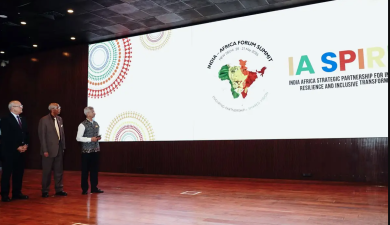
New Delhi will host the Fourth India-Africa Forum Summit (IAFS-IV) from 28 to 31 May 2026, themed “IA SPIRIT: India Africa Strategic Partnership for Innovation, Resilience, and Inclusive Transformation.” Organized in collaboration with the African Union Commission, this landmark event revives the multilateral engagement platform after a gap of over a decade since the last summit in 2015. The scheduled itinerary includes Senior Officials’ and Foreign Ministers’ meetings ahead of the main structural dialogue. The core agenda covers crucial multi-sectoral dimensions including trade, critical minerals, digital transformation, health, space technology, and climate action, focusing on aligning India’s vision of a developed nation by 2047 with Africa’s Agenda 2063.
Core Pillars of India-Africa Engagement
The institutional mechanism of the partnership rests on a comprehensive South-South cooperation framework, primarily divided into specific priority vectors.
Economic and Commercial Trade Realities
- Bilateral Trade Performance: Trade between the two regions grew by 14.39% year-on-year to reach USD 93.69 billion in the 2025-26 fiscal year.
- Trade Balance Components: Out of the total trade, Indian exports to African nations stood at USD 45.42 billion, while imports from Africa accounted for USD 48.27 billion. The continent accounts for nearly 10% of India’s overall energy imports.
- Investment Portfolio: Total cumulative Indian investments across various African nations have crossed USD 80 billion, positioning India among the top five external investors on the continent.
Development Assistance and Capacity Building
- Lines of Credit (LoC): New Delhi has extended more than 190 Lines of Credit worth over USD 10 billion to 41 African nations.
- Project Execution: Around 220 individual infrastructure and developmental projects worth USD 4.5 billion have been successfully executed under these credit frameworks.
- Human Resource Programs: Educational and skill upgrades are regularly institutionalized via the Indian Technical and Economic Cooperation (ITEC) program and the Indian Council for Cultural Relations (ICCR) scholarship schemes.
Diplomatic Footprint Expansion
- New Missions: India has expanded its institutional presence by establishing 17 new diplomatic missions in Africa since 2018.
- Total Diplomatic Presence: The addition of these embassies has scaled up the permanent Indian diplomatic representation from 29 to 46 sovereign countries across the continent.
- High-Level Exchanges: The past decade recorded nearly 50 high-level bilateral visits from India to Africa and approximately 100 incoming visits from African heads of state or government.
Key Sectoral Frameworks and Future Cooperation
Digital Public Infrastructure and Technology
- Digital Architecture Transfer: India has finalized digital cooperation framework agreements with seven African nations to implement indigenous open-source tech stacks like UPI and Aadhaar-based systems.
- Space Technology Integration: Cooperation fields are expanding into satellite mapping, remote sensing, and weather forecasting applications.
Defense and Maritime Security
- Peacekeeping Operations: India continues to be a primary contributor, deploying approximately 5,000 personnel in various United Nations Peacekeeping Missions deployed across diverse African conflict zones.
- Maritime Safety: Joint anti-piracy operations, hydrographic surveys, and coastal surveillance systems form the core of maritime security initiatives in the Western Indian Ocean region.
- Defense Material Exports: Focus is shifting toward exporting indigenous defensive equipment, training military personnel, and organizing joint defense exercises like AFINDEX.
Clean Energy and Climate Action
- International Solar Alliance (ISA): 39 African nations have joined the India-led ISA framework to execute local solar decentralization grids.
- Critical Minerals Value Chain: Engagement is prioritizing secure supply chains for transition minerals like lithium, cobalt, and nickel required for electric mobility and electronics manufacturing.
Comparative Matrix of Strategic Partnerships in Africa
| External Partner | Apex Institutional Summit Framework | Inception Year | Frequency of Summit | Most Recent Iteration |
| India | India-Africa Forum Summit (IAFS) | 2008 | Irregular (Targeted 3–5 years) | IAFS-IV (New Delhi, May 2026) |
| China | Forum on China-Africa Cooperation (FOCAC) | 2000 | Every 3 Years | 9th FOCAC (Beijing, Sept 2024) |
| European Union | European Union–African Union Summit | 2000 | Every 3–4 Years | 7th Summit (Luanda, Nov 2025) |
| Japan | Tokyo International Conference on African Development (TICAD) | 1993 | Every 3 Years | TICAD-IX (Yokohama, Aug 2025) |
IASPOINT Booster Facts for UPSC
- African Continental Free Trade Area (AfCFTA): A mega-trade bloc representing an estimated market size of USD 3.4 trillion. India is looking to integrate its trade standard mechanisms with AfCFTA.
- G20 Inclusion: During its presidency in 2023, India spearheaded the inclusion of the African Union (AU) as a permanent member of the G20, amplifying Global South representation.
- Agenda 2063: The African Union’s structural blueprint consisting of 7 aspirational pillars aimed at converting Africa into a global powerhouse of the future.
- Tri-Tiered Governance Proposal: Strategic think tanks propose a structured execution setup for future IAFS initiatives comprising a high-level oversight body, Regional Economic Communities (RECs) liaison offices, and country-specific bilateral working groups.