
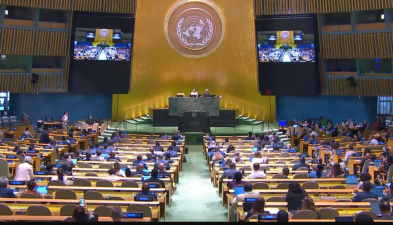
India abstained from voting on a United Nations General Assembly (UNGA) resolution urging nations to comply with climate change obligations based on a landmark advisory opinion from the International Court of Justice (ICJ). Adopted with 141 votes in favor, 8 against, and 28 abstentions, the resolution seeks to turn the ICJ’s July 2025 advisory opinion into global political and legal momentum. India stated that while it engaged constructively throughout the negotiations, the final draft failed to address its core concerns. New Delhi clarified that the resolution does not create binding commitments for it, as India’s climate obligations flow solely from the United Nations Framework Convention on Climate Change (UNFCCC) process.
Core Reasons for India’s Abstention
India’s decision to abstain reflects institutional, legal, and economic safeguards designed to protect developing nations.
Undermining the UNFCCC Architecture
- Dilution of Equity: India expressed serious concerns that the resolution flattens the distinction between developed and developing countries, thereby diluting the core principle of Common But Differentiated Responsibilities and Respective Capabilities (CBDR-RC).
- Quasi-Binding Status: By elevating a non-binding ICJ advisory opinion to a quasi-binding status through a UNGA vote, the text attempts to bypass the established multilateral negotiations under the UNFCCC.
- Threat to National Policy Space: The resolution prescribes specific global mitigation pathways and imposes external benchmarks for ambition. This mechanism threatens the bottom-up architecture of the Paris Agreement, where states freely determine their own climate actions.
Complete Omission of Climate Finance
- Absence of Text: The term “climate finance” is entirely missing from the operative text of the resolution.
- Imbalance of Obligations: India pointed out the serious omission of any explicit reference to the legal necessity for developed countries to provide adequate, predictable, and scalable financing, technology transfer, and capacity building.
- Unfair Legal Vulnerability: Opening up the domestic climate action plans of developing countries to judicial or quasi-judicial scrutiny without a corresponding legal audit of the unfulfilled financial pledges made by rich nations creates a structural imbalance.
Global Voting Pattern and Key Provisions
The resolution generated significant division among major economies and energy producers at the UN General Assembly.
Voting Alignment at the UNGA
| Voting Stance | Number of Nations | Key Countries Involved |
| In Favor | 141 | Australia, United Kingdom, France, Germany, Vanuatu, and various Small Island Developing States (SIDS). |
| Against | 8 | United States, Russian Federation, Saudi Arabia, Iran, Israel, Belarus, Liberia, Yemen. |
| Abstentions | 28 | India, Turkey, Qatar, Nigeria. |
Key Mandates Contained in the Resolution
- Fossil Fuel Transition: Calls on countries to implement domestic measures to accelerate a just transition away from fossil fuels within energy systems.
- Subsidies Phase-out: Urges the phase-out of inefficient fossil fuel subsidies that encourage wasteful consumption.
- Temperature Caps: Mandates alignment with national circumstances to limit global average temperature rise to below 1.5 degrees Celsius above pre-industrial levels.
- Compliance Reporting: Requests the UN Secretary-General to submit a comprehensive report to the General Assembly exploring pathways to advance compliance based on the ICJ’s findings.
Background: The ICJ Advisory Opinion on Climate Change
The UNGA resolution is the political translation of a prolonged legal effort initiated by vulnerable island states.
Origin and Evolution
- Vanuatu Initiative: The Pacific island nation of Vanuatu led a core group of states to sponsor a UNGA resolution in March 2023, successfully requesting the ICJ to clarify states’ legal responsibilities regarding climate change.
- The December 2024 Hearings: The ICJ conducted extensive oral hearings where a record number of countries, including India and the United States, submitted statements regarding environmental damage and state sovereignty.
- The July 2025 Ruling: The ICJ delivered a unanimous advisory opinion declaring that protecting the climate system is a legal duty under international law. It ruled that states face legal liability and repair obligations if their climate inaction causes transboundary harm to vulnerable nations.
India’s Balanced Diplomatic Stance
- Solidarity with SIDS: India reiterated its deep sympathy for Small Island Developing States facing existential threats from sea-level rise. To avoid hurting their cause, India chose to abstain rather than vote against the resolution.
- Alternative Partnerships: New Delhi continues to support vulnerable nations through non-judicial, practical platforms like the Security and Growth for All in the Region (SAGAR) initiative, the Coalition for Disaster Resilient Infrastructure (CDRI), and the International Solar Alliance (ISA).
IASPOINT Booster Facts for UPSC
- Nature of UNGA Resolutions: Unlike UN Security Council resolutions passed under Chapter VII, UNGA resolutions are generally non-binding and function as expressions of the collective will of the international community.
- Legal Weight of ICJ Advisory Opinions: Advisory opinions delivered by the ICJ carry great legal weight and moral authority but are inherently non-binding under Article 65 of the ICJ Statute.
- Vanuatu’s Geographic Vulnerability: Vanuatu is a South Pacific ocean nation highly vulnerable to climate hazards; its low-lying terrain means sea-level rise threatens its territorial integrity.
- India’s Net-Zero Target: India formally committed to achieving net-zero greenhouse gas emissions by the year 2070 during the COP26 summit in Glasgow.
- Historical vs. Current Emissions: While India is currently one of the top annual emitters due to its large population, its cumulative historical emissions account for less than 5 percent of the global total, and its per-capita emissions remain far below the global average.