
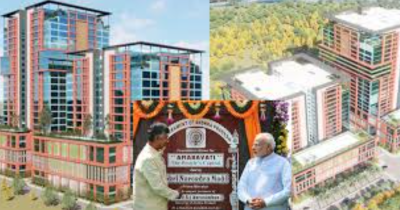
The Cabinet Committee on Economic Affairs (CCEA), chaired by Prime Minister Narendra Modi, approved the construction of a state-of-the-art Central Government Office (CGO) complex in Amaravati, Andhra Pradesh. The infrastructure project involves an estimated financial outlay of ₹1,299 crore. Spanning an area of 5.53 acres, the complex will feature two multi-storey blocks designed to accommodate approximately 8,000 central government officials across various ministries and departments. Executed by the Central Public Works Department (CPWD), the project will modernize central administrative infrastructure in Andhra Pradesh, while generating substantial direct and indirect employment opportunities during its construction and subsequent operational phases.
Structural Architecture and Institutional Facilities
Multi-Storey Block Design
The architectural blueprint for the Amaravati CGO complex incorporates two multi-storey towers optimized for high-density administrative operations. The structural layout prioritizes spatial efficiency, modular workspace configurations, and advanced seismic safety compliance. By consolidating multiple scattered central departments into a single unified campus, the complex simplifies inter-departmental coordination and reduces long-term commercial real estate leasing costs for the public exchequer.
Integrated Civic Amenities
To support its 8,000-strong daily administrative workforce and visiting citizens, the complex functions as an integrated mini-township. The campus includes built-in public utilities, including a dedicated banking enclave, an automated post office, institutional health units, and advanced multi-level parking zones. It also features high-capacity conference halls and digital seminar rooms equipped with modern telepresence infrastructure to facilitate large-scale inter-governmental assemblies.
Environmental Sustainability and Green Building Standards
GRIHA 4-Star Rating Benchmarks
The construction protocol mandates strict adherence to eco-friendly design principles to secure a Green Rating for Integrated Habitat Assessment (GRIHA) 4-Star rating. The building’s lifecycle design incorporates passive architectural features to lower heat absorption, solar photovoltaic roof installations to meet clean energy needs, and closed-loop water treatment systems.
ECSBC 2024 Compliance
The complex is engineered to fully comply with the Energy Conservation and Sustainable Building Code (ECSBC) 2024. This framework sets strict targets for low embodied carbon materials, high-efficiency heating, ventilation, and air conditioning (HVAC) systems, and smart energy management networks. The table below outlines the core environmental parameters enforced during construction:
| Sustainability Dimension | Implementation Mechanism | Primary Environmental Target |
| Energy Management | Smart LED lighting and motion sensors | Reduces grid power consumption by over 30%. |
| Water Conservation | Zero Liquid Discharge (ZLD) plants | recycles 100% of greywater for landscaping and flushing. |
| Material Sourcing | Fly-ash bricks and low-VOC paints | Reduces carbon footprint and improves indoor air quality. |
| Waste Treatment | On-site organic waste converters | Converts cafeteria and organic waste into agricultural compost. |
Socio-Economic and Administrative Impact
Infrastructure Upgradation
Establishing a dedicated CGO complex in Amaravati bridges a critical infrastructural gap in Andhra Pradesh’s capital region. Since the bifurcation of the state, several central agencies have operated out of temporary or rented spaces. This permanent campus provides a centralized administrative hub, making it easier for citizens to access central public services.
Economic Multiplier Effect
The ₹1,299 crore capital expenditure injects immediate liquidity into the regional construction economy. The project creates sustained demand for domestic steel, cement, and electrical manufacturing industries. Furthermore, the construction phase generates extensive employment for skilled and unskilled workers, while the operational phase opens long-term service contracts in facilities management, security logistics, and hospitality.
IASPOINT Booster Facts for UPSC
- About CCEA: The Cabinet Committee on Economic Affairs is chaired by the Prime Minister of India and handles macro-level economic policies, investment proposals above specified financial limits, and major industrial infrastructure projects.
- GRIHA Genesis: The Green Rating for Integrated Habitat Assessment (GRIHA) was developed indigenously by The Energy and Resources Institute (TERI) and formally adopted by the Ministry of New and Renewable Energy (MNRE) as the national rating system for green buildings.
- CPWD Statutory Origin: The Central Public Works Department (CPWD) is the premier central government authority for public domain infrastructure, operating under the aegis of the Ministry of Housing and Urban Affairs (MoHUA).
- ECSBC Evolution: The Energy Conservation and Sustainable Building Code (ECSBC) is updated periodically by the Bureau of Energy Efficiency (BEE), a statutory body under the Ministry of Power established under the Energy Conservation Act, 2001.