
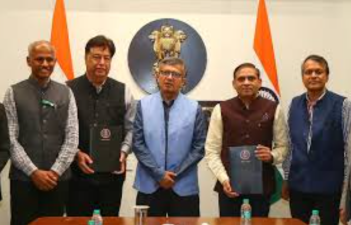
The Ministry of Defence signed a contract worth Rs 449 crore with Bengaluru-based Accord Software and Systems Private Limited for the procurement of 20 Enhanced Capability Global Navigation Satellite System (ECGNSS) Jammers for the Indian Navy. Executed under the Buy (Indian-IDDM) category, the agreement requires a minimum of 75% indigenous content. The procurement took place in New Delhi in the presence of Defence Secretary Rajesh Kumar Singh. The systems protect Indian naval platforms by disrupting enemy satellite navigation signals and neutralising positioning-dependent targeting systems in multi-threat maritime environments.
Technology and Working Mechanism
GNSS Signal Degradation
Global Navigation Satellite System (GNSS) jammers operate by emitting radio frequency signals that match the frequency bands used by satellite navigation networks such as GPS, GLONASS, Galileo, and BeiDou. The ECGNSS jammers degrade the satellite signal acquisition and tracking performance of enemy receivers. This prevents hostile ships, drones, or precision-guided munitions from determining their exact geographic coordinates.
Spoofing and Deceptive Jamming
Unlike basic jamming which merely blocks signals by overpowering them with noise, the ECGNSS system possesses advanced electronic warfare capabilities like spoofing. Signal spoofing involves transmitting false navigation data to the enemy receiver. The target accepts the fabricated coordinates as genuine, leading to incorrect calculations of position, velocity, and time, thereby throwing the adversary off course without triggering immediate system alarms.
Procurement and Policy Alignment
Buy (Indian-IDDM) Category
The acquisition is classified under the Buy (Indian-Indigenously Designed, Developed and Manufactured) category of the Defence Acquisition Procedure. This category holds the highest priority in defence procurement. It mandates that the product must be designed, developed, and manufactured within India, ensuring technology ownership remains domestic.
Indigenisation Metrics
The project enforces a strict requirement of at least 75% indigenous content. This legal and operational obligation reduces dependence on foreign military hardware components and supports the domestic electronic warfare engineering industry.
Strategic Initiatives
The contract aligns directly with the Aatmanirbhar Bharat and Make in India frameworks. By trusting domestic private firms like Accord Software and Systems with critical electronic warfare systems, the government expands the domestic defence industrial base.
Operational Impact on Maritime Security
Multi-Threat Navigation Safety
Modern naval warfare relies heavily on network-centric operations and precision guidance. Indian Navy vessels operate in complex electronic environments where adversaries can deploy sea-skimming missiles, loitering munitions, and unmanned aerial vehicles. The ECGNSS jammers provide a defensive shield by breaking the satellite link required by these hostile assets to home in on Indian naval platforms.
Geopolitical Context in the Indian Ocean Region
The Indian Ocean Region faces growing militarisation and deployment of high-tech surveillance assets by regional state actors. Protecting the electronic spectrum ensures that Indian warships maintain tactical superiority, operational security, and navigational freedom without their positions being compromised by foreign satellite tracking systems.
Technical Profiles of GNSS Networks
| Satellite System | Origin Country/Region | Operational Scope |
| GPS | United States | Global |
| GLONASS | Russia | Global |
| Galileo | European Union | Global |
| BeiDou | China | Global |
| NavIC | India | Regional |
IASPOINT Booster Facts for UPSC
- NavIC Status: Navigation with Indian Constellation (NavIC) is India’s independent regional satellite navigation system developed by ISRO, consisting of a constellation of 7 operational satellites covering India and an area up to 1,500 km beyond its borders.
- Accord Software Historical Context: Accord Software and Systems was the first Indian private company to develop indigenous NavIC receivers, establishing baseline capabilities in domestic positioning, navigation, and timing technologies.
- DAP 2020 Order of Preference: Under the Defence Acquisition Procedure (DAP) 2020, Buy (Indian-IDDM) is prioritized first, followed by Buy (Indian), Buy and Make (Indian), Buy (Global – Manufacture in India), and lastly Buy (Global).
- Electronic Warfare Segments: Electronic warfare is divided into three major categories: Electronic Attack (which includes jamming and spoofing), Electronic Protection (protecting friendly forces from jamming), and Electronic Warfare Support (sensing and identifying enemy signals).
