
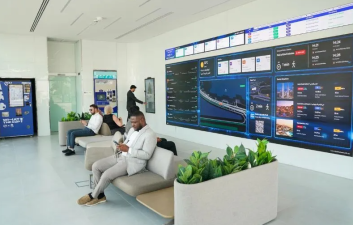
Dubai Roads and Transport Authority inaugurated the world’s first artificial intelligence-powered smart bus station at Mall of the Emirates on 10 May 2026. The 147 square-metre facility integrates directly with the Mall of the Emirates Metro Station and accommodates up to 20 passengers simultaneously. The station serves eleven bus routes, including feeder routes to the metro, internal city routes, and seasonal routes, which enhances connectivity across residential, commercial, and tourist districts. The Dubai Roads and Transport Authority oversees the project under the leadership of Mattar Al Tayer, with an overarching goal to convert 25% of all transport journeys in the emirate into autonomous or AI-supported operations by the next decade.
Core Technological Framework and AI Integration
The smart bus station functions as a next-generation public transport hub. It embeds multiple automation layers to streamline urban mobility.
Computer Vision and Crowd Management
The facility deploys high-definition artificial intelligence cameras. These cameras manage commuter flow through specific algorithmic tasks:
- Crowd Movement Analysis: Real-time tracking of passenger density to prevent overcrowding inside the terminal.
- Violation Detection: Automated identification of safety or operational breaches within the station perimeter.
- Occupancy Tracking: Continuous monitoring of bus passenger loads to provide immediate data to transport planners.
24/7 Digital Consumer Infrastructure
Operations run completely without manual ticket counters, relying on automated visitor systems:
- Interactive Kiosks: Round-the-clock digital interfaces that facilitate ticketing, card recharging, and map navigation.
- Virtual Assistant: An AI-powered concierge that assists passengers with real-time journey planning and customer support inquiries.
- Unified Transport Displays: Large screens displaying live arrival updates for buses, synchronized schedules for the Dubai Metro, and current taxi availability.
Sustainability and Environmental Architecture
The architecture incorporates specific eco-friendly and climate-resilient elements to minimize the operational carbon footprint.
Energy Efficiency and Resource Management
- Solar Power Generation: Photovoltaic solar panels are integrated into the roof structure to generate renewable energy for localized operations.
- Smart Climate Control: Automated cooling mechanisms adjust temperatures based on real-time occupancy data, optimizing electricity consumption during extreme summer conditions.
Environmental Monitoring
- Air-Quality Sensors: Smart environmental sensors track particulate matter and indoor air purity continuously.
- Predictive Maintenance: AI systems evaluate structural and hardware components to detect technical wear, reducing material waste through targeted interventions.
Key Smart Transportation Initiatives Globally
Cities worldwide are adopting Artificial Intelligence to address rapid urbanization and vehicle congestion.
| City / Region | Core Technology Deployed | Specific Application | Primary Benefit |
| Dubai, UAE | AI Computer Vision & Smart Kiosks | Bus occupancy tracking, 24/7 virtual journey assistants, and multimodal metro synchronization. | Reduced commuter wait times and lower station emissions. |
| Singapore | Predictive Big Data Analytics | Bus arrival forecasting and automated headway management systems. | Prevention of bus bunching and optimal fleet distribution. |
| Hangzhou, China | “City Brain” AI Platform | Real-time traffic signal manipulation via surveillance feed analysis. | 15% reduction in traffic congestion and faster emergency vehicle transit. |
| London, UK | Machine Learning Traffic Models | Optimizing the ultra-low emission zone (ULEZ) enforcement cameras. | Automated detection of non-compliant vehicles to improve air quality. |
IASPOINT Booster Facts for UPSC
- Dubai Autonomous Transportation Strategy: Aiming for 25% of all trips to be smart and driverless by 2030, this strategy targets economic savings via reduced traffic accidents, lower pollution, and increased productivity of travel hours.
- One Health and Smart Cities: In urban governance, smart transport networks directly support environmental health pillars by cutting down urban heat island effects through localized renewable installations.
- Biosafety and Material Safety in Mass Transit: The integration of contactless kiosks and touch-free digital verification methods acts as a preventative public health shield, minimizing vector transmission points in dense commuter hubs.
- Intelligent Transport Systems (ITS) in India: India is scaling up its own ITS frameworks through initiatives like the National Common Mobility Card (NCMC) and AI-based traffic management systems under the Smart Cities Mission across selected metropolitan corridors.