
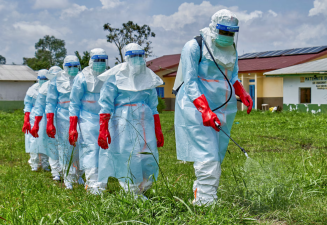
The World Health Organization (WHO) declared the escalating Ebola outbreak caused by the rare Bundibugyo virus strain in the Democratic Republic of the Congo (DRC) and Uganda a Public Health Emergency of International Concern (PHEIC) in May 2026. Simultaneously, the Africa Centres for Disease Control and Prevention (Africa CDC) classified the situation as a Public Health Emergency of Continental Security (PHECS). The outbreak centers in the conflict-hit Ituri, North Kivu, and South Kivu provinces of the DRC, with cross-border imported cases detected in Kampala, Uganda. Neighboring nations, particularly South Sudan, face high exposure risks due to intense regional population mobility. India has recorded zero cases but issued travel advisories for the affected African regions. World Health Organization (WHO)+ 3
Epidemiological Profile of Bundibugyo Virus
Taxonomy and Virulence
The Bundibugyo virus (Bundibugyo ebolavirus) belongs to the genus Orthoebolavirus within the family Filoviridae. It represents one of the six identified species of the virus, four of which cause severe viral hemorrhagic fever in humans. The virus exhibits a historical case fatality rate (CFR) ranging from 30% to 40%, making it less lethal than the Zaire ebolavirus strain (up to 90% CFR) but highly pathogenic. The current 2026 outbreak shows an early CFR of approximately 11% to 12% among laboratory-confirmed cases. World Health Organization (WHO)
Transmission Dynamics
Zoonotic spillover occurs when humans come into direct contact with the blood, secretions, organs, or bodily fluids of infected animals, such as fruit bats (Pteropodidae family), non-human primates, or forest antelopes. Secondary human-to-human transmission propagates through: Wikipedia
- Direct contact with broken skin or mucous membranes exposed to the blood, feces, vomit, or semen of symptomatic individuals. ECDC – European Union
- Indirect contact with environments or materials contaminated with infectious fluids, such as soiled bedding, clothing, or medical equipment. Public Health – European Commission – European Union
- Traditional burial ceremonies that involve direct contact with the bodies of deceased victims. CDC
Clinical Manifestations
The incubation period ranges from 2 to 21 days. The disease begins with sudden onset of fever, intense fatigue, muscle pain, headache, and sore throat. This progresses to vomiting, diarrhea, impaired kidney and liver function, and in severe cases, internal and external hemorrhaging. World Health Organization (WHO)
Global and Continental Emergency Declarations
WHO PHEIC Declaration
The WHO Director-General activated the emergency protocol under the International Health Regulations (IHR 2005). The declaration specifies that the event is extraordinary because it features rapid cross-border spread from semi-urban areas, high positivity rates in initial samples, and a high risk of health-worker infection. WHO issued temporary recommendations mandating exit screenings at ports of entry in affected areas but advised against broad international travel or trade restrictions. World Health Organization (WHO)+ 1
Africa CDC PHECS Declaration
The Africa CDC independent emergency committee declared a Public Health Emergency of Continental Security (PHECS). This mechanism coordinates continent-wide resource mobilization, deploys the African Health Volunteers Corps, and streamlines joint cross-border surveillance between the DRC and neighboring member states. ECDC – European Union
Comparative Analysis of Orthoebolavirus Species
| Virus Species | Historical Case Fatality Rate | Availability of Approved Vaccines / Therapeutics | Primary Geographical Hotspots |
|---|---|---|---|
| Zaire ebolavirus | 60% to 90% | Yes (Ervebo vaccine; Inmazeb and Ebanga treatments) | DRC, Republic of the Congo, West Africa |
| Sudan ebolavirus | 40% to 60% | No (Experimental candidates only) | Uganda, Sudan |
| Bundibugyo ebolavirus | 30% to 40% | No approved vaccines or specific therapeutics | Uganda (Bundibugyo district), DRC |
| Taï Forest ebolavirus | Single recorded human case | No | Côte d’Ivoire (Taï National Park) |
| Reston ebolavirus | Non-pathogenic in humans | Not applicable | Philippines, Republic of China (Affects swine and primates) |
Critical Countermeasure Deficits and Global Response
The Vaccine and Treatment Gap
The two globally licensed Ebola vaccines—Ervebo (rVSV-ZEBOV) and Zabdeno/Mvabea—provide specific protective immunity exclusively against the Zaire strain. They offer no documented cross-protection against the Bundibugyo strain. Similarly, monoclonal antibody therapies like Inmazeb (REGN-EB3) and Ebanga (Ansuvimab) fail to neutralize non-Zaire filoviruses. Gavi, the Vaccine Alliance
Emergency R&D Mobilization
WHO and the Coalition for Epidemic Preparedness Innovations (CEPI) convened emergency scientific consultations to fast-track clinical trial protocols for candidate vaccines. Treatment relies heavily on early supportive care, including intensive fluid resuscitation, electrolyte stabilization, and symptomatic therapies. World Health Organization (WHO)+ 1
Operational Bottlenecks in the Impact Zone
The response in northeastern DRC faces complex challenges due to active armed conflicts, long-standing humanitarian crises, and a dense network of informal healthcare facilities. These factors hamper systematic contact tracing and the enforcement of uniform infection prevention and control (IPC) protocols. World Health Organization (WHO)
India’s Preparedness and Bio-Security Protocols
Surveillance and Advisories
The Ministry of Health and Family Welfare directed integrated disease surveillance units at international airports and seaports to flag travelers exhibiting unexplained fever or hemorrhagic symptoms who have a recent history of travel to Central and East Africa. Indian citizens are advised to avoid non-essential travel to the DRC and Uganda.
Laboratory Diagnostic Infrastructure
The ICMR-National Institute of Virology (NIV) in Pune serves as the apex central diagnostic facility equipped with Biosafety Level-4 (BSL-4) containment to isolate and test suspected filovirus samples using advanced reverse transcription-polymerase chain reaction (RT-PCR) assays.
IASPOINT Booster Facts for UPSC
- Discovery of the Strain: The Bundibugyo virus was first identified in November 2007 following an outbreak in the Bundibugyo District of western Uganda, near the DRC border. CDC
- First International PHEIC for Ebola: The first time an Ebola outbreak was declared a PHEIC was during the West African epidemic (2014–2016), which primarily affected Guinea, Liberia, and Sierra Leone.
- The One Health Approach: Managing filovirus spillovers depends heavily on the One Health framework, which links human health, animal health, and environmental management to monitor viral circulation in wild reservoirs like fruit bats.
- International Health Regulations (IHR 2005): The IHR is a legally binding instrument of international law involving 196 countries. It defines a PHEIC as an extraordinary event that constitutes a public health risk to other states through international disease spread and potentially requires a coordinated international response. World Health Organization (WHO)
- The Biosafety Level 4 (BSL-4) Standard: BSL-4 laboratories handle dangerous and exotic agents that pose a high individual risk of life-threatening disease, have no available vaccine or therapy, and are easily transmitted via aerosols. Personnel wear positive-pressure suits supplied with breathing air.