
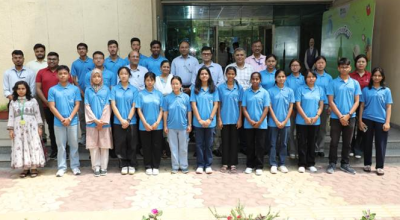
The Department of School Education and Literacy under the Ministry of Education recently flagged off a delegation of 56 Indian school students to participate in the Sakura Science Programme 2026 in New Delhi. Scheduled from May 24 to May 30, 2026, the week-long bilateral exchange is organized by the Japan Science and Technology Agency (JST). The Indian contingent includes 24 boys and 32 girls from government schools across 15 States and Union Territories. These students, all beneficiaries of the National Means-cum-Merit Scholarship Scheme (NMMSS), will join global peers from Ghana, Nigeria, and South Africa to experience Japan’s advanced scientific, technological, and cultural ecosystem.
Core Objectives and Implementation Framework
Institutional Structure and Inception
The Sakura Science Programme, formally known as the Japan-Asia Youth Exchange Program in Science, was launched by the Japan Science and Technology Agency in 2014. The program addresses the need for international talent circulation by introducing young minds to advanced Japanese science and technology. India became an active participant in April 2016. Since its inception, 674 Indian students and 96 supervisors have visited Japan under this initiative.
Operational Modalities
The exchange functions through collaborative frameworks planned jointly by overseas sending institutions and Japanese host organizations. Applications are submitted directly to the JST by the Japanese hosts. The program is fully funded by the Japanese government, covering travel, accommodation, and institutional visits.
Structural Paths of the Exchange Program
Categorization of Core Courses
The Sakura Science Exchange Program operates through distinct structured tracks designed for different academic levels and research durations:
| Course Category | Core Nomenclature | Target Target Beneficiaries | Maximum Duration |
| Course A | Science and Technology Experience Course | High school, university, and public sector personnel | 7 Days |
| Course B | Collaborative Research Activities Course | University students, graduate researchers, and postdocs | 3 Weeks |
| Course C | Science and Technology Training Course | Young researchers and technical personnel | 10 Days |
| Course D | Annual Mutual Exchange Course | University undergraduates, graduates, and faculty members | Full Academic Term Component |
Special Institutional Initiatives
Apart from the standard open courses, JST runs dedicated tracks such as the Sakura Science High School Program (SSHP) and the Sakura Science Indian University Program. The university program, introduced in financial year 2023, invites talented Indian undergraduates to top-tier laboratories, famous corporate research facilities, and information sessions aimed at building careers within the Japanese technology ecosystem.
Indian Selection Matrix and Strategic Alignment
Target Beneficiary Mapping
For the school-level exchange, the Indian government maps selection criteria to national welfare and merit schemes. Candidates are chosen from:
- National Means-cum-Merit Scholarship Scheme (NMMSS): Targetting meritorious students from economically weaker sections studying in government, government-aided, and local body schools.
- INSPIRE-MANAK Scheme: Managed by the Department of Science and Technology (DST), targeting top-performing innovators from the middle and high school levels who have won national science project competitions.
Prerequisites for Selection
Students must be studying in classes X, XI, or XII, be at least 15 years old, and have strong oral and written proficiency in English. The program prioritizes students who have not visited Japan previously, ensuring that the exposure serves as their first international scientific intervention.
Integration with National Education Policy (NEP) 2020
The initiative acts as a practical extension of the National Education Policy 2020. NEP 2020 advocates for a shift from rote learning to experiential, holistic, and discovery-oriented education. International exposure visits to top-level research facilities and interactions with global scientists provide students with cross-cultural competencies and practical knowledge that cannot be replicated in text-only classroom environments.
IASPOINT Booster Facts for UPSC
- NMMSS Node: The National Means-cum-Merit Scholarship Scheme is a Central Sector Scheme launched in 2008. It provides scholarships to selected Class IX students that continue through Class XII to reduce school dropout rates.
- Age and Nationality Caps: The JST mandates that all young researchers, faculty, or professionals applying under standard courses must be under 40 years of age.
- Global Peer Group 2026: In the May 2026 cohort, India shares the platform specifically with three African nations: Ghana, Nigeria, and South Africa, highlighting Japan’s expanded geopolitical science diplomacy outreach under Course D.
- Geographical Exclusions (FY2026): For the 2026 financial year open applications, regions like North America, Europe (excluding specific zones), and parts of Oceania remain ineligible, keeping the primary focus on developing and emerging economies.
- Nobel Laureate Interactions: A unique highlight of the Sakura High School Program is that it provides school students with the rare opportunity to attend lectures delivered directly by Japanese Nobel Laureates in physics, chemistry, and medicine.