
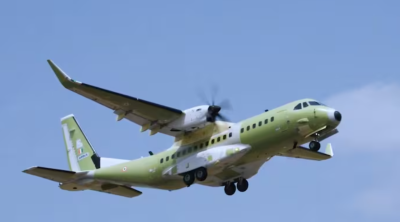
The first indigenously assembled C-295 military transport aircraft successfully completed its maiden flight on June 10, 2026, from the Final Assembly Line (FAL) in Vadodara, Gujarat. The Indian Air Force (IAF) is procuring 56 C-295 aircraft at a total cost of approximately ₹21,935 crore to modernize its tactical airlift fleet. While the initial 16 aircraft are delivered directly in fly-away condition from Airbus’ facility in Seville, Spain, the remaining 40 units are being manufactured and assembled domestically by Tata Advanced Systems Limited (TASL) in a historic partnership with Airbus. This milestone marks the first instance of a military transport aircraft being built entirely in India by a private sector enterprise, advancing the Atmanirbhar Bharat initiative and establishing a foundational base for advanced aerospace manufacturing within the country.
Institutional Framework and Procurement Matrix
The C-295 program represents a structural departure from India’s legacy defense procurement models, introducing a private-sector-led ecosystem for manufacturing large-scale aerospace assets.
The Fly-Away vs. Domestic Assembly Split
The September 2021 contract signed between the Ministry of Defence and Airbus Defence and Space outlines a clear dual-phase delivery mechanism:
- Fly-Away Fleet (16 Aircraft): Manufactured entirely at the Airbus plant in Seville, Spain. The delivery of these initial units to the IAF commenced systematically, with the 16th aircraft arriving in fly-away condition to operationalize early training and integration requirements.
- Indigenously Assembled Fleet (40 Aircraft): Undertaken by TASL at the Vadodara FAL, which was formally inaugurated in October 2024. The successful June 10, 2026 test flight represents the first validation of this post-production assembly line. The partners remain on schedule to deliver the first completed “Made in India” unit to the IAF later this year.
Industrial Ecosystem and Pulse-Line Manufacturing
The assembly plant in Vadodara utilizes a specialized “pulse-line” manufacturing concept. This system moves aircraft through fixed, synchronized workstations for structural joining, system integration, engine fitment, and avionics testing. To build a comprehensive defense industrial base, the project integrates a vast network of Indian Micro, Small, and Medium Enterprises (MSMEs), which manufacture detailed parts, structural sub-assemblies, and electrical harnesses across various domestic hubs.
Technical Profile and Operational Capabilities
The C-295 is an multi-role tactical transport aircraft designed to operate under harsh environmental conditions and within highly constrained geographical terrains.
Propulsion and Design Specifications
The aircraft features an elongated fuselage design, delivering a 50% increase in volumetric payload capacity compared to earlier structural variants. It is powered by two highly efficient Pratt & Whitney Canada PW127G turboprop engines.
Performance Parameters
- Payload Capacity: Capable of carrying up to 9.2 tonnes of cargo or exactly 71 infantry troops, or up to 50 fully equipped paratroopers.
- Cruise Speed: Achieves a maximum cruise speed of 260 knots.
- Short Take-Off and Landing (STOL): Optimized to operate from short, unpaved, and semi-prepared airstrips, enabling direct access to remote locations.
Tactical Role and Fleet Modernization
The induction of the C-295 directly resolves critical operational gaps within the IAF’s logistics and tactical air transport divisions.
| Replacement Target | Primary Operational Role | Enhanced C-295 Capabilities |
| Avro HS-748 Fleet | Legacy twin-engine transport aircraft serving since the 1960s; obsolete systems. | Modern glass cockpit avionics, superior fuel efficiency, and a rear ramp door for rapid loading/unloading. |
| AN-32 Supplementary Support | Works alongside the medium-lift Antonov An-32 fleet for forward logistics. | Advanced electronic warfare suites and highly reliable engines optimized for high-altitude mountainous take-offs. |
Border Logistics and Special Operations
The aircraft’s STOL capabilities are vital for sustaining forward operating bases along India’s northern borders, the rugged terrain of the North-East, and isolated island territories like the Andaman and Nicobar Islands. Beyond standard cargo transport, the C-295 is equipped for specialized missions, including maritime patrol, airborne surveillance, medical evacuation (medevac) configuring 24 litters, VIP transport, and airborne firefighting operations.
IASPOINT Booster Facts for UPSC
- The Private Sector First: The C-295 project represents the first time a private sector company (TASL) has been permitted to manufacture a complete military transport aircraft in India, a domain previously reserved for the state-owned Hindustan Aeronautics Limited (HAL).
- Employment Projections: The Ministry of Defence estimates that the domestic manufacturing loop will generate 15,000 highly skilled direct aerospace jobs and over 10,000 indirect technical jobs across the Indian MSME network over the next decade.
- The Global Fleet Context: With the completion of this order, India becomes the largest single customer and operator of the C-295 platform globally.
- Electronic Warfare Integration: All 56 Indian C-295 aircraft are being fitted with an indigenous Electronic Warfare Suite (EWS) developed by Bharat Electronics Limited (BEL) and Bharat Dynamics Limited (BDL) to protect the asset against surface-to-air missile threats.
- Strategic Autonomy Step: The localization of aircraft component manufacturing under this deal ensures that India develops independent, long-term Maintenance, Repair, and Overhaul (MRO) capabilities, removing foreign dependency during bilateral conflicts.
This detailed examination highlights the strategic transition of the C-295 program, mapping its journey from global acquisition to local manufacturing independence.
Last Modified: June 12, 2026