
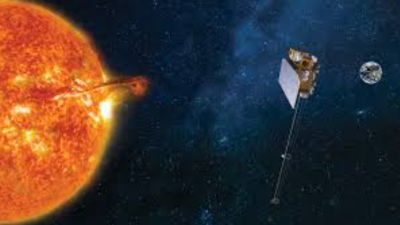
The U.S. National Oceanic and Atmospheric Administration (NOAA) activated SOLAR-1, its first dedicated operational space weather monitoring satellite. Positioned at the Sun-Earth Lagrange Point 1 (L1), approximately 1.6 million km from Earth, it provides continuous, real-time data to protect critical infrastructure from solar radiation and geomagnetic storms. Originally launched as Space Weather Follow On–Lagrange 1 (SWFO-L1) in 2025, it serves as a critical asset for planetary defense.
Key Mission Objectives and Instrumentation
- Mission: Continuous 24/7 monitoring of Coronal Mass Ejections (CMEs), solar wind disturbances, and energetic particles.
- Compact Coronagraph (CCOR-2): Captures images of CMEs by blocking the Sun’s bright disk to observe the outer corona.
- Solar Wind Instrument Suite (SWIS): Comprises three sub-sensors:
- SWiPS: Measures solar ion density, speed, and thermal properties.
- STIS: Detects high-energy particles from solar flares.
- Magnetometer (MAG): Quantifies local interplanetary magnetic field strength.
Strategic Advantages
- Latency Reduction: Delivers CME imagery in under 30 minutes (vs. up to 8 hours for legacy systems) and in-situ data within 5 minutes.
- Infrastructure Protection: Enables early warnings for electrical grids (preventing transformer failures), aviation/maritime communications, and satellite operations (mitigating signal scintillation and hardware damage).
IASPOINT Booster Facts
- L1 Mechanics: A gravitational balance point between the Sun and Earth, allowing fuel-efficient, permanent, unobstructed solar viewing.
- Operational Context: Works alongside instruments on the GOES-19 satellite.
- Global Context: Joins global missions at L1, such as India’s Aditya-L1 (ISRO), to study solar dynamics.
- Future Planning: NOAA’s “Space Weather Next” program plans for successor observatories (SOLAR-A/B) post-2030.