
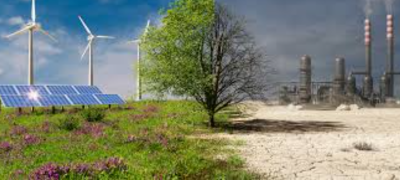
Recently global renewable electricity generation exceeded coal for the first time in modern history (renewables 33.8% v. coal 33.0%). Yet human-induced warming reached 1.37°C above pre‑industrial levels in 2025. The gap between cleaner grids and continued accelerating warming is now a governance, economic and technological challenge.
Current issue and significance
The power sector is decarbonising faster than demand growth. However, total greenhouse gas emissions remain record high at 60.63 billion tonnes CO2e. Policy must now extend beyond electricity to hard‑to‑abate industry, transport and buildings. Failure will exhaust the remaining carbon budget for a 50% chance of staying below 1.5°C in roughly three years. Implications span development finance, energy security and international diplomacy.
Trends in global power generation
Renewables overtaking coal
- Scale: Renewables supplied 33.8% of global electricity while coal fell to 33.0%.
- Fossil decline: Total fossil generation declined 0.2%, indicating decoupling of electricity demand from power‑sector emissions.
Regional leadership
- China: Contributed over half of global solar capacity growth; wind + solar share ~22% domestically.
- India: Doubled its previous record for renewable generation growth and installed more new solar capacity than the United States.
Persistent warming and climate indicators
- Temperature: Human‑induced warming at 1.37°C (2025 baseline).
- GHG concentrations: Atmospheric CO2 rose by 15.6 ppm and methane by 70.0 ppb between 2019 and 2025.
- Emissions: Global GHG emissions totaled 60.63 billion tonnes CO2e in 2025.
- Oceans & sea level: Earth’s energy imbalance has doubled since the 1970s. Over 90% of excess heat is absorbed by oceans. Global sea level ~23 cm above 1901 baselines; rate accelerating at about 1.8 mm per year. Marine heatwave days have more than tripled versus 1991 parameters.
Carbon budget and long‑term trajectory
- Carbon budget: Remaining budget for 50% chance of <1.5°C is ~130 billion tonnes CO2.
- Timescale: At current emission rates, this budget will be exhausted within three years.
- Warming rate: Human‑caused warming expands at ~0.27°C per decade; absent rapid mitigation, a structural breach of 1.5°C by 2030 is projected.
Bottlenecks in alternative clean technologies
Limits of electrification
Many heavy industrial processes require molecular energy carriers rather than electricity alone. Steel, cement and maritime shipping face material and process constraints that resist direct electrification.
Green hydrogen constraints
- Capital: Electrolyser manufacturing and deployment require high upfront investment.
- Infrastructure: Dedicated pipelines, storage and port facilities are largely absent.
- Efficiency: Conversion and transport losses raise delivered energy costs.
- Scale-up: Manufacturing gaps and supply chains limit rapid expansion.
International cooperation and climate finance gaps
- Technology transfer: Cross‑border restrictions and proprietary controls slow local adaptation of deep‑tech solutions.
- Finance: Developing economies face high borrowing costs for large green infrastructure projects.
- Mechanisms: Existing multilateral vehicles remain insufficient for rapid, large‑scale concessional financing and capacity building.
India — progress, policies and constraints
- Renewable growth: Rapid expansion in solar and wind reduced domestic fossil generation.
- National Green Hydrogen Mission: Initial outlay ₹19,744 crore; target ≥5 MMT green hydrogen annually by 2030 and ~125 GW additional clean capacity.
- SIGHT scheme: Financial support for domestic electrolyser manufacturing and local hydrogen production.
- Bottlenecks: High electrolyser costs, lack of dedicated pipelines, grid integration and need for demand‑pull in industry and transport.
Policy and governance imperatives
- Sectoral decarbonisation: Extend mitigation from power to steel, cement, chemicals, shipping, aviation, freight and building stocks through targeted standards and mandates.
- Scale green hydrogen: Combine R&D, capital subsidies, manufacturing incentives, infrastructure investment and demand‑side measures such as procurement mandates and blending targets.
- Climate finance: Secure concessional financing, risk mitigation instruments and public‑private blended finance to lower costs for developing economies.
- Technology access: Negotiate accelerated tech transfer, licensing pools or public procurement conditions to broaden access to critical low‑carbon technologies.
- Measurement & MRV: Strengthen monitoring, reporting and verification for non‑power sectors and GHG species (CO2, CH4).
- Policy coherence: Align industrial policy, trade policy and energy policy to support domestic manufacturing and export competitiveness in green technologies.
Model Questions
- Despite global renewable electricity surpassing coal, human‑induced warming accelerated. Analyse reasons for this paradox and the structural challenges in achieving a comprehensive green transition beyond the power sector. [GS-III: Environment & DM]
- Assess India’s contribution to global renewable expansion and evaluate bottlenecks and policy responses for scaling green hydrogen. [GS-III: Economic Development]
- Examine international cooperation gaps in technology transfer and climate finance and their implications for developing economies aiming to decarbonise rapidly. [GS-II: International Relations]
- Elucidate the concepts of Earth’s Energy Imbalance and remaining carbon budget, and explain how emissions from non‑power sectors continue to drive alarming climate indicators despite progress in clean electricity. [GS-III: Science & Technology]
The answer must explain decoupling of electricity demand from power‑sector emissions, cite renewables 33.8% v. coal 33.0% and fossil generation decline. Cover persistent high emissions from industry, transport and buildings; record global GHGs (60.63 Gt CO2e); rising CO2 and methane. Discuss hard‑to‑abate sectors needing molecular carriers (green hydrogen), bottlenecks (electrolyser costs, pipelines, conversion losses) and policy measures (sectoral mandates, carbon pricing, finance, R&D).
Mention India’s doubled renewable growth and greater solar additions than the US. Describe National Green Hydrogen Mission (₹19,744 crore; 5 MMT by 2030; ~125 GW) and SIGHT incentives. Analyse barriers: high electrolyser capital, infrastructure gaps, conversion losses, finance and demand uncertainty. Recommend measures: manufacturing incentives, concessional finance, demand‑pull (procurement, blending), R&D and port/infrastructure investment.
Define gaps: limited technology transfer, proprietary restrictions, inadequate concessional finance and high borrowing costs. Explain impacts: delayed deployment, slower industrial decarbonisation, and higher costs for developing countries. Propose remedies: scaled concessional funds, IP licensing arrangements, technology pools, capacity building, risk‑sharing instruments and strengthened multilateral coordination to accelerate equitable access to deep‑tech solutions.
Define EEI as absorbed solar radiation minus emitted infrared radiation; note oceans absorb >90% of excess heat and EEI has doubled since the 1970s. Define carbon budget (130 Gt CO2 for 50% chance of <1.5°C). Explain how persistent CO2 and methane rises, industrial process emissions and transport emissions maintain EEI and sea‑level rise, requiring molecular fuels, CCS, stronger MRV and cross‑sector mitigation.