
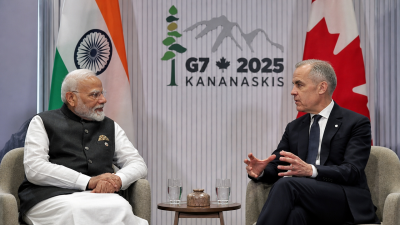
On the sidelines of the G7 summit in Evian, Prime Ministers Narendra Modi and Mark Carney agreed to speed up negotiations for a Comprehensive Economic Partnership Agreement (CEPA) and to launch talks on a General Security of Information Agreement (GSOIA). Leaders noted progress and set an aim to reach CEPA by end‑2026.
What is current and why it matters
- Current status: CEPA negotiations are being accelerated with an objective to conclude by end‑2026. GSOIA negotiations will be launched to enable secure defence and security cooperation. A Canadian trade mission led by Minister Maninder Sidhu is expected later in 2026.
- Significance: Faster CEPA completion can expand market access, increase FDI, and secure supply of energy and raw materials. GSOIA enables classified information exchange, supporting defence collaboration and procurement cooperation.
CEPA — scope, opportunities and exposure for India
Scope
- Coverage: Goods, services, investment, intellectual property, digital trade, government procurement, regulatory cooperation and dispute settlement.
- Sensitive areas: Agriculture, dairy, some manufacturing segments, public procurement and mobility of professionals commonly draw protection concerns in bilateral pacts.
Opportunities for India
- Market access: Preferential access for IT services, pharmaceuticals, textiles, and engineering goods could raise exports to Canada’s high‑income market.
- Investment: Improved investor protection and rules can attract Canadian capital into logistics, clean energy, mining and manufacturing under PLI and Make in India frameworks.
- Energy and inputs: Commercial arrangements on LNG, LPG and metallurgical coal support industrial and power sectors, aiding energy security and steel production.
- Services and professionals: Mobility provisions can benefit IT, healthcare and education services if visa and recognition issues are addressed.
Risks and adjustment costs
- Domestic industry pressure: Tariff reduction may expose MSMEs and sensitive farm sectors. Safeguard and adjustment measures will be needed.
- Rules of origin and non‑tariff barriers: Complex RoO and stringent standards (SPS/TBT) can limit actual gains unless Indian firms meet compliance costs.
- Data and digital trade: Commitments on cross‑border data flows and localisation could conflict with domestic policy on data governance and privacy.
| Dimension | Potential benefit | Indian policy response |
|---|---|---|
| Tariff liberalisation | Expand exports, lower input costs | Phased liberalisation, safeguard clauses, tariff lines exclusion |
| Services market access | Export growth, higher remittances | Mutual recognition, skills upgradation, visa facilitation |
| Investment | Capital for infrastructure, clean energy | Ease of doing business, land and labour reform alignment |
Security cooperation — GSOIA and strategic intent
- GSOIA purpose: Provide legal framework for secure sharing of classified information. It supports defence R&D, joint exercises, technology transfers and defence procurement collaboration.
- Strategic context: Diversifying defence and intelligence partnerships aligns with broader Indo‑Pacific strategy and need for reliable partners. GSOIA reduces friction in bilateral defence projects and interoperability.
- Implementation issues: Domestic legal reviews, classification standards, and parliamentary oversight will affect timing and depth of cooperation.
Supply chains, energy and food security
- Energy supplies: Commercial arrangements for LNG, LPG and metallurgical coal help secure feedstock for power, fertiliser and steel sectors. Long‑term contracts and joint investments reduce volatility.
- Food security: Canada is a supplier of pulses, grains and edible oils. Diversified sourcing reduces exposure to regional shocks and supports buffer stock strategies.
- Resilience measures: Trade facilitation, storage infrastructure, joint R&D in agri‑tech, and transparent logistics corridors improve supply reliability.
Drivers of renewed engagement
- Diplomatic reset: Recent high‑level visits and business delegations indicate a shift from earlier strains to pragmatic engagement.
- Mutual economic complementarity: India’s market and services capabilities complement Canada’s resources, technology and financial capacity.
- Geopolitical factors: Need for dependable partners and diversified supply chains amid strategic competition in the Indo‑Pacific.
- Business diplomacy: Largest‑ever Indian business delegation and planned Canadian trade mission signal commercial momentum behind political will.
Policy implications for India
- Negotiating stance: Protect sensitive agricultural and MSME interests while securing services and investment gains. Use phased tariff cuts and clear safeguard mechanisms.
- Regulatory preparedness: Strengthen standards compliance, quality certification, and exporter support through DGFT and export promotion councils.
- Investment facilitation: Align incentives (PLI), land reforms and ease‑of‑doing‑business steps to absorb Canadian investment in manufacturing and energy.
- Security governance: Ensure legal and parliamentary frameworks for GSOIA, with clear oversight over classified information sharing and tech transfers.
- Supply‑chain strategy: Combine CEPA with strategic contracts, buffer stocks, and logistics investments for energy and food security.
Risks, mitigation and monitoring
- Domestic backlash: Use targeted compensation, skill programmes and credit support for sectors facing import pressure.
- Trade remedies: Retain ability to impose anti‑dumping, countervailing and safeguard measures consistent with WTO rules.
- Performance monitoring: Establish inter‑ministerial CEPA implementation unit and business‑government committees to track market access, non‑tariff barriers and investment projects.
Model Questions
- Critically analyse the potential economic benefits and challenges for India from a Comprehensive Economic Partnership Agreement (CEPA) with Canada. [GS-III: Economic Development]
- Examine the factors driving the renewed India‑Canada engagement and the implications of launching General Security of Information Agreement (GSOIA) negotiations. [GS-II: International Relations]
- Discuss how resilient and reliable supply chains between India and Canada can strengthen global energy and food security. [GS-II: International Relations]
- What are India’s overriding objectives in accelerating trade negotiations and deepening bilateral ties with Canada in the present geopolitical context? [GS-II: Governance]
Hint: Assess market access for goods and services, investment inflows, and energy/raw material security. Identify sensitive domestic sectors and adjustment costs. Discuss rules of origin, SPS/TBT compliance, digital trade and labour mobility. Recommend phased liberalisation, safeguards, exporter support and regulatory upgrades to maximise net gains.
Hint: Trace diplomatic reset, high‑level visits and commercial diplomacy. Link mutual economic interests and geopolitical need for diversified partners. Explain GSOIA’s role in secure information sharing, defence cooperation and procurement. Note legal, classification and oversight requirements that will shape strategic collaboration.
Hint: Explain vulnerabilities from concentrated suppliers and benefits of diversified sourcing. Use LNG, LPG, metallurgical coal and agricultural commodities as examples. Recommend long‑term contracts, storage, logistics investment, joint R&D and trade facilitation measures to reduce volatility and enhance national buffer capabilities.
Hint: Identify objectives: secure diversified energy and raw materials, expand market access for goods and services, attract Canadian investment, and strengthen strategic partnerships. Link these to India’s economic goals (USD 50 billion trade target by 2030), supply‑chain security and broader Indo‑Pacific diplomatic strategy. Suggest policy tools to achieve them.