
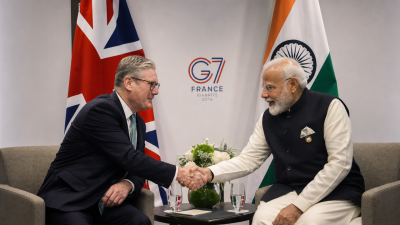
India and the UK announced that their Free Trade Agreement (CETA) will enter into force on 15 July 2026, accompanied by a Double Contribution Convention (DCC). The pact settles outstanding issues on steel safeguards and introduces tariff, services and mobility measures with wide economic and strategic consequences.
Context and immediate governance relevance
The agreement begins on 15 July 2026 and was finalised after a compromise on Britain’s steel safeguard regime that protects about 85% of Indian steel exports via quotas and special access. Leaders reiterated political commitment during the G7 summit. For governance, the deal affects industrial policy, external economic strategy, labour mobility and regulatory coordination.
Economic projections and aggregate gains
| Dimension | Estimate |
|---|---|
| India GDP gain | £5.1 billion (long run) |
| UK GDP gain | £4.8 billion (long run) |
| Increase in bilateral trade | £25.5 billion annually (long run) |
These projections imply trade-led growth, potential reallocation within manufacturing and services, and altered tariff revenue trajectories for both governments. Fiscal and sectoral adjustment measures will be necessary to manage short-term dislocations.
Key provisions and sectoral impact
- Tariff changes (selected):
- Whisky: India’s current tariff reduced from 150% to 40% over ten years.
- Automobiles: Duties lowered to 10% under a quota mechanism.
- Cosmetics: Tariffs of up to 22% removed either immediately or phased over ten years.
- Market access for labour-intensive exports: Britain reduces tariffs on clothing, footwear and selected food items; textiles and footwear are scheduled for duty-free access, improving competitiveness for Indian exporters.
- Services and investment: The agreement expands market access commitments and investment protections, encouraging bilateral FDI and potentially facilitating supply-chain integration in technology and manufacturing.
Strategic dimension: beyond commerce
The FTA is India’s most extensive trade pact to date. It couples tariff and rules reforms with provisions on investment, regulatory cooperation and services mobility. The DCC enhances people-to-people links. Collectively, the instruments aim to strengthen technology ties, deepen investment flows and improve institutional coordination between regulators and business communities.
Double Contribution Convention (DCC) — operational details and impact
- Duration of exemption: Extends exemption from dual social security contributions for Indian professionals in the UK from three to five years.
- Beneficiaries: Estimated to benefit over 75,000 Indian professionals and more than 900 companies by lowering employment costs and simplifying assignment terms.
- Implementation effect: Reduces regulatory compliance and wage-cost burdens for short-to-medium term postings; increases attractiveness of intra-firm transfers and professional services exports.
Negotiation dynamics and resolution: steel safeguards and bargaining
Negotiations saw a late dispute over Britain’s new steel safeguard regime. The final compromise secures quota and special access arrangements that protect around 85% of Indian steel exports. The outcome reflects calibrated trade-offs: market access in sensitive sectors in exchange for broader liberalisation elsewhere.
Implications for India’s trade diplomacy
- Precedent-setting negotiation: Successfully resolving a safeguard dispute demonstrates negotiating capacity on contentious, politically sensitive issues.
- Template for future deals: Use of quotas, special access, and phased tariff reductions provide procedural options for managing domestic adjustment while opening markets.
- Policy instruments: Suggests reliance on targeted safeguards, adjustment assistance and regulatory cooperation in future agreements to protect vulnerable producers.
Benefits for professionals, businesses and supply chains
- Professionals: Extended social security exemption lowers employer costs and increases mobility for Indian skilled workers, aiding services exports and technology transfer.
- Businesses: Duty reductions open UK markets for labour-intensive Indian exporters; quota-based auto access and tariff cuts on high-value items (whisky, cosmetics) create export opportunities and encourage product upgrading.
- Supply chains: Greater predictability and market access can attract UK investment into Indian manufacturing and services, supporting backward and forward linkages.
Implementation, promotion and domestic adjustment
- Promotion: The UK Department for Business and Trade launched a UK‑India roadshow to inform firms and prompt registration ahead of implementation.
- Regulatory alignment: Effective implementation will require customs modernisation, rules-of-origin systems, and strengthened sanitary and phytosanitary (SPS) and technical barriers to trade (TBT) compliance.
- Adjustment measures: Governments should prepare targeted support—skill upgradation, credit, and phased relief—for sectors facing short-term disruption.
Risks and monitoring
- Displacement risk: Short-term displacement in protected sectors, notably segments of steel and firms unable to meet new competition.
- Regulatory frictions: Non-tariff barriers, certification delays and customs capacity could blunt benefits unless addressed.
- Political economy: Domestic constituencies may demand compensatory measures; transparent monitoring and periodic review clauses will be critical.
Practical checklist for stakeholders
- Exporters: Verify tariff lines, rules‑of‑origin and quotas; register for preferential access; upgrade quality and certification.
- Businesses hiring international staff: Recalibrate assignment costs using DCC benefits; revise HR and payroll planning.
- Policymakers: Establish monitoring mechanism for trade diversion, revenue impact and sectoral adjustment; plan targeted assistance where needed.
Model Questions
- Analyse the economic implications of the India–UK Free Trade Agreement for both nations. How will specific provisions reshape bilateral trade dynamics and impact key sectors? [GS-III: Economic Development]
- Examine how the India–UK FTA and the Double Contribution Convention strengthen bilateral ties beyond trade. Assess implications for technology, investment and people-to-people links. [GS-II: International Relations]
- Evaluate the negotiation challenges faced during the India–UK FTA talks, especially on steel safeguards, and discuss lessons for India’s future trade diplomacy. [GS-II: International Relations]
- Discuss the direct benefits of the India–UK FTA and the DCC for Indian professionals and firms. How do such agreements facilitate cross-border mobility and reduce operational costs? [GS-III: Economic Development]
The answer should quantify projected gains (India £5.1bn, UK £4.8bn, trade +£25.5bn), detail tariff changes (whisky, autos, cosmetics), sectoral winners (textiles, footwear, autos, spirits), supply‑chain effects, fiscal and adjustment costs, and policy measures needed to manage short‑term displacement and maximise long‑term competitiveness.
Cover trade-plus provisions: investment protections, services commitments, regulatory cooperation; DCC impact on mobility (3→5 years) and benefits to 75,000 professionals; potential for technology partnerships, FDI inflows, diaspora engagement and institutional mechanisms for ongoing cooperation.
Discuss the late steel safeguard dispute and the quota-based compromise protecting ~85% Indian steel exports; analyse trade-off strategies, use of phased liberalisation, safeguard clauses, domestic stakeholder management, and how these approaches inform India’s negotiation playbook going forward.
Explain DCC extension of social security exemption to five years and its effect on employer costs; quantify beneficiaries (75,000 professionals, 900+ companies); show how duty reductions and market access lower export costs, encourage assignments, and enhance competitiveness of Indian services and labour‑intensive goods.