
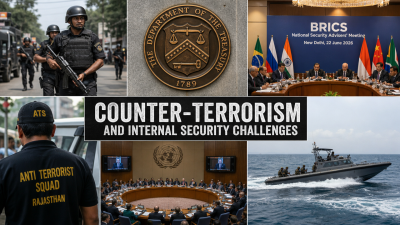
Recently, multiple developments exposed the multi-dimensional nature of terrorist threats: Rajasthan ATS arrested Babita Dhakad (alias Khadija) for alleged Jaish-e‑Mohammed links; BRICS NSAs met in New Delhi under Ajit Doval; OFAC sanctioned facilitators for ISIS; UN Counter‑Terrorism Week begins shortly. These events link online radicalisation, terror financing, narco‑terrorism and multilateral responses.
What is the current issue?
A domestic arrest with claimed Pakistan‑based JeM links and a wider set of international actions show contemporaneous threats: online recruitment and religious influence across borders, continued terror financing networks, and the crime–terror nexus. Concurrent diplomatic and financial measures reflect a multi‑agency, multi‑country response.
Why it matters
- Security: Cross‑border recruitment and handlers planning travel increase risk of attacks and sleeper networks within India.
- Governance & Rule of Law: Investigative and prosecutorial capacity is tested by encrypted communication, foreign‑based handlers and evidence collection.
- Economy & Finance: Terror financing and narco‑revenues distort markets and strain AML/CFT mechanisms.
- International relations: Counter‑terror cooperation, sanctions and diplomatic engagement determine operational space for groups and state actors.
Nature of evolving terror threats
Online radicalisation and foreign influence
- Case evidence: arrested individual’s mobile reportedly contained extremist content, links to JeM profiles and communications with Pakistani numbers; alleged conversion under influence of a Pakistan‑based cleric and travel planning by handlers.
- Mechanisms: social media, messaging apps, VOIP contacts and foreign profiles facilitate remote radicalisation and recruitment.
Cross‑border terrorist linkages
- Groups such as Jaish‑e‑Mohammed continue to influence actors inside India. Investigators cited alleged connections to JeM operatives including Qari Zarar and Yusuf Azhar.
- Handlers exploit porous information flows, illicit travel routes and diaspora networks to maintain control and operational direction.
Terror financing
- Financial facilitators sustain groups: recent OFAC designations named individuals and entities across Europe, the Middle East and West Africa for moving funds for ISIS.
- Channels include hawala, trade mis‑invoicing, charities, cash couriers and increasingly cryptocurrencies.
Narco‑terrorism nexus
- Designated terrorist organisations engage in narco‑trafficking to finance operations; US Southern Command killed two narco‑terrorists in a Caribbean strike on a trafficker vessel.
- Consequences: expanded logistics, corrupting officials, and cross‑border criminal networks complicate domestic law enforcement.
Geopolitical hotspots and spillover
- Conflict zones (for example Syria) remain sources of militancy and transnational fighters; diplomatic briefs to the UN note continued attacks on security forces.
Domestic counter‑terrorism framework
Intelligence, investigation and evidence
- State ATS units (Rajasthan ATS) conduct local detection and arrests. Central agencies (NIA, IB) handle interstate and transnational links.
- Digital forensics, mobile extraction and telecom records are critical. NATGRID, police fusion centres and cyber forensics labs must be resourced and standardised.
Inter‑agency coordination
- Coordination among ATS, state police, NIA, ED, FIU‑IND, NCB and central intelligence prevents duplication and secures chain‑of‑custody for digital evidence.
- Standard operating procedures for joint investigations and fast‑track MLAT responses improve operational tempo.
Legal and institutional tools
- Primary laws: UAPA for terrorism offences, PMLA for money‑laundering, IT Act for cyber offences, NDPS for narcotics. Prosecution capacity must match investigative sophistication.
- Institutions: NIA, ED, NCB, I4C (Indian Cyber Crime Coordination Centre), CERT‑In, state cyber cells and specialised ATS wings.
Prevention, de‑radicalisation and community measures
- Programmes for prison rehabilitation, counselling, community policing and credible counter‑narratives reduce vulnerability to online recruiters.
- Engagement with religious and civil society actors supports reintegration and reporting of suspicious activity.
Border and travel controls
- Passport checks, watchlists, immigration screening, and coastal security (Coast Guard, BSF) restrict movement of handlers and recruits.
- Prevention of foreign travel for radicalised individuals requires coordination with external affairs and immigration bodies.
International cooperation and multilateral mechanisms
- BRICS dialogue: Security advisers met in New Delhi to discuss non‑traditional threats and technology. BRICS can facilitate intelligence exchanges and shared approaches to new technologies.
- UN mechanisms: UN Counter‑Terrorism Week promotes multi‑stakeholder responses; UN Security Council remains a forum for state‑level briefings on hotspots.
- Financial measures: OFAC sanctions and similar actions by partners disrupt facilitators. India must coordinate AML/CFT efforts with FATF, Egmont Group and FIUs.
- Operational cooperation: Bilateral intelligence sharing, MLATs, INTERPOL notices and joint training improve cross‑border interdiction.
Nexus of terrorism and organised crime — implications and responses
- Implications: Drug‑money and organised crime provide steady revenue, logistics and corruption; this raises internal security risks and weakens institutions.
- Responses: Strengthen NCB capacity, asset‑forfeiture powers under PMLA, targeted sanctions, cross‑agency task forces combining NIA, ED and NCB, and international maritime/coastal surveillance cooperation.
Role of technology in terrorism and counter‑terrorism
Exploitation by terrorist groups
- Use of encrypted apps, social platforms, VOIP and foreign profiles for recruitment, command and propaganda.
- Financing via crypto and covert online payment channels.
- Operational planning using open‑source tools and anonymising services.
Counter‑technology measures
- Digital forensics, OSINT, metadata analysis and lawful interception subject to legal safeguards.
- Capacity: expand cyber labs, I4C, CERT‑In, and train investigators in crypto‑asset tracing and dark‑web analysis.
- Policy and legal tools: use provisions of the IT Act, PMLA and criminal law for takedowns, data preservation and cooperation with platform providers.
- Public‑private action: agreements with social media and messaging platforms for rapid removal of extremist content and disruption of networks.
| Stakeholder | Primary role |
|---|---|
| State ATS / Police | Local detection, arrests, initial digital forensics |
| National Investigation Agency (NIA) | Investigate transnational and large‑scale terror cases |
| Intelligence Agencies (IB, R&AW) | Strategic intelligence, external link analysis |
| ED, FIU‑IND | Financial investigation, asset tracking |
| NCB | Counter‑narcotics enforcement and investigations |
| CERT‑In, I4C | Cyber response, coordination and forensic support |
| Ministry of External Affairs | Bilateral/multilateral cooperation, MLATs, extradition |
Model Questions
1. The recent arrest of an individual with alleged Jaish‑e‑Mohammed links in Rajasthan highlights the complex challenges of internal radicalisation and cross‑border terrorism. Analyse the multifarious dimensions of this threat and suggest measures for enhancing India’s counter‑terrorism framework. [GS‑III: Internal & External Security]
Answer: The threat combines online radicalisation, remote handlers, cross‑border command, and travel facilitation. Strengthen local cyber forensics, ATS‑to‑central agency handoffs, watchlists and passport controls; enhance financial probes under PMLA and ED; scale community‑based de‑radicalisation and prison rehabilitation; expand NATGRID integration and fusion centres; deepen bilateral intelligence sharing with priority on MLATs and platform cooperation to disrupt handlers and travel plans.
2. In the context of the BRICS NSA meeting and UN counter‑terrorism initiatives, critically examine the role of multilateral forums in addressing non‑traditional security challenges, including terror financing and use of new technologies. [GS‑II: International Relations]
Answer: Multilateral forums enable information exchange, standard‑setting and coordinated sanctions. BRICS can frame technology norms and joint capacity building; the UN provides policy coherence and multi‑stakeholder engagement via Counter‑Terrorism Week. Practical outputs must include intelligence sharing protocols, AML/CFT alignment, cooperation on platform moderation, joint training on crypto tracing, and operational mechanisms for rapid mutual legal assistance and sanctions implementation.
3. The kinetic strike against narco‑terrorist organisations in the Caribbean illustrates the nexus between terrorism and organised crime. Discuss implications for India’s internal security and propose strategies to counter this convergence. [GS‑III: Internal & External Security]
Answer: The nexus supplies funds, logistics and corruption risk. India faces smuggling routes, money‑laundering and recruitment channels. Responses: strengthen NCB, ED and customs intelligence; enhance maritime and coastal surveillance; tighten AML/CFT enforcement and asset seizure; pursue bilateral operations and intelligence sharing with partner states; disrupt money flows via FIU‑IND and international cooperation targeting hawala, trade fraud and crypto exchanges.
4. New technologies present both opportunities and challenges in counter‑terrorism. Explain how terrorist organisations exploit technology and evaluate India’s legal, institutional and policy measures to mitigate technology‑driven terror threats. [GS‑III: Science & Technology]
Answer: Terrorists use encrypted apps, social media, VOIP, crypto and dark‑web services for recruitment, planning and financing. India’s response combines IT Act provisions, CERT‑In, I4C, cyber forensics, and specialised cyber cells. Gaps remain in rapid platform takedown, cross‑border data access and trained manpower. Policy fixes: formal platform cooperation frameworks, legal clarity on interception with safeguards, expanded forensic labs and specialised training for investigators and prosecutors.
Last Modified: June 23, 2026